Category: FYFD Video

  • Featured Video Play Icon

    Martian Bees, Canopies, and Dandelion Seeds

    The latest FYFD/JFM video is out! May brings us a look at the incredible flight of dandelion seeds, numerical simulations that reveal the flow above forest canopies, and a look at bee-inspired flapping wing robots being developed for exploring Mars! Learn about all this in the video below, and, if you’ve missed other videos in the series, you can catch up here. (Image and video credit: N. Sharp and T. Crawford)

  • Featured Video Play Icon

    Bees, Squid, and Oil Plumes

    It’s time for another JFM/FYFD collab video! April’s video brings us a taste of spring with research on how bees carry pollen, squid-inspired robotics, and understanding the physics of underwater plumes like the one that occurred in the Deepwater Horizons spill eight years ago. Check it all out in the video below. (Image and video credit: T. Crawford and N. Sharp)

  • Can Zooplankton Mix Oceans?

    Can Zooplankton Mix Oceans?

    Krill and other tiny marine zooplankton make daily migrations to and from the ocean surface. Previously, models of ocean mixing ignored these migrations; these animals are tiny, researchers argued, so any effects they could have would be too small to matter. But zooplankton make these migrations in huge swarms, and studies of a laboratory analog of their migrations (using brine shrimp rather than krill) reveal that, when moving en masse, these tiny swimmers create turbulent jets and eddies far larger than an individual. Their collective motion is enough to mix salty water layers 1000 times faster than molecular diffusion alone! Learn more in the latest FYFD video, embedded below. (Image and video credit: N. Sharp; research credit: I. Houghton et al.; h/t to Kam-Yung Soh)

  • Featured Video Play Icon

    Bouncing, Floating, and Jetting

    Get inside some of the latest fluid dynamics research with the newest FYFD/JFM video. Here researchers discuss oil jets from citrus fruits, balls that can bounce off water, and self-propelled levitating plates. This is our third entry in an ongoing series featuring interviews from researchers at the 2017 APS DFD conference. Missed one of the previous ones? Not to worry – we’ve got you covered. (Video and image credit: N. Sharp and T. Crawford)

  • Featured Video Play Icon

    Under Pressure

    Pressure is a concept that can be unintuitive, but it’s incredibly important in physics and engineering. So I’m excited to debut a collaborative video series that @mostlyenginerd and I are producing all about hydrostatic pressure! Today’s video is one of our openers: it focuses on where pressure comes from and why it’s a function of height but not volume. And to show you just how pressure increases with depth, we teamed up with divers from the Oregon State University Scientific Diving Team and headed to the Oregon Coast Aquarium’s Halibut Flats exhibit. Ever seen what a balloon looks like 7 meters underwater? You’re about to! (Video and image credit: N. Sharp and A. Fillo)

    Want to see how this was made? Support FYFD on Patreon, and you can get access to behind-the-scenes content and a chance to see upcoming videos early!

  • Featured Video Play Icon

    Skiing, Avalanches, and Freezing Bubbles

    To wrap up our look at Olympic physics, we bring you a wintry mix of interviews with researchers, courtesy of JFM and FYFD. Learn about the research that helped French biathlete Martin Fourcade leave PyeongChang with 3 gold medals, the physics of avalanches, and how bubbles freeze. 

    If you missed any of our previous Olympic coverage, you can find our previous entries on the themed series page, and for more great interviews with fluids researchers, check out our previous collab video. (Video credit: T. Crawford and N. Sharp; image credits: GettyImages, T. Crawford and N. Sharp)

  • Featured Video Play Icon

    Water Walking, Exploding Droplets, and Colliding Vortices

    Every year I look forward to the APS DFD conference in November. It brings thousands of researchers together to share the latest in fluid dynamics. So much goes on in those three days that it’s impossible to capture, but last year I teamed up with Tom Crawford and the Journal of Fluid Mechanics to attempt just that. We interviewed 50 researchers on their projects, and we’ll be bringing you their work, in their words, each month leading up to the 2018 APS DFD meeting.

    This first video focuses on some of the awesome entries to the 2017 Gallery of Fluid Motion. Watch to learn about oil droplets that go flying everywhere when you’re cooking, balls that walk on water, the water music of Vanuatu and more! To see the videos we discuss and all the other entries, go to gfm.aps.org. (Video credit: N. Sharp and T. Crawford)

  • How Cycling Position Affects Aerodynamics

    How Cycling Position Affects Aerodynamics

    New FYFD video! How much does a rider’s position on the bike affect the drag they experience? To find out I teamed up with folks from the University of Colorado at Boulder and at SimScale to explore this topic using high-speed video, flow visualization, and computational fluid dynamics. 

    Check out the full video below, and if you need some more cycling science before the Tour de France gets rolling, you can find some of my previous cycling-related posts here. (Image and video credit: N. Sharp; CFD simulation – A. Arafat)

    ETA: Please note that the video contained in this post was sponsored by SimScale.

  • These Invertibrates May Help Robots Swim

    These Invertibrates May Help Robots Swim

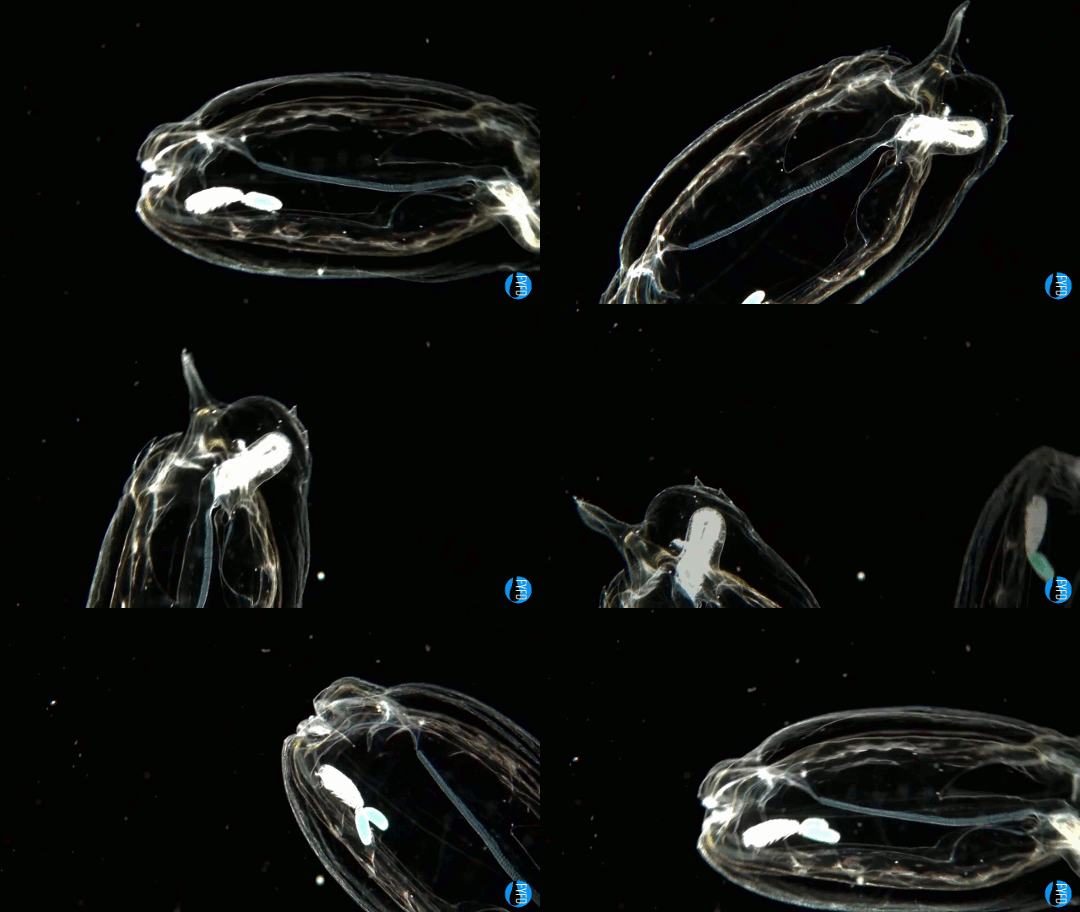
    New FYFD video! Learn all about salps, vortex rings, and underwater robots. Thanasi Athanassiadis takes me inside his lab and his newly published research into how proximity affects the thrust two vortex rings can produce.

    There are a ton of little things I love about how this video came out, especially the chalkboard animations. Check it the full video below and click through to the video description for lots more information about salps and vortex rings.

    (Image and video credits: N. Sharp and A. Athanassiadis; Original salp images: A. Migotto and D. Altherr)

  • Featured Video Play Icon

    How Fluid Dynamics Saved the Space Shuttle

    New FYFD video! In which Dianna Cowern (Physics Girl) joins me to explore boundary layer transition and how a couple of small bits of roughness could be a huge problem for the Space Shuttle during re-entry. A lot of people have asked me what I did for my PhD research, and the truth is, I’ve never really discussed my own work here on FYFD. This video is probably the closest I’ve come. The story I tell about STS-114 is one that appears in the first chapter of my dissertation, and it did, in many respects, motivate my work exploring roughness effects on transition in Mach 6 boundary layers. I hope you enjoy my video, and don’t forget to check out Dianna’s video, too! (Video credit: N. Sharp/FYFD)