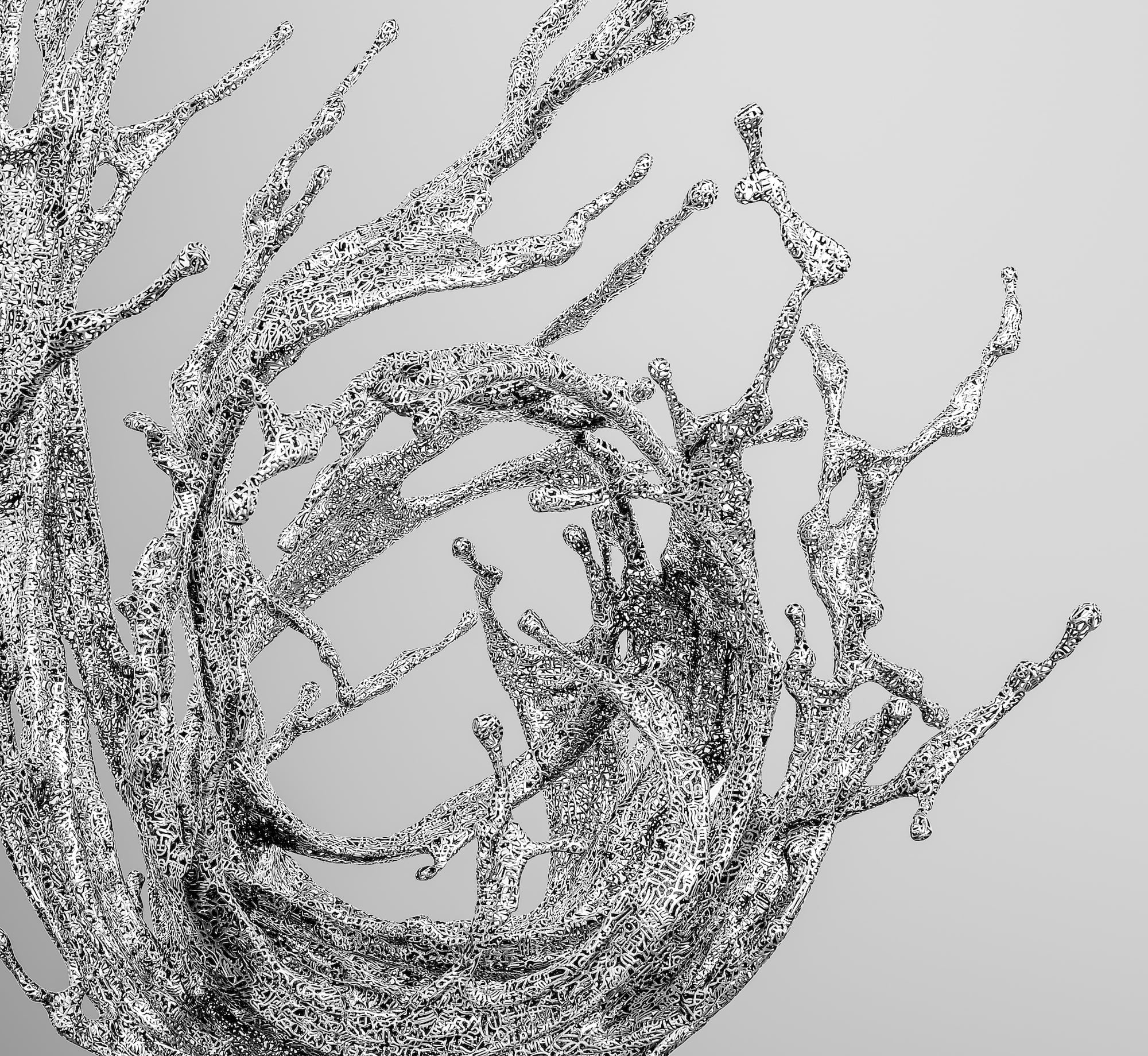
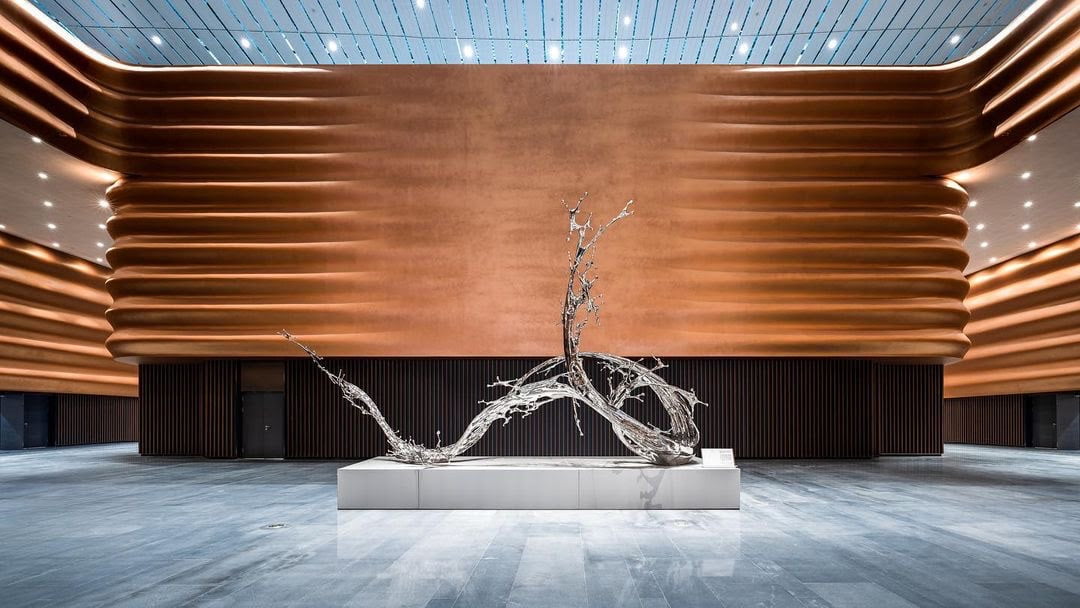
Zheng Lu’s stainless steel sculptures capture elaborate splashes in action. In some of the pieces, thousands of Chinese characters cover the sculpture’s surface; these are quotes from historical texts and poems, an homage to early Chinese philosophers who studied the principles of the natural world. See more examples of the artist’s work here. (Image credit: Z. Lu; via Colossal)
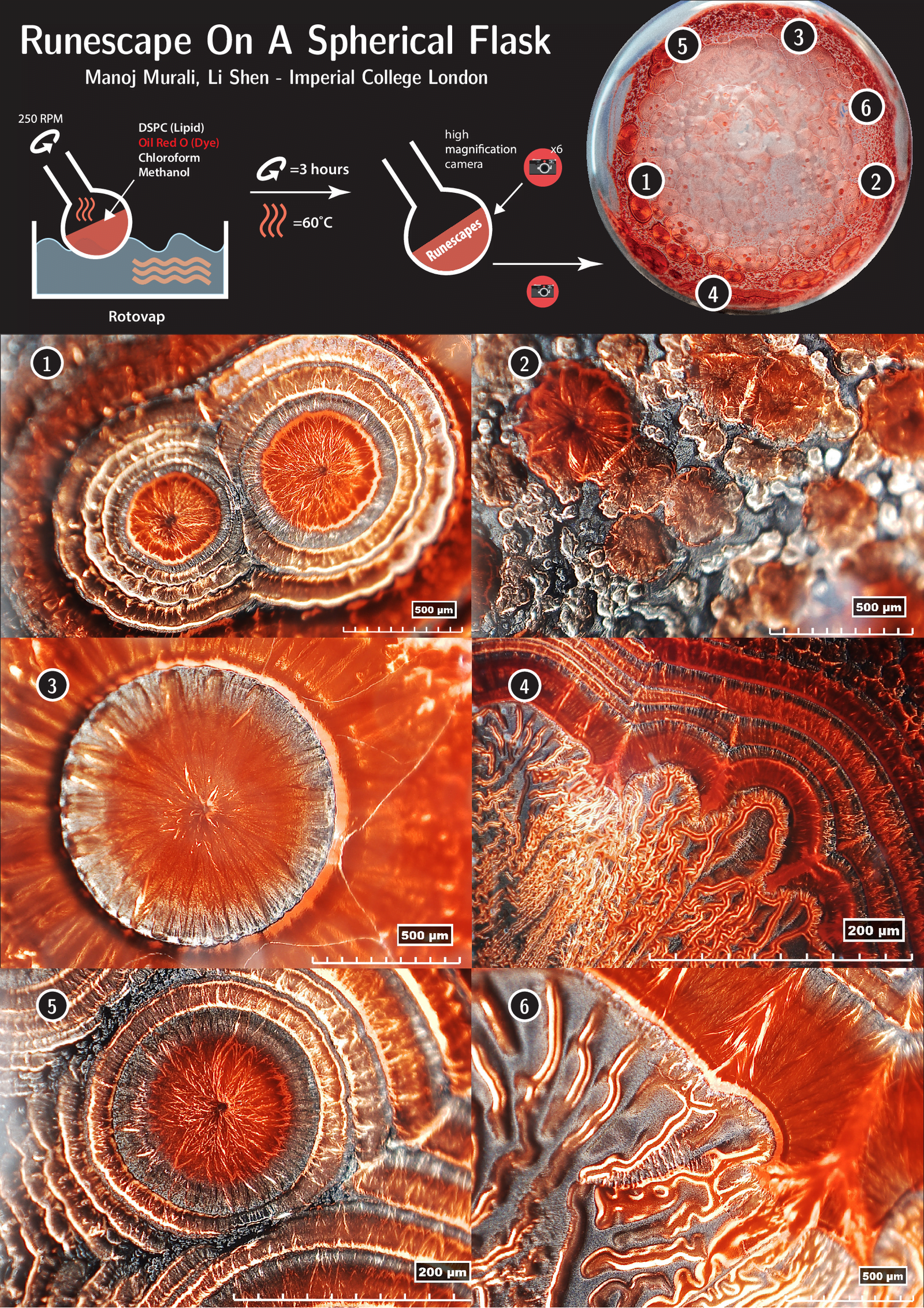
Drying fluids can leave behind all kinds of fascinating patterns, as we’ve seen before with whiskey, coffee, and even blood. Here researchers study patterns left behind by lipids, dyes, and other fluids. They place their mixture in a rotating flask kept in a warm bath. For a few hours, the fluids mix, chemically react, and evaporate. The complex interactions that take place in that time leave behind fascinating, rune-like patterns, seen here under a microscope. It’s a bit like looking at photos of Martian landscapes! (Image credit: M. Murali and L. Shen)
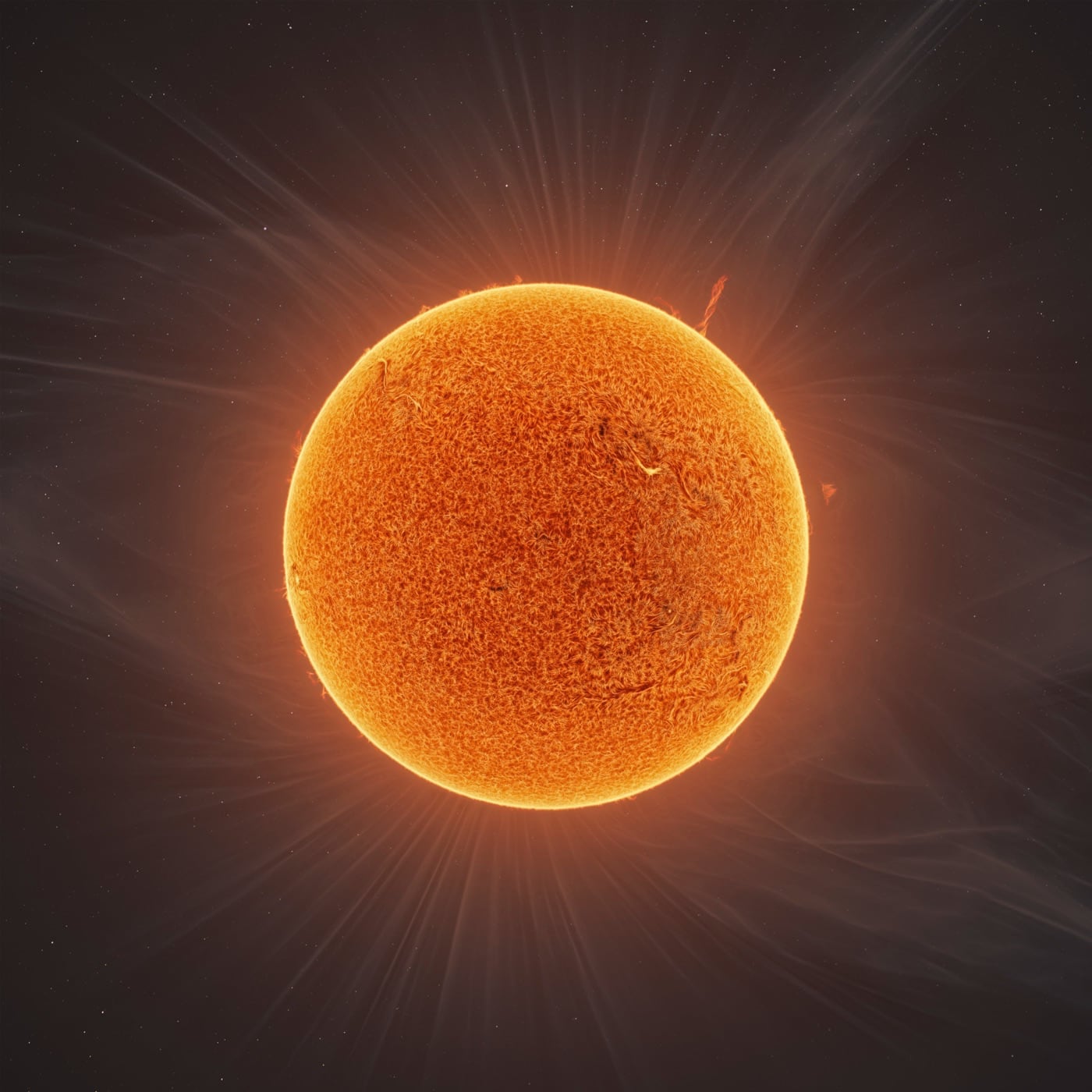
Built from approximately 90,000 individual images, “Fusion of Helios” reveals the wisp-like corona of our Sun. Astrophotographers Andrew McCarthy and Jason Guenzel joined forces to combine eclipse images with data from NASA to build this fusion of art and science. Jets of plasma, known as spicules, dot the sun’s surface, and a towering tornado of plasma shoots off one side. For scale, that vortex stretches as far as 14 Earths stacked atop one another. (Image credit: A. McCarthy and J. Guenzel; via Colossal)
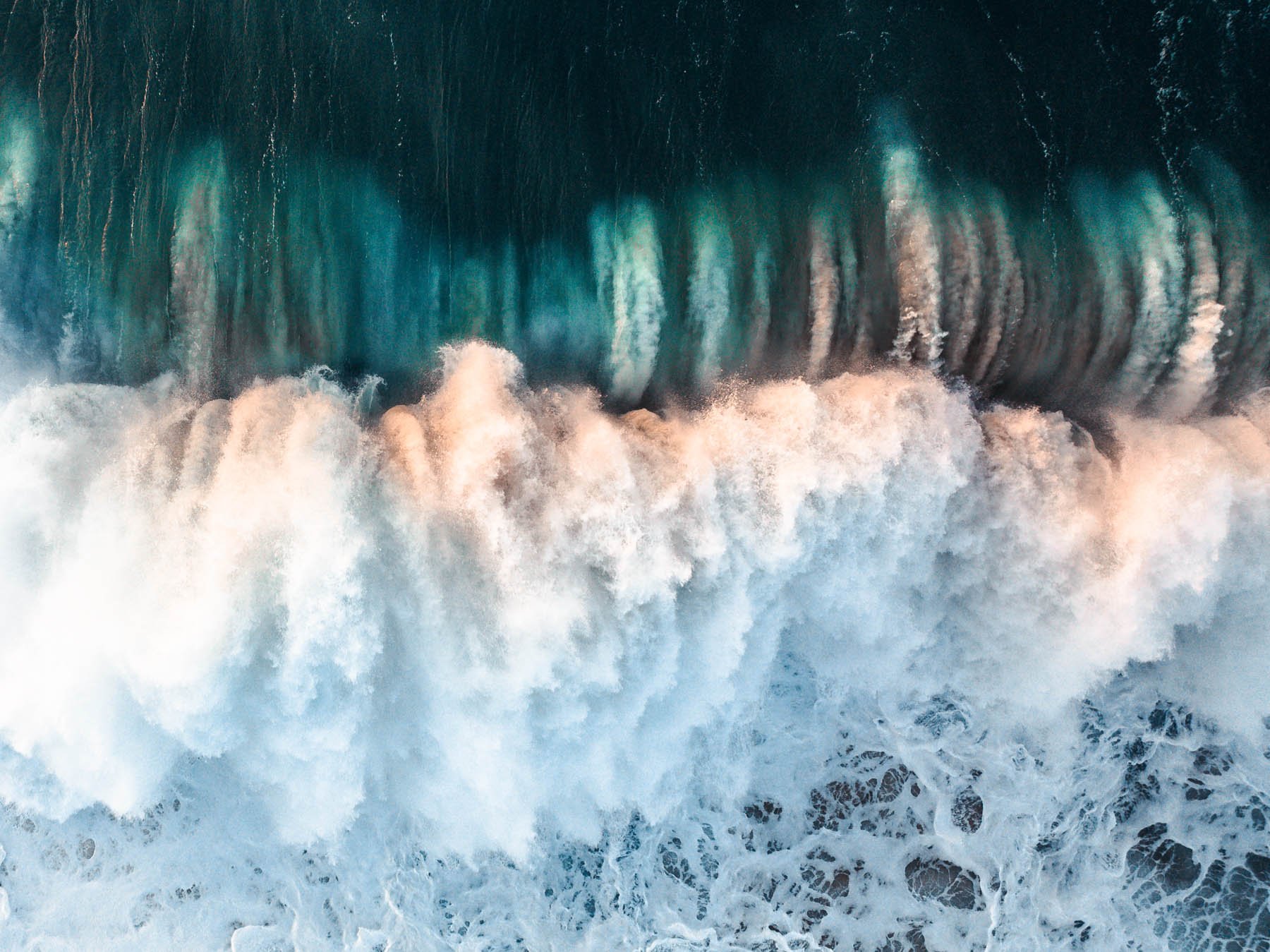
On the north shore of O’ahu, Hawaii, Banzai Pipeline is known for some of the most thrilling and deadly surfing in the world. The area’s barrel rolls are triggered when incoming waves break over the shallow reef. Photographer Kevin Krautgartner captures the waves from above, showcasing the incredible energy inherent in the ocean. The motion and texture of the water is mesmerizing. I feel like I could stare at these all day long! (Image credit: K. Krautgartner; via Colossal)
One hundred photographers of all genres are coming together this month to raise money for ocean conservation in “100 For the Ocean.” Through the end of this month, they’re selling prints of these and other images, starting at $100 apiece. All proceeds will go to ocean conservation. Check out all the prints here, and if your wall has a bare spot, now’s a great time to add some artwork on a fluidsy nature. (Image credits: 100 For the Ocean, individual photographers listed in gallery titles; via Colossal)
Disclosure: I have no affiliation whatsoever with this fundraiser. I just like great photos and preserving nature.
In the Hakkōda Mountains of Japan, snow encases the trees, transforming the ski slopes into a hoodoo-filled winter wonderland. Photographer Sho Shibata captured these images while journeying through the area a few years ago. The combination of wind and snow sculpts the trees into surprisingly similar shapes! (Image credit: S. Shibata; via Colossal)
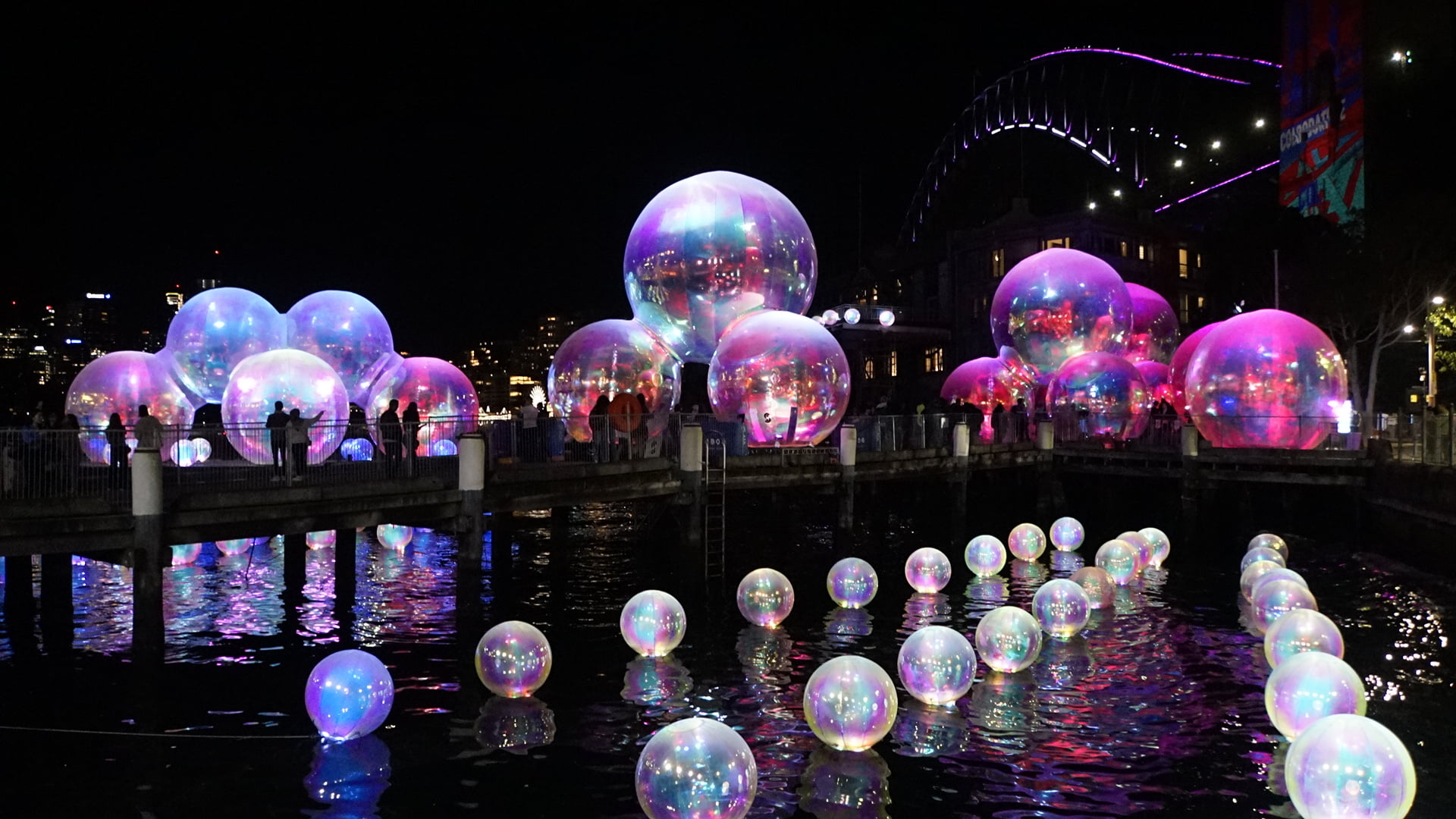
Giant iridescent inflatables dot public spaces in the “Evanescent” exhibit. The “bubble-tecture” is the work of Sydney-based artistic collaboration Atelier Sisu. Conceived during the pandemic, the duo “endeavoured to communicate this feeling of transient beauty and the need to live in the moment through the idea of the bubble.” The exhibit has appeared in more than 22 cities in 12 different countries. (Image credit: Atelier Sisu; via Colossal)
Stingrays swim over rippled sands in this award-winning image from photographer Gregory Sherman. Above this peaceful vista, waves break and a dramatic skyscape looms. It’s the regular back-and-forth of the waves that shapes the ripples of sand. The rays can also use the sand for cover; note the remnants of sand atop a few of these rays, and then see how they hide themselves. See more winners from the Underwater Photographer of the Year awards in this gallery. (Image credit: G. Sherman/UPY 2023; via Colossal)
Lava spurts from the Fagradalsfjall volcano in Iceland in this award-winning photo by Riten Dharia. It’s always bizarre to see molten rock flowing in fountains and rivers because it’s so unlike our daily experiences. Some deeply buried areas of the Earth, including the outer part of the core, are often described as liquid rock, which brings to mind lava. But that’s not, in fact, what those regions are like. If you were to visit Earth’s outer core in some super-submersible, you would not find a sea of lava. Instead, you would find yourself surrounded by what seemed to be solid rock. That’s not to say that the outer core is solid — just that it flows on geological timescales that are far longer than any human’s lifetime! (Image credit: R. Dharia; via Gizmodo)
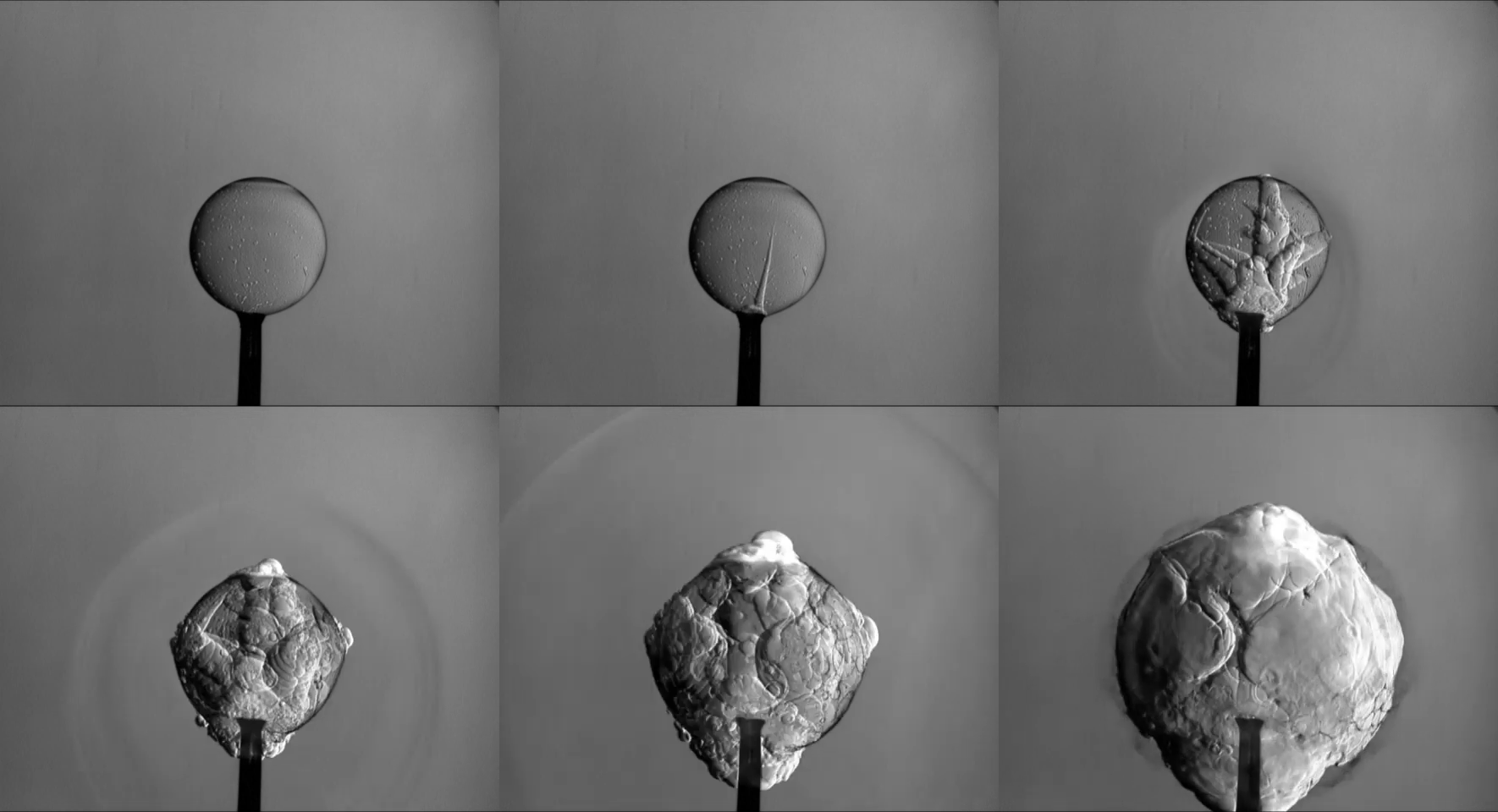
In this high-speed video, artist Linden Gledhill ignites a mixture of oxygen and hydrogen contained within a soap bubble. As neat as the video is, I decided to take a closer look at the initial detonation with this animation:
The ignition sequence within the bubble, slowed down further.
Even here, it’s hard to appreciate just how fast ignition is; it lasts only a handful of frames, despite filming at 40,000 frames per second. But we can still pick out some very neat physics. The ignition begins with a spike-like jet but immediately forks into three ignition fronts that pierce the soap bubble. You can see the shadowy mist of the bubble bursting as the flame front expands. Watch the background carefully, and you can see a shock wave flying away from that moment of detonation.
Once the soap bubble is gone, the expanding flames begin to wrinkle and deform. Turbulence takes shape, eddying through the flames at a much slower speed than the initial detonation. This is where most of combustion takes place, with turbulence mixing the hydrogen and oxygen together to better enable burning. (Image and video credit: L. Gledhill)