Tag: landslide

  • Roll Waves in Debris Flows

    Roll Waves in Debris Flows

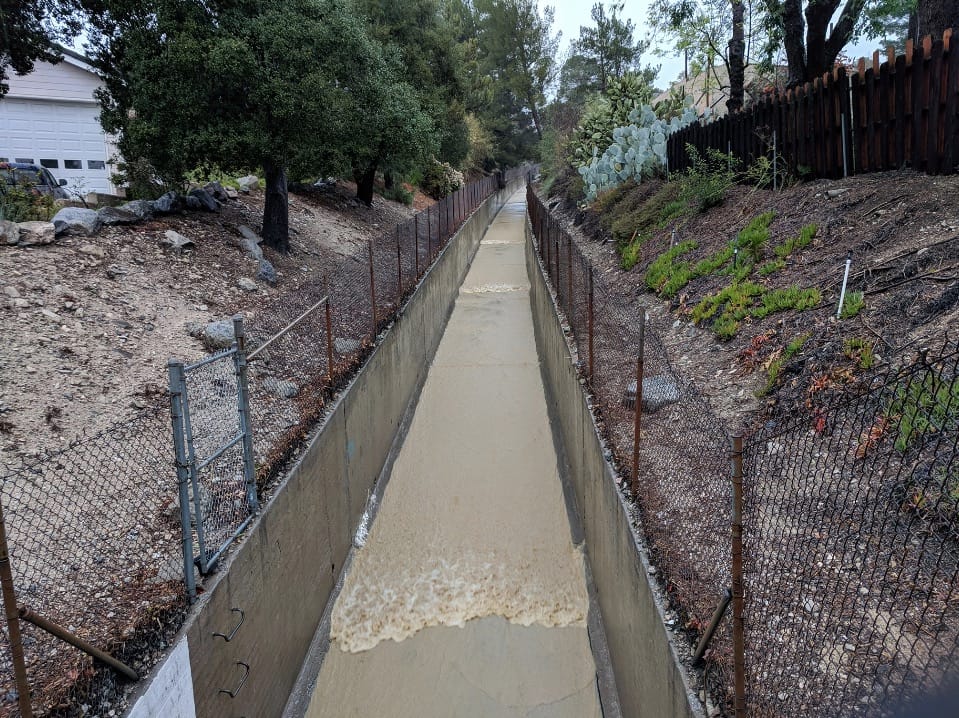
    When a fluid flows downslope, small disturbances in the underlying surface can trigger roll waves, seen above. Rather than moving downstream at the normal wave speed, roll waves surge forward — much like a shock wave — and gobble up every wave in their way.

    Such roll waves are fairly innocuous when flowing down a drainage ditch but far more problematic in the muddy debris flows of a landslide. Debris flows are harder to predict, too, thanks to their combined ingredients of water, small grains, and large debris.

    A new numerical model has shed some light on such debris flows, after showing good agreement with a documented landslide in Switzerland. The model suggests that roll waves get triggered in muddy flows at a higher flow speed than in a dry granular flow but a lower flow speed than is needed in pure water.

    For a great overview of roll waves, complete with videos, check out this post by Mirjam Glessner. (Image credit: M. Malaska; research credit: X. Meng et al.; see also M. Glessmer; via APS)

    Fediverse Reactions
  • Predicting Landslide Speeds

    Predicting Landslide Speeds

    Knowing what speed a landslide will reach helps us predict how much damage they can cause. That speed depends on many factors: the steepness of the terrain, the sliding distance, the thickness of the flowing layer, and the type of grains making up the flow. Researchers found that predictions from previous studies often underestimated the speeds reached by thicker flows. Through laboratory experiments with grains of different shapes, a team found that those models mistakenly assumed a fully-developed flow — in other words, one where the grains have reached a constant final speed. While spherical grains reach that state over a short sliding distance, that’s not the case for other grains.

    Instead, the team used their results to build a new predictive model for landslide speeds. This one still depends on incline angle and flow thickness, but it also uses a dynamical friction coefficient to describe the granular material and capture how the flow’s speed varies with distance down the incline. (Image credit: W. Hasselmann; research credit: Y. Wu et al.; via APS News)

    Fediverse Reactions
  • Predicting Landslides

    Predicting Landslides

    Landslides can cause catastrophic damage, but historically it’s been difficult to monitor susceptible slopes and predict when they’ll fail. But a recent study looking at the 2017 Mud Creek landslide in California shows that new methods could provide a heads up.

    The researchers used satellite data from the months preceding the landslide to study how areas on the slope moved relative to one another. Within their survey region, they found sub-regions where ground locations largely moved together. These sub-regions, called communities in the researchers’ parlance, were remarkably persistent, showing little variation over long periods. But 56 days before the landslide, the researchers saw a sudden change between the communities on the slope. They believe their methodology could help identify slopes in danger of imminent slides.

    So far, though, they’ve only applied this method to the Mud Creek landslide. It’s a promising start, but they’ll need to show that the technique works for other slides as well. If so, it will be a major step forward in landslide prediction. (Image credit: USGS; research credit: V. Desai et al.; via APS Physics)

  • Landslide-Triggered Tsunamis

    Landslide-Triggered Tsunamis

    After the 2018 Anak Krakatoa eruption, a tsunami that ricocheted through the surrounding waters, killing hundreds on nearby islands. The source of that tsunami was a small landslide. Once the air cleared and researchers could assess how much material slid into the ocean, they were shocked that such a small volume created so much destruction.

    Now new efforts are revealing the linkage between landslides and the waves they make. Researchers released glass beads into a tank of water, observing the waves that form as the beads run out. Depending on the relative initial height of the beads compared to the water depth, they observed three different kinds of waves. Not only that, they were able to connect the granular mechanics of the landslide to the hydrodynamic formation of waves, allowing predictions of the waves that will form for a given landslide.

    Currently, the predictive model isn’t sophisticated enough to handle a geometry as complex as that of the Anak Krakatoa landslide, but it’s an important step toward understanding — and potentially mitigating the damage of — future oceanside landslides. (Image and research credit: W. Sarlin et al.; via APS Physics; submitted by Kam-Yung Soh)

  • Featured Video Play Icon

    Michigan Dam Failure

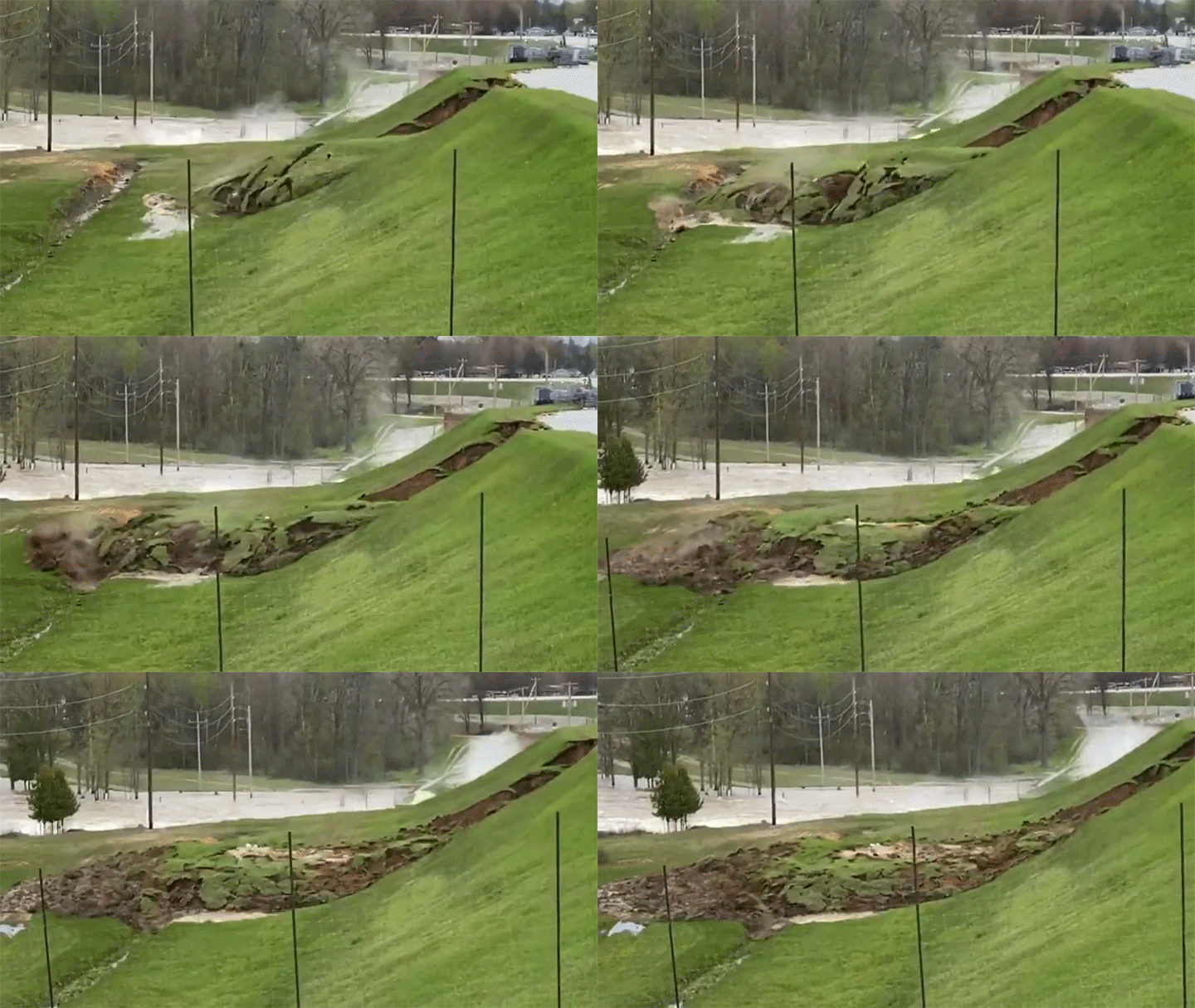
    Last week Michigan’s Edenville Dam failed, triggering catastrophic flooding. While the exact causes of dam’s failure are not yet clear, this video of the collapse provides some interesting hints.

    As the video begins, we see water that’s already trickled down the slope, potentially a sign that the top of the dam has already degraded. Then a noticeable bulge forms near the bottom of the earthwork slope, followed quickly by a landslide. Water doesn’t pour out immediately, though. That delay suggests that only part of the dam’s thickest section failed in the landslide. During the delay, the remaining interior of the dam is failing from the sudden lack of support. Then, the floodwaters come pouring out.

    From the sequence of events, it seems likely that the dam was suffering from soil liquefaction prior to the collapse. With high water levels behind the dam, pressure can drive water into the soil beneath the dam, reducing its strength. You can see this effect in action in this video and this one. For more on the Edenville dam specifically, check out the great analysis over at AGU from Dave Petley (1, 2).

    Sadly, failures like these are quite avoidable, provided dams are properly maintained. Climate change is drastically altering precipitation patterns across the world, and without updating and reworking our infrastructure to account for that, we’ll see more failures like this in the future. (Video and image credit: L. Coleman/MLive; via Earther; see also D. Petley 1, 2)

  • Martian Landslides

    Martian Landslides

    Sometimes there are advantages to studying planetary physics beyond Earth. Mars does not have plate tectonics, vegetation, or the level of erosion we do, allowing geological features like those left behind by landslides to persist undisturbed for millions of years. And, thanks to a suite of orbiters, we’ve mapped most of Mars at a resolution better than many parts of our own planet. All together, this gives researchers a treasure trove of geological data from our nearest neighbor.

    One peculiar feature of many landslides is their long runout. Even over relatively flat ground, some landslides cover extreme distances from their point of origin. On Earth, we often see this behavior near glaciers, so scientists theorized that the presence of ice was somehow necessary for the landslide to cover such a long distance. But previous laboratory experiments with dry, ice-free grains showed the same behavior: long runouts marked with ridges running parallel to the flow. The mechanism behind the ridges is still somewhat unclear, but it seems to be connected to fluid dynamical instabilities that form between fast-flowing particles of differing density. But such results have been confined to lab-scale experiments and numerical simulations.

    A new report, however, shows that landslides on Mars share the same characteristic spacing and thickness between their ridges. This evidence suggests that the same ice-free mechanism could account for the long run-out of landslides on Mars and other planets. (Image credit: NASA/JPL-Caltech/University of Arizona; research credit: G. Magnarini et al.; via The Conversation; submitted by Kam-Yung Soh)

  • Anak Krakatoa Landslide

    Anak Krakatoa Landslide

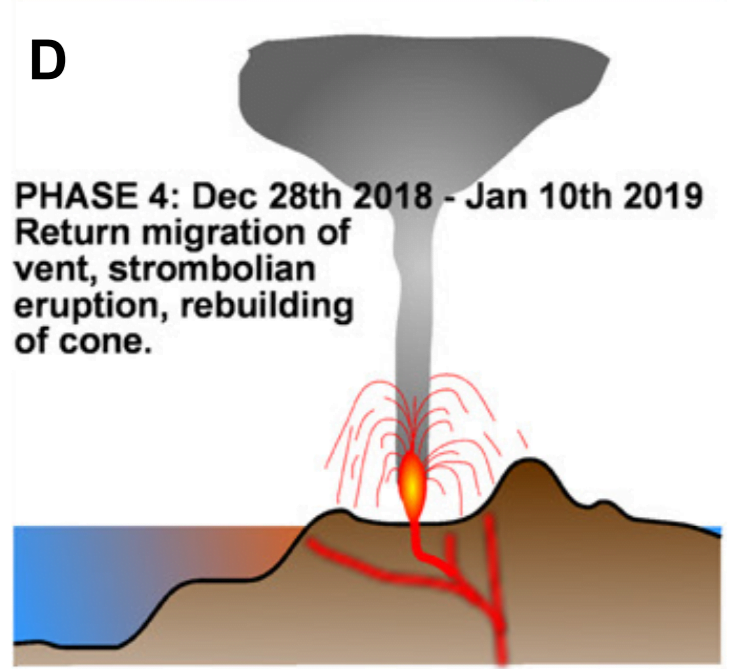
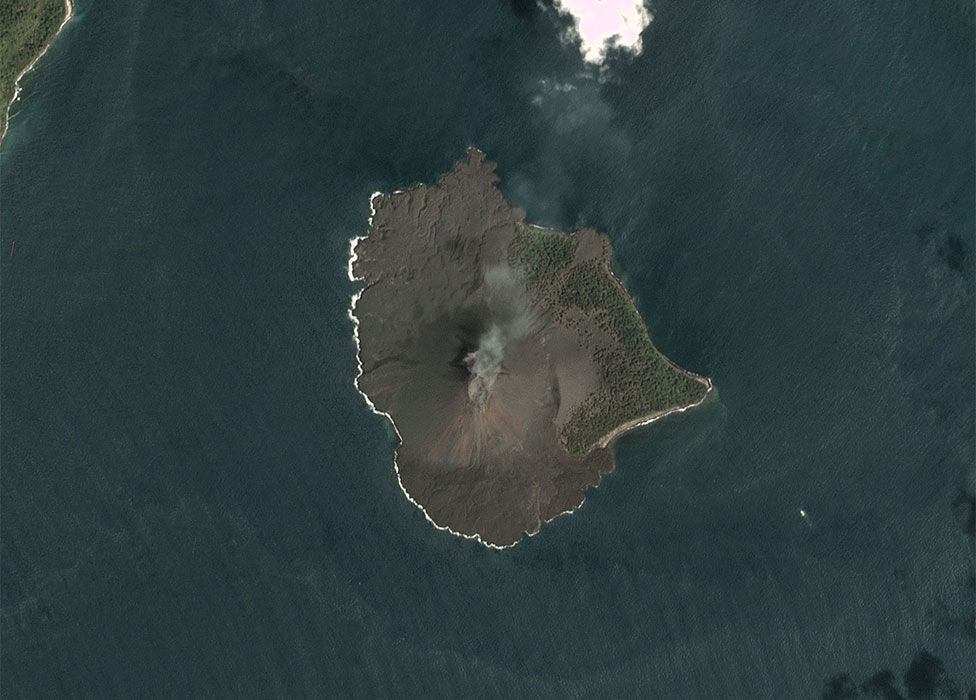
    Last December, the collapsing flank of the Anak Krakatoa volcano caused a deadly tsunami in Indonesia. Using satellite imagery, scientists have now constructed a timeline of the island’s dramatic restructuring. In the process, they found that the landslide that triggered the tsunami was likely much smaller than originally estimated.

    Their evidence shows that the landslide and tsunami (Image B) occurred before the eruption that destroyed the volcano’s cone. In fact, the landslide seems to have created a vent that opened directly underwater, which explains the increased violence of the eruption in late December and the eventual destruction of the volcano’s cone (Image C). After that, the underwater vent closed off and the eruption returned to its quieter state as the volcano began rebuilding its cone (Image D).

    The key finding here is that the initial landslide contained roughly a third of the material originally estimated. That means our tsunami models have been seriously underestimating the catastrophic potential of smaller volcanic landslides. Hopefully the lessons we learn from Anak Krakatoa will help us avoid future tragedies. (Image and research credit: R. Williams et al.; via BBC; submitted by Kam-Yung Soh)

  • Anak Krakatoa Tsunami

    Anak Krakatoa Tsunami

    In late December 2018, a landslide on the island Anak Krakatoa triggered a deadly tsunami in Indonesia. The island (upper left, pre-landslide) lost an estimated 300 meters of height in the landslide, dramatically altering its appearance (upper right; post-landslide). Much of the slide occurred underwater, dumping material into a crater left by the famous 1883 eruption of Krakatoa

    The slide displaced a massive amount of water, creating a tsunami that spread, refracting around nearby islands and reflecting off shorelines in complicated patterns. A new numerical simulation, shown above, models the post-slide tsunami based on terrain data and fluid physics. Its wave predictions match well with the high-water readings from nearby islands. The scientists hope that such models, combined with monitoring, will help save lives should a future eruption trigger more tsunamis.

    For a full picture of both the recent Anak Krakatoa eruption and its famous predecessor, check out this video. (Image credits: satellite views before and after landslide – Planet Labs; simulation – S. Ward, source; via BBC News; submitted by Kam-Yung Soh)

  • Landslide Lubrication

    Landslide Lubrication

    In 2008, an 8.2 magnitude earthquake in China caused the enormous Daguangbao landslide, which loosed over one cubic kilometer of rocks and debris. That material rushed down the mountainside, running more than 4 kilometers before coming to a stop. A new study uses field measurements and laboratory experiments to explain how the landslide could run so far from its source.

    The researchers found that friction between the sliding material and the stable rock heated that layer to over 850 degrees Celsius, hot enough to start decomposing the dolomite in the fall. That vaporized carbon dioxide out of the rock, which helped lower the friction. Simultaneously, the high temperatures and high pressures within in the landslide caused recrystallization in the falling rocks; this created a viscous layer that helped lubricate the slide. The team estimated that the two mechanisms working in tandem enabled the landslide to reach an estimated 60 m/s. (Image and research credit: W. Hu et al.; via Nature; submitted by Kam-Yung Soh)

  • Featured Video Play Icon

    Landslide

    Landslides, despite their inclusion of solid materials, function essentially as gravity-driven fluid flows. This timelapse video shows a recent earthflow in Wyoming near the Snake River. Rapid snowmelt and heavy rainfall combined to cause a seven day landslide over the highway and into the river. # (via Bad Astronomy)