Tag: capillary tubing

  • Changing with the Flow

    Changing with the Flow

    Chemically-reacting flows are some of the toughest problems to unravel. In this new study, researchers found that the very act of flowing through narrow channels can change the speed of chemical reactions. In particular, they found that protein molecules carried through a capillary tube (comparable in size to human capillaries) changed their local shape as a result of the shear forces they experienced. Those changes actually sped up the proteins’ chemical reactions compared to the reaction speed for the chemicals in bulk.

    That finding suggests two important takeaways: 1) chemicals may be absorbed in the human bloodstream differently in capillaries than in other parts of the cardiovascular system, and 2) mimicking these tiny capillaries in microfluidic devices could be useful in speeding up certain biochemical reactions. (Image credit: top – KazuN, visual abstract – T. Hakala et al.; research credit: T. Hakala et al.; via Science; submitted by Kam-Yung Soh)

    Graphical abstract showing that shear forces in small channels can cause local changes to protein structure that affect the rate of chemical reactions.
  • Spin Coating Capillary Tubes

    Spin Coating Capillary Tubes

    To coat the interior of a capillary tube, you typically fill the tube with a viscous liquid, then pump air in to displace the liquid, leaving behind a thin film of the viscous fluid. Keeping that film uniform and thin is a challenge, though, since the pumps used often struggle to keep a consistent low flow rate. Instead, a team of researchers used spin coating to treat the interior of capillary tubes.

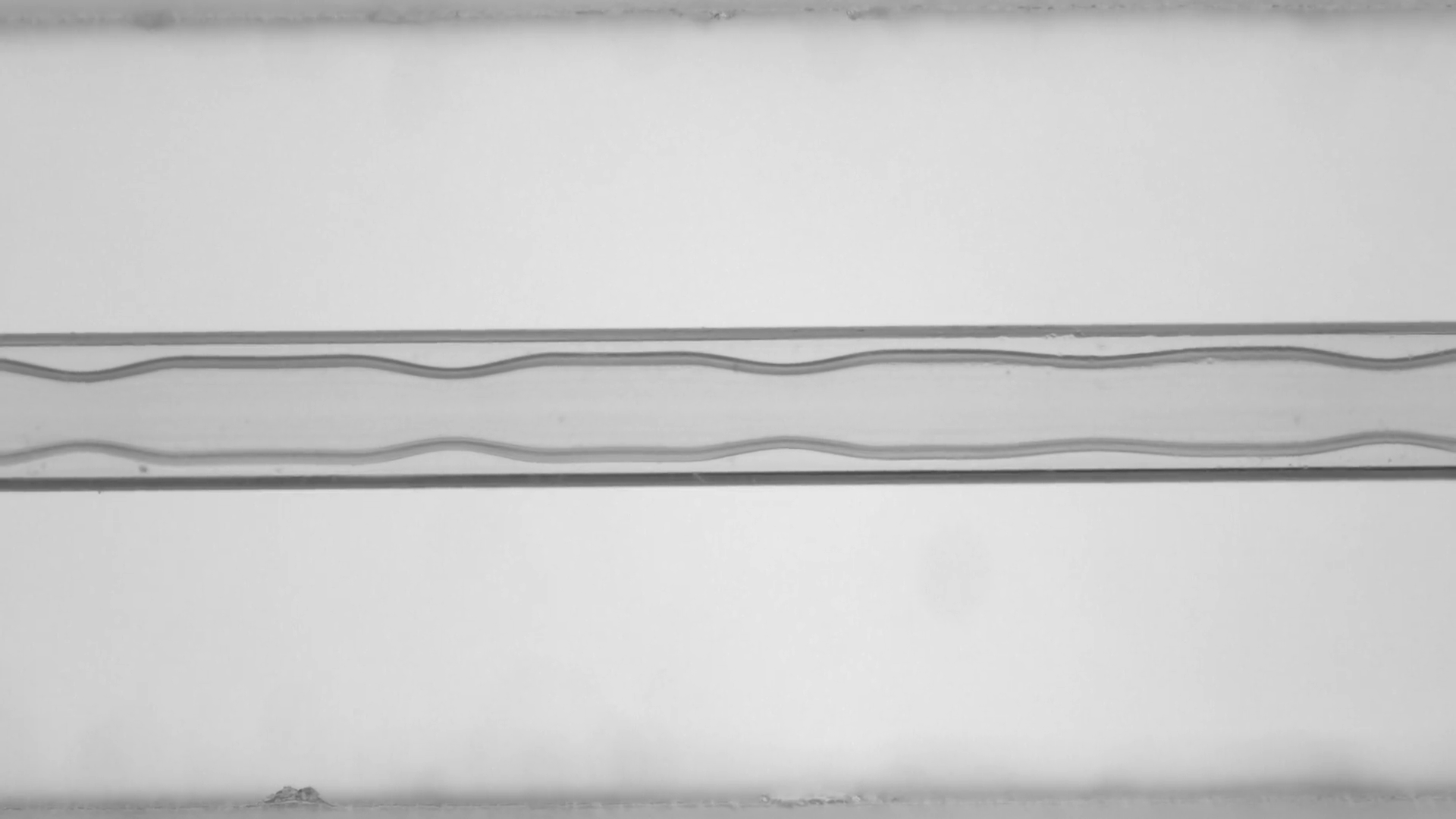
    Their apparatus consisted of a repurposed computer fan, stripped of its blades and fitted with a 3D-printed platform that could hold capillary tubes (left). When spinning, an oil slug inside each tube gets forced outward from the center of the platform, leaving behind a thin, uniform film coating in the tube. The group found that some fluids develop a wavy, Plateau-Rayleigh instability in the film once spinning stops (right), which is useful for creating a consistent wavy interior for the tube, particularly when using curable polymers for the coating. (Image, research, and submission credit: B. Primkulov et al.)

  • Contact-Line Dissipation

    Contact-Line Dissipation

    In the confines of a narrow tube, a flow’s energy gets dissipated in two places: inside the bulk fluid and along the contact line. The former is standard for all flows; viscosity acts like internal friction in the fluid and dissipates a flow’s kinetic energy into heat. Contact line dissipation is trickier. While it isn’t hard to imagine that a moving contact line would dissipate energy, it’s been unclear just how much energy the contact line eats up.

    To answer that question, researchers performed a novel experiment using an extremely narrow capillary tube, initially filled with air. By dipping one end of a horizontal tube in an oil reservoir, they sucked some oil into the tube. Then they set the oil-filled end of the tube against a water reservoir, causing it to suck up water. The oil slug then moves along the tube at a constant speed, which enables the team to separate out the two sources of dissipation. They found that contact-line dissipation accounted for a surprisingly large amount of the overall dissipation — between 20 and 50 percent, depending on the length of the oil slug! (Image credit: N. Sharp; research credit and submission: B. Primkulov et al.)

  • Featured Video Play Icon

    Encapsulating Droplets

    In applications like drug delivery, it’s often desirable to encapsulate one or more liquid droplets in an additional immiscible fluid. These drops-within-drops, called double emulsions, are typically a multi-step process, created from the innermost drop outward. In this new microfluidic technique, though, researchers are able to create multi-component emulsions in a single step. A double-bored capillary tube creates the two inner droplets (both water, dyed different colors) while oil flows down the outside of the injection tube to encapsulate the droplets. The multi-component double emulsions then flow as one to the right in the outer carrier fluid. The spacing of the capillary tubes is critical to prevent the inner droplets from coalescing with one another. (Video credit: L. L. A. Adams et al.)