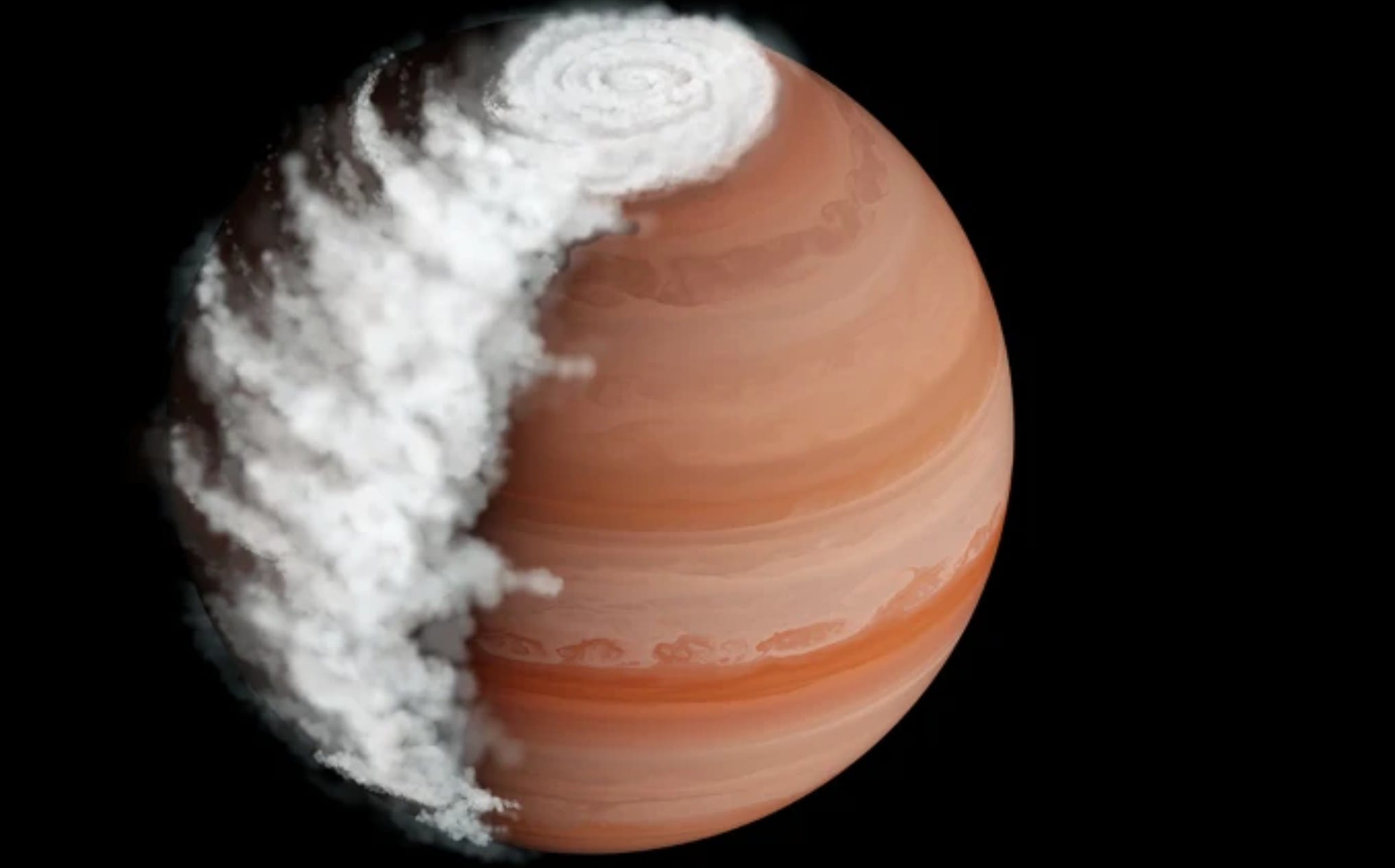
In the past few decades, our knowledge of exoplanets has exploded, but we’re still relatively limited in what we can learn about these worlds. That’s due, in large part, to the indirect way we observe them. Most exoplanets are found when we see them transit, passing between Earth and their star. During a transit, the planet blocks a portion of the light we would otherwise detect from the star, letting us know that something’s there. We’re often able to measure the spectra of light passing through the exoplanet’s atmosphere, giving us a glimpse of chemical signatures.
Today’s study looks at exoplanet WASP-94A b, a gas giant tidally-locked so that only one side ever faces its star. In its transit, researchers could clearly measure different spectra from the morning and evening sides of the planet. The asymmetry seems to indicate that the exoplanet develops thick clouds on the nightside, which then dissipate during the daytime. (Image credit: H. Robbins/JHU; research credit: S. Mukherjee et al.; via Nature)



Leave a Reply