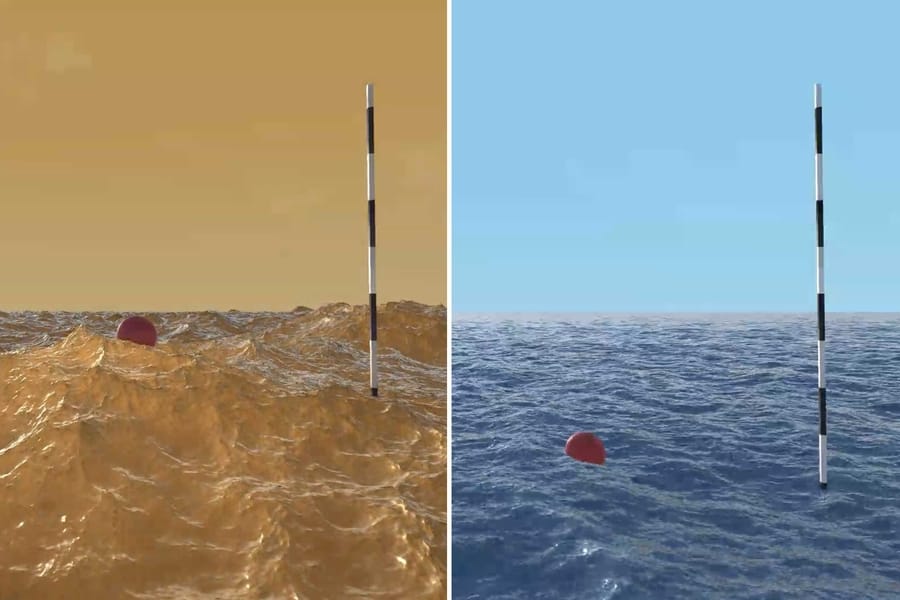
On Earth, most waves form when wind blows across the water. The shear and added energy from the wind ripples the surface, eventually building up waves (through the Kelvin-Helmholtz instability). The same process should happen anywhere else where wind and open liquid surfaces meet–even on other planets. To explore this, researchers built a new model, PlanetWaves, that predicts the waves based on a planet’s gravity, atmospheric conditions, and the density, viscosity, and surface tension of its surface liquid.
After validating the model with conditions on Earth, the team explored wave conditions for Titan, ancient Mars, and several exoplanets. They found that Titan’s lighter gravity and liquid ethane (which is less dense than water) combined to make waves on Titan much taller than those generated at the same wind speed on Earth (top image). You can watch them in action in the video below. Standing in a light breeze on Titan, you’d watch giant 3-meter waves rolling in.
The team also found that waves on Mars would have gotten shorter as Mars lost its atmosphere and the air pressure dropped. Over time, the same wind speed would have elicited smaller and smaller waves. Wave action has a big effect on a landscape’s erosion, so understanding how waves look on other planets will help us parse their geography. (Video, image, and research credit: U. Schneck et al.; via MIT News; submitted by Joseph S.)



Leave a Reply