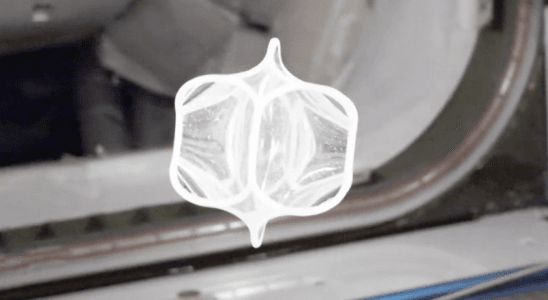
There are many shapes that can be tiled to fill space, but nearly all of them have sharp corners. Last year, mathematicians identified a new class of shapes, known as “soft cells,” that feature curved edges and faces but very few sharp corners. Like traditional polyhedrals, soft cells can tile to fill a space completely without overlapping or gapping.
Now the researchers, with some help from astronauts aboard the ISS, have brought one of their soft cells to life. Using an edge skeleton to guide the shape, astronaut Tibor Kapu filled the skeleton with water, which, in microgravity, formed a perfect soft cell, complete with faces curved by surface tension to their minimal area. See it in action below. (Image and video credit: HUNOR/NASA; research credit: G. Domokos et al.; via Oxford Mathematics)



Leave a Reply