Month: July 2025

  • Cloud Convection on Titan

    Cloud Convection on Titan

    Saturn’s moon Titan is a fascinating mirror to our own planet. It’s the only other planetary body with surface-level liquid lakes and seas, but instead of water, Titan’s are made of frigid ethane and methane. Like Earth, Titan has a weather cycle that includes evaporation, condensation, and rain. And now scientists have made their first observations of clouds convecting in Titan’s northern hemisphere.

    Using data from both the Keck Observatory and JWST, the team tracked clouds on Titan rising to higher altitudes, a critical step in the planet’s methane cycle. This translation took place over a period of days, giving scientists modeling the Saturnian moon new insight into the seasonal behaviors of Titan’s atmosphere. (Image credit: NASA/ESA/CSA/STScI; research credit: C. Nixon et al.; via Gizmodo)


    Fediverse Reactions
  • Crown Splash

    Crown Splash

    When a falling drop hits a thin layer of water, the impact sends up a thin, crown-shaped splash. This research poster shows a numerical simulation of such a splash in the throes of various instabilities. The crown’s thick edges are undergoing a Rayleigh-Plateau instability, breaking into droplets much the way a dripping faucet does. On the far side, the crown has rapidly expanding holes that pull back and collide. The still-intact liquid sheet at the base of the crown shows some waviness, as well, hinting at a growing instability there. (Image credit: L. Kahouadji et al.)

    Fediverse Reactions
  • Searching for the Seiche

    Searching for the Seiche

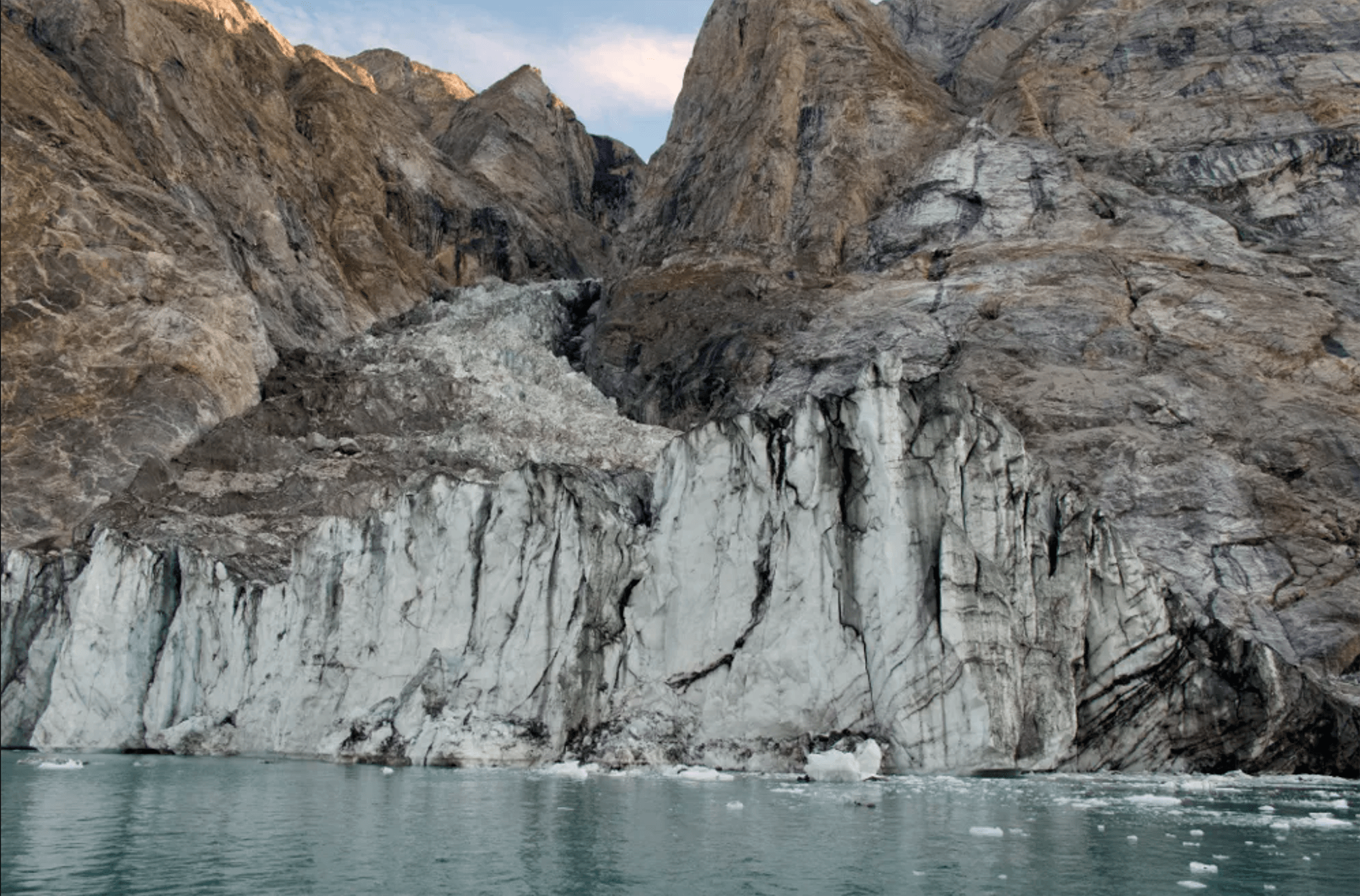
    A rock and ice face in Dickson Fjord after its collapse.

    On 16 September 2023, seismometers around the world began ringing, registering a signal that — for 9 days — wobbled back and forth every 92 seconds. A second, similar signal appeared a month later, lasting about a week. Researchers tracked the signal’s origin to a remote fjord in East Greenland, where it appeared a glacier front had collapsed. The falling rocks and ice triggered a long-lasting wave — a seiche — that rang back and forth through the fjord for days.

    Simulations showed that a seiche was plausible from a rockfall like the two that caused the seismic signal, but, without first-hand observations, no one could be certain. Now a new study has looked at satellite data to confirm the seiche. Researchers found that the then-new Surface Water and Ocean Topography (SWOT) satellite and its high-resolution altimeters had passed over the fjord multiple during the two landslide events. And, sure enough, the satellite captured data showing the water surface in the fjord rising and falling as the seiche ricocheted back and forth.

    It’s a great reminder that having multiple instrument types monitoring the Earth gives us far better data than any singular one. Without both seismometers and the satellite, it’s unlikely that scientists could have truly confirmed a seiche that no one saw firsthand. (Image credit: S. Rysgaard; research credit: T. Monahan et al.; via Eos)

    Fediverse Reactions
  • A Sprite From Orbit

    A Sprite From Orbit

    A sprite, also known as a red sprite, is an upper-atmospheric electrical discharge sometimes seen from thunderstorms. Unlike lightning, sprites discharge upward from the storm toward the ionosphere. This particular one was captured by an astronaut aboard the International Space Station. That’s a pretty incredible feat because sprites typically only last a millisecond or so. The first one wasn’t photographed until 1989. (Image credit: NASA; via P. Byrne)

    Fediverse Reactions
  • Branching Dendrites

    Branching Dendrites

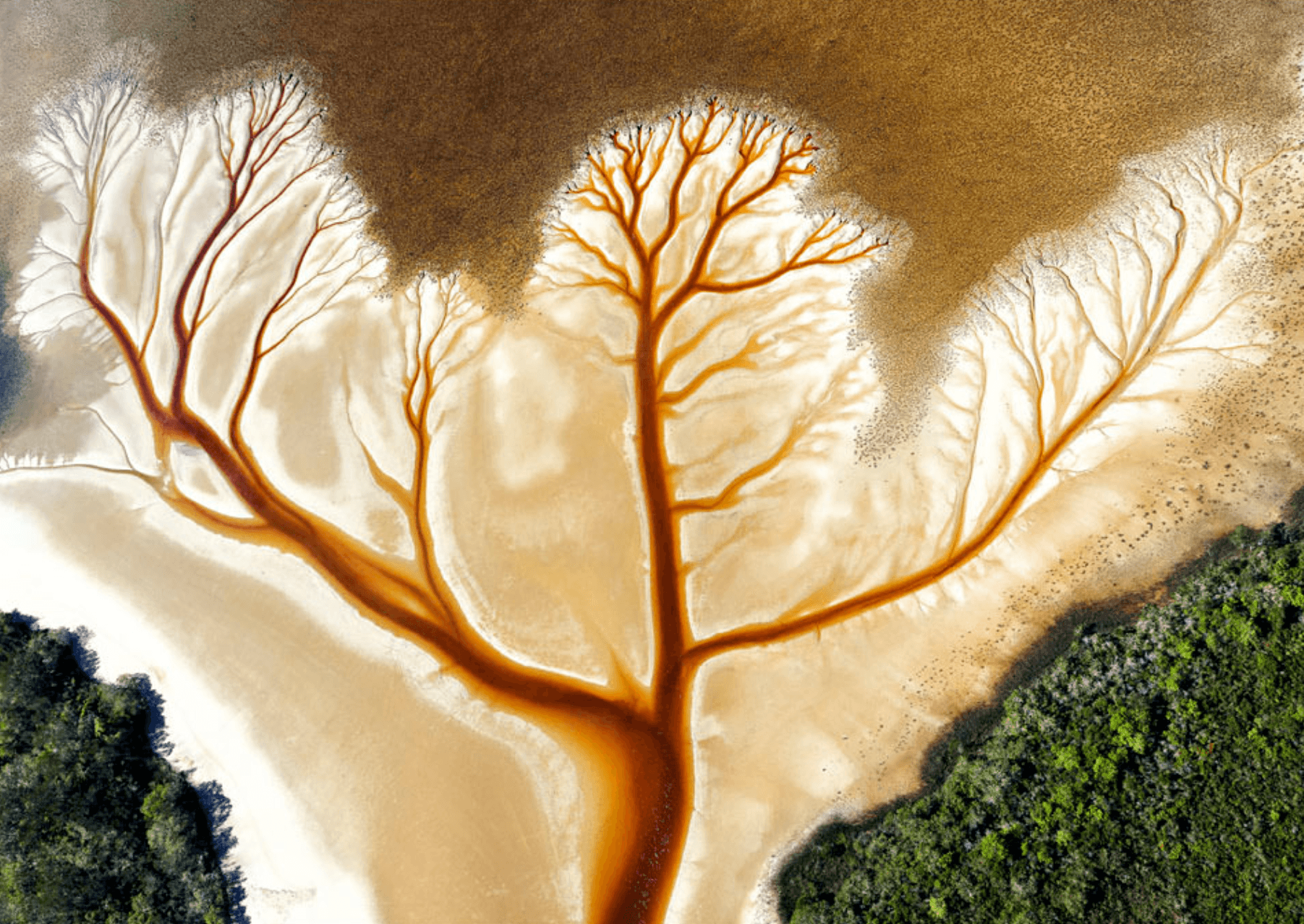
    This award-winning aerial image by photographer Stuart Chape shows a tidal creek in Lake Cakora, New South Wales, Australia. At first glance, it looks much like any river delta, with branching dendritic paths that split into smaller and smaller waterways. That’s deceptive, though, because very different forces shape this creek. Because tides move in and out, a tidal creek is home to flows that move both directions — toward and away from the branches. That also means that flow speeds can change rapidly as the tides shift, which in turn changes which sediments get lifted, dropped, and moved around the creek bed. (Image credit: S. Chape/IAPOTY; via Colossal)

    Fediverse Reactions
  • Featured Video Play Icon

    See the Solar Wind

    After a solar prominence erupts, strong solar winds flow outward from the sun, carrying energetic particles that can disrupt satellites and trigger auroras if they make their way toward us. In this video, an instrument onboard the ESA/NASA’s Solar Orbiter captures the solar wind in the aftermath of such an eruption. The features seen here extended 3 solar radii and lasted for hours. The measurements give astrophysicists their best view yet of this post-eruption relaxation period, and the authors report that their measurements are remarkably similar to results of recent magnetohydrodynamics simulations, suggesting that those simulations are accurately capturing solar physics. (Video and image credit: ESA; research credit: P. Romano et al.; via Gizmodo)

    Fediverse Reactions
  • A Variety of Vortices

    A Variety of Vortices

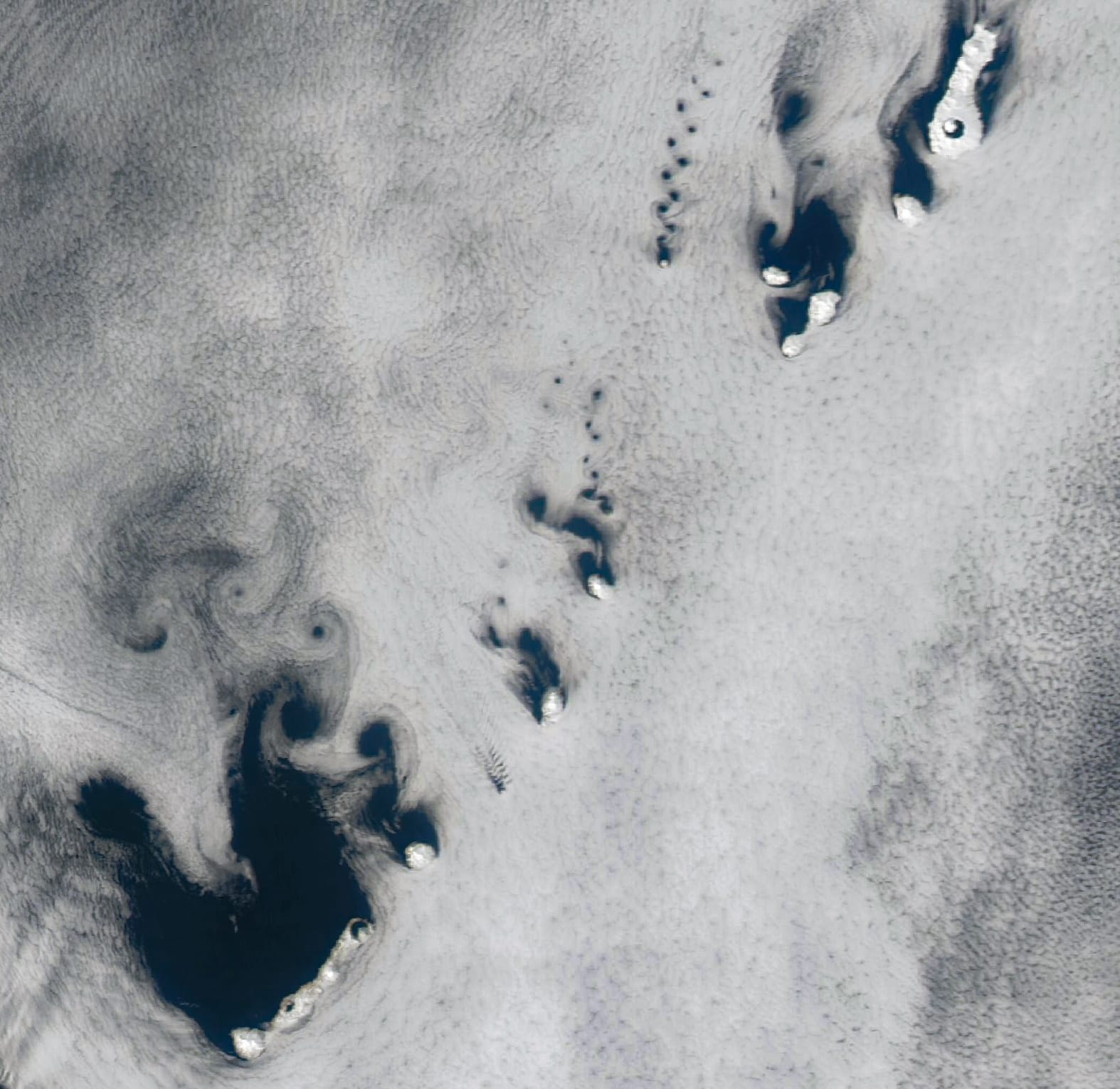
    Winds parted around the Kuril Islands and left behind a string of vortices in this satellite image from April 2025. This pattern of alternating vortices is known as a von Karman vortex street. The varying directions of the vortex streets show that winds across the islands ranged from southeasterly to southerly. Notice also that the size of the island dictates the size of the vortices. Larger islands create larger vortices, and smaller islands have smaller and more frequent vortices. (Image credit: M. Garrison; via NASA Earth Observatory)

    Fediverse Reactions
  • Capturing River Waves

    Capturing River Waves

    Rainfall, ice jams, and dam breaks create surges of high flow that make their way down a river in a wave that stretches tens to thousands of kilometers in length. Traditionally, scientists monitor such flow waves using river gauges, which measure river height at specific locations. But gauges are few and far between on many rivers, so a group of researchers are supplementing that data with the SWOT (Surface Water and Ocean Topography) spacecraft. SWOT bounces microwaves off the water to precisely measure the water’s height, giving researchers a glimpse of the flow wave’s shape along the entire river.

    In their paper, the team identify and describe flow waves on three different rivers — the Yellowstone, Colorado, and Ocmulgee rivers — ranging in height up to 9 meters and stretching up to 400 kilometers. (Image credit: CNES; research credit: H. Thurman et al.; via Gizmodo)
    Fediverse Reactions
  • Dancing Metal Droplets

    Dancing Metal Droplets

    Droplets of a gallium alloy are liquid at room temperature. When spiked with aluminum grains and immersed in a solution of NaOH, the droplets change shape and move in a random fashion. This video delves into the phenomenon, describing how a chemical reaction with the aluminum grains changes the local surface tension and creates Marangoni flows that make the droplets move. To get the droplet motion, you need to have the aluminum concentration just right. With too little, there’s not enough Marangoni flow. With too much, the hydrogen gas produced in the chemical reaction disrupts the droplet motion. (Video and image credit: N. Kim)

    Fediverse Reactions
  • Featured Video Play Icon

    “Creation”

    Videographer Vadim Sherbakov’s short film “Creation” is full of glittery vistas created under a macro lens. Shifting, particle-seeded flows shimmer in bright colors. Glistening deltas shift and form, and Marangoni flows generate feathers and tree-like dendritic arms. Macro flows never cease to fascinate. (Video and image credit: V. Sherbakov; via Colossal)