Antarctica is nearly fully covered in ice and doubles in surface area each winter as the surrounding sea freezes. So it’s an especially spectacular place for viewing icebergs, like these photographed by Jan Erik Waider. The ice comes in many shapes — some clearly fractured and some sculpted by wind and water. The colors, too, are striking. Even in overcast conditions, the blues of the ice seem almost to glow from within. (Image credit: J. Waider; via Colossal)
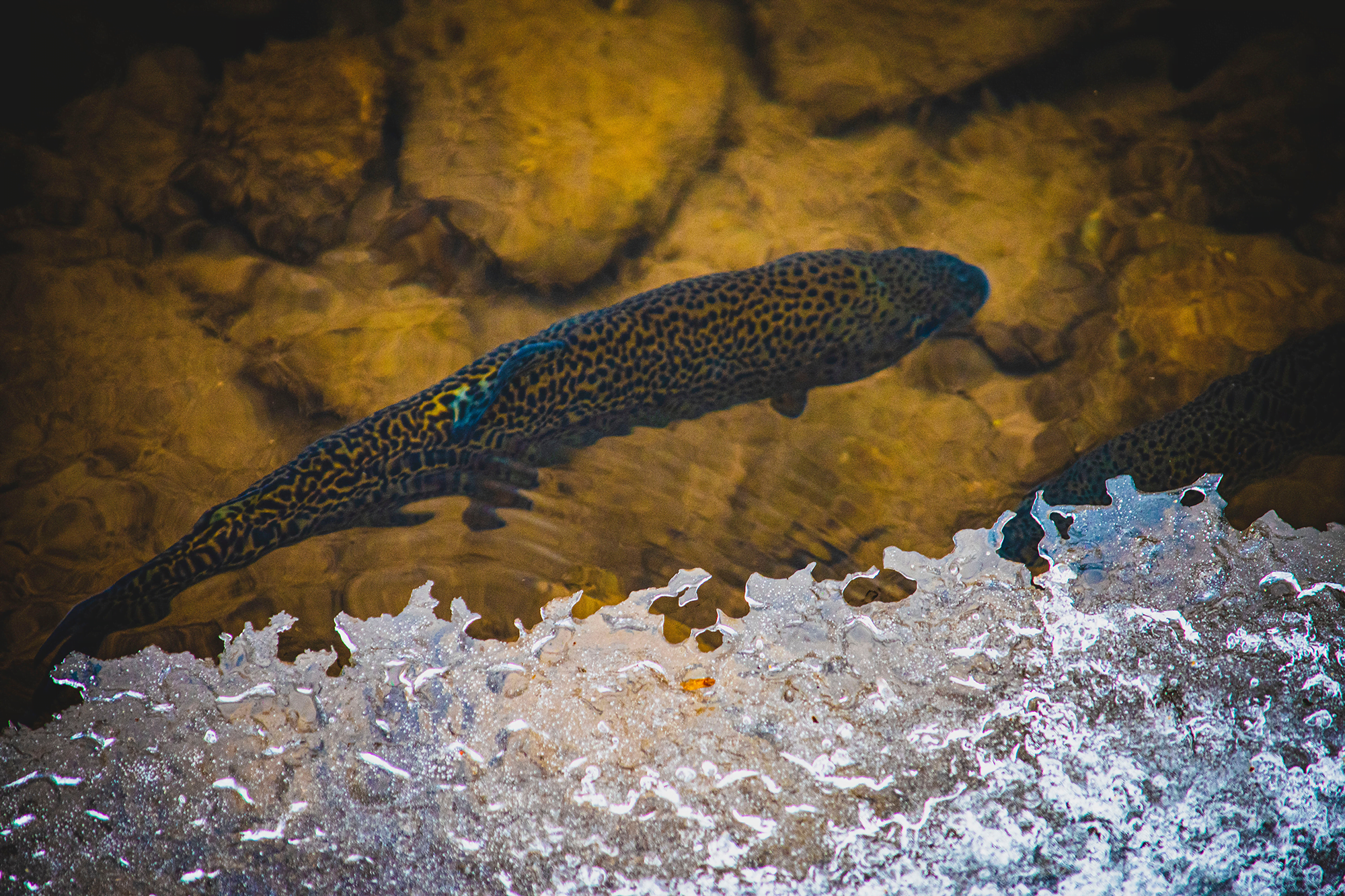
Researchers studying how fishswim have long focused on their tail fins and the flows created there. But a fish’s other fins have important effects, too, as seen in this recent study. Researchers built a CFD simulation based on observations of a swimming rainbow trout, focusing on the flow from its back and tail fins. They found that the vortex created by the back fin stabilizes and strengthens the one generated by the tail. It also played a role in reducing drag on the fish by maintaining the pressure difference across the body. When they tried changing the size and geometry of the fins, the fish’s efficiency suffered, indicating that evolution has already optimized the trout’s fins for swimming efficiency. (Image credits: top – J. Sailer, simulation – J. Guo et al.; research credit: J. Guo et al.; via APS Physics)
Visualization of flow around a digitized rainbow trout.
Quick, agile, and fierce, the hummingbird is an amazing creature. Small for a bird but much larger than an insect, it’s able to hover in place and eat nectar directly from flowers. Many species use a forked tongue with curled edges that help it capture the sweet, viscous fluid. Even their distinctive sounds are fluid-influenced, coming from their wingstrokes and the fluttering of tail and wing feathers. (Image and video credit: BBC Earth)
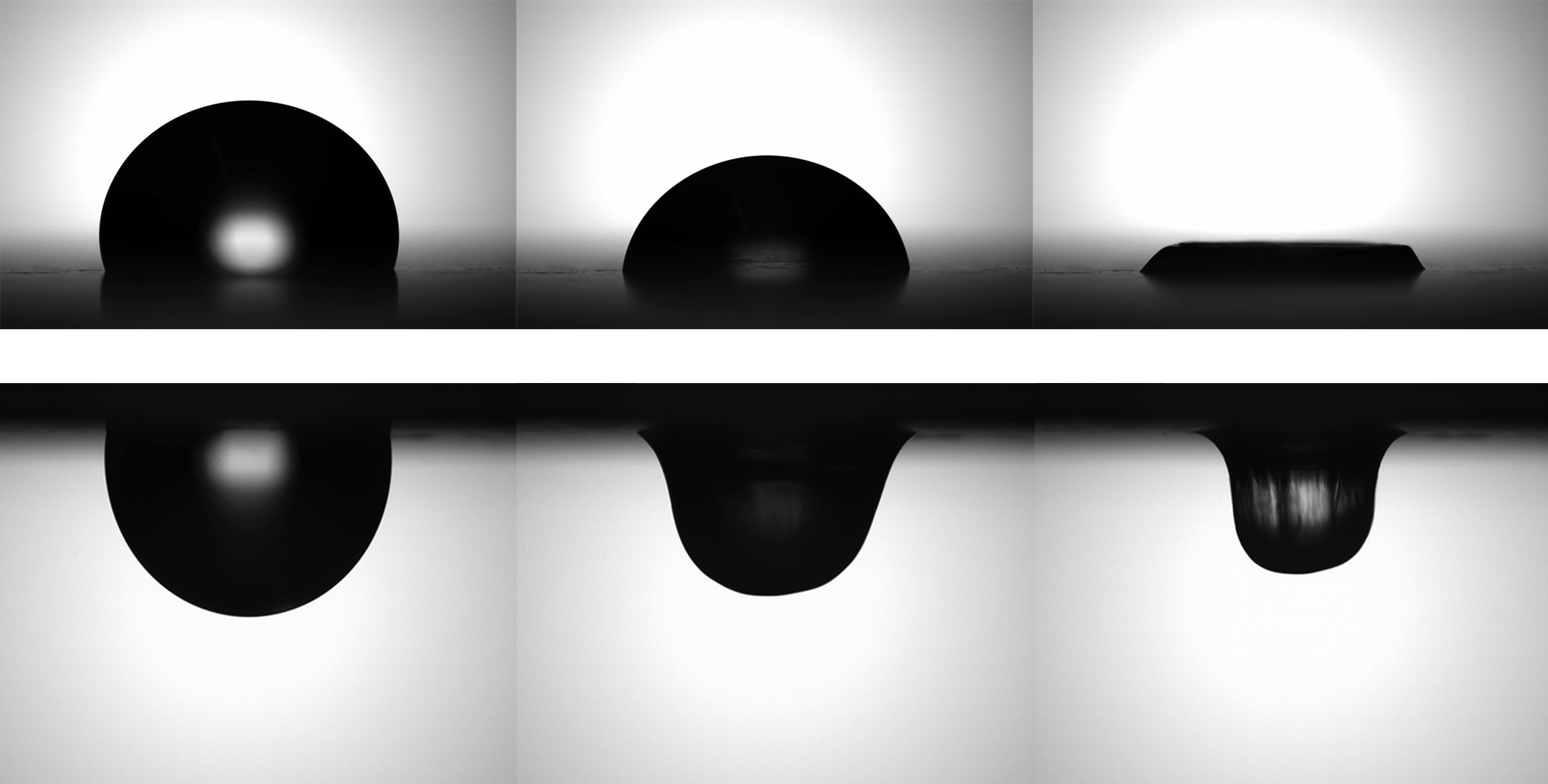
With small droplets, gravity usually has little effect compared to surface tension. An evaporating water droplet holds its spherical shape as it evaporates. But the story is different when you add proteins to the droplet, as seen in this recent study.
The protein-filled sessile drop starts out largely spherical, but as the drop evaporates, the concentration of proteins reaches a critical point and an elastic skin forms over the drop. From this point onward, the drop flattens.
As a protein-doped droplet sitting on a surface evaporates, it starts out spherical, like its protein-free cousin. But, as the water evaporates, it leaves proteins behind, gradually increasing their concentration. Eventually, they form an elastic skin covering the drop. As water continues to evaporate, the droplet flattens.
For a hanging droplet, the shape again starts out spherical. But as the drop’s water evaporates and the proteins concentrate, it also forms an elastic skin. As the drop evaporates further, the skin wrinkles.
In contrast, a hanging droplet with proteins takes on a wrinkled appearance once its elastic skin forms. The key difference, according to the model constructed by the authors, is the direction that gravity points. Despite these droplets’ small size, gravity makes a difference! (Image, video, and research credit: D. Riccobelli et al.; via APS Physics)
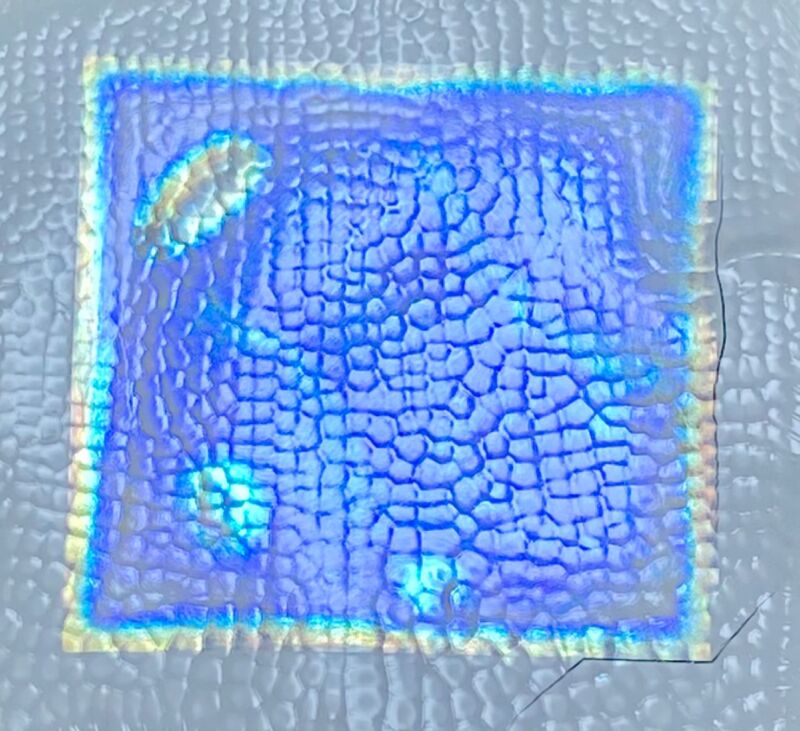
For humans, staying cool in the summer heat often means expending energy on air conditioners, fans, and other cooling devices. But scientists are exploring other, less energy-intense options for beating the heat. At a conference, researchers recently unveiled a plant-based bi-layer film that’s able to stay about 7 degrees Fahrenheit cooler than its surroundings while illuminated by the sun.
The film uses passive daytime radiative cooling, which means that it emits its heat into space (without getting absorbed by the air nearby) without any external power source. A square meter of the film generates over 120 watts of cooling power, comparable to many residential air conditioners. Even better, the films are built from layered cellulose, a sustainable and renewable resource, and can be made in a variety of colors.
The team hopes to transition their films to commercial manufacturing, where they can be incorporated into buildings and automobiles to provide some passive cooling, thereby limiting reliance on air conditioners. (Image and research credit: Q. Shen et al.; via Ars Technica)
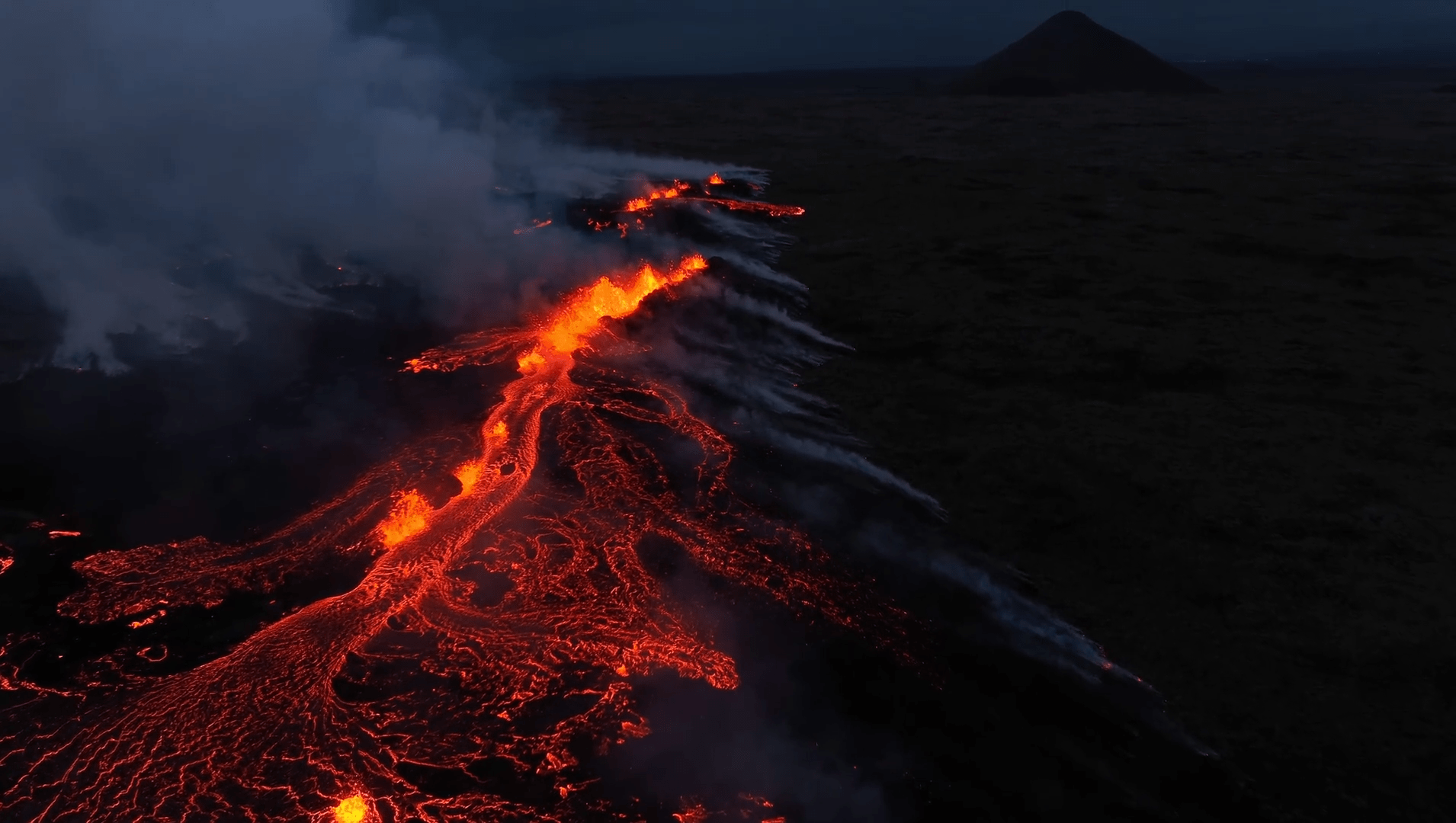
North of Iceland’s Fagradalsfjall, a new volcanic fissure opened in July 2023. This drone footage from Isak Finnbogason captures that fissure on its first night. Lava fountains jet from the earth, forming a complex, slow-moving river. The similarities between flowing lava and more common liquids like water never ceases to fascinate me. Even with the vast differences in temperature and viscosity, so much of their physics remains recognizably the same. (Image and video credit: I. Finnbogason; via Colossal)
Understanding chaotic, turbulent flows has long challenged scientists and engineers due to their sheer complexity. In turbulent flows, energy cascades from the largest scales — like the kilometer-size cross-section of a cloud — to the very smallest scales, less than a millimeter in size, where viscosity transforms the flow’s motion to heat. For nearly a century, our theoretical understanding of turbulence has posited that there are certain universal behaviors in the statistics of a turbulent flow — essentially that, due to this energy cascade, some aspects of every turbulent flow are the same from clouds to ocean currents to your coffee cup.
Accordingly, experimentalists have tried for decades to measure this expected universality. Often, there are some signs of agreement, and any deviation was attributed to the finite difference between the large and small scales of the flow. (The theory assumes the difference in these scales’ size is effectively infinite.) But now researchers have achieved the largest range of scales yet — comparable to those found in the atmosphere — and the gaps between theory and experiment remain. The new study does show signs of universality but in a different way than existing theory predicts. As the authors point out, we’ll need new theories to explain these findings. (Image credit: D. Páscoa; research credit: C. Küchler et al.; via APS Physics)
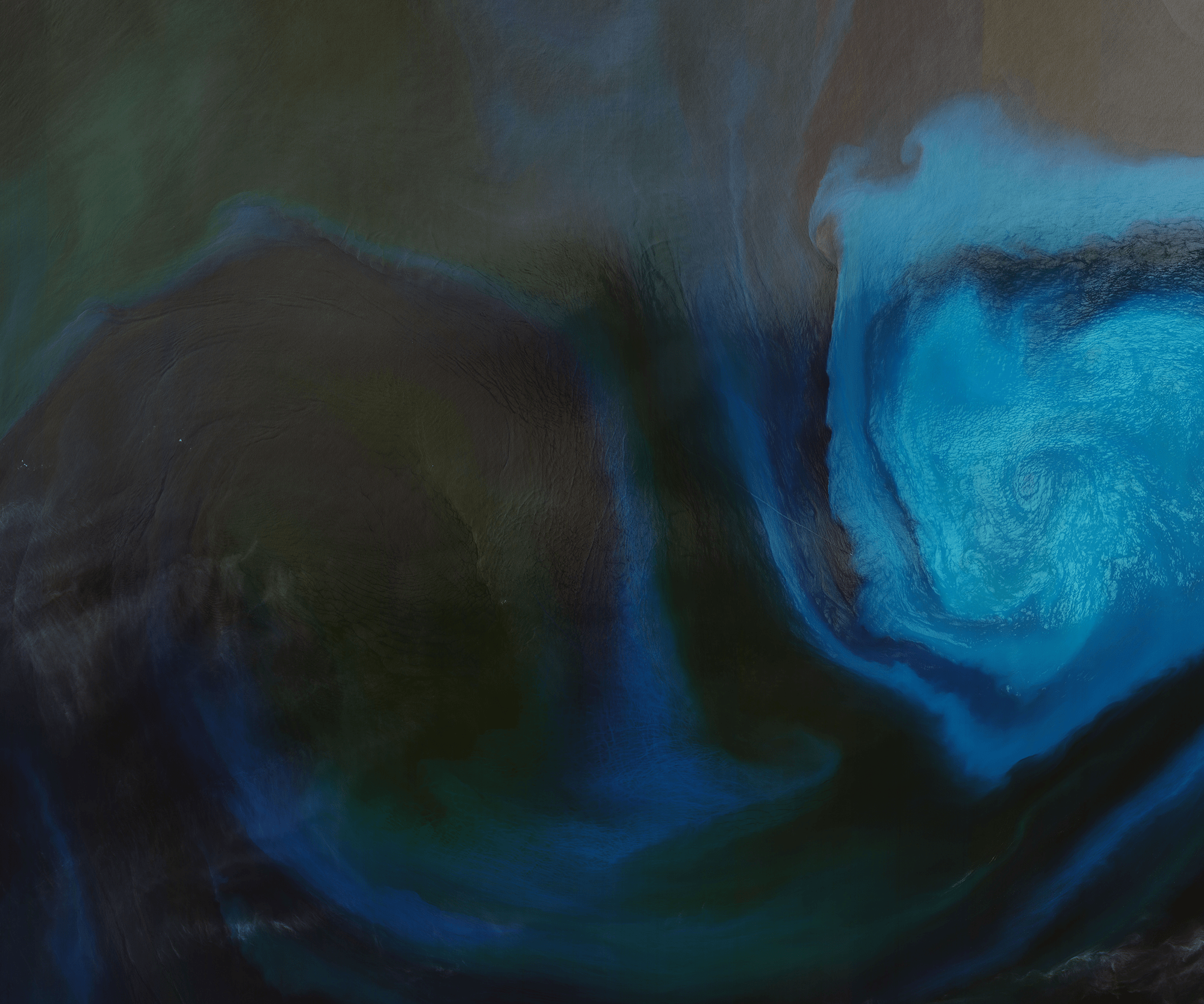

In April 2023, swirls of green and turquoise burst into vivid color in the Atlantic. Much of the color comes from a phytoplankton bloom. Although phytoplankton are individually microscopic, they form eddies a hundred kilometers across that are visible from space. In detailed images like the one above (available here in full resolution) these swirls have amazing turbulent details. Some of the brightest sections almost look like a field of sea ice! (Image credit: L. Dauphin; via NASA Earth Observatory)
Getting around on sandy slopes is no easy feat. On steep inclines, even small disturbances will cause an avalanche. The predatory antlion takes advantage of this fact by building a conical pit that makes ants that walk in slide down into its waiting jaws. But a new study shows that it’s more than just pressure that determines when an object slides down the slope.
To simulate hapless ants sliding into an antlion’s pit, researchers used plexiglass disks with four smaller disks that act as legs on the granular slope. By varying the distance between these points of contact, researchers found that stance also affects when a slide starts. The closer together the contacts are, the more likely the disk would slide. In contrast, spreading the points of contact increased stability, meaning that adopting a wider stance could keep an animal, human, or robot from sliding as easily. (Image credit: NEOM; research credit: M. Piñeirua et al.; via APS Physics)
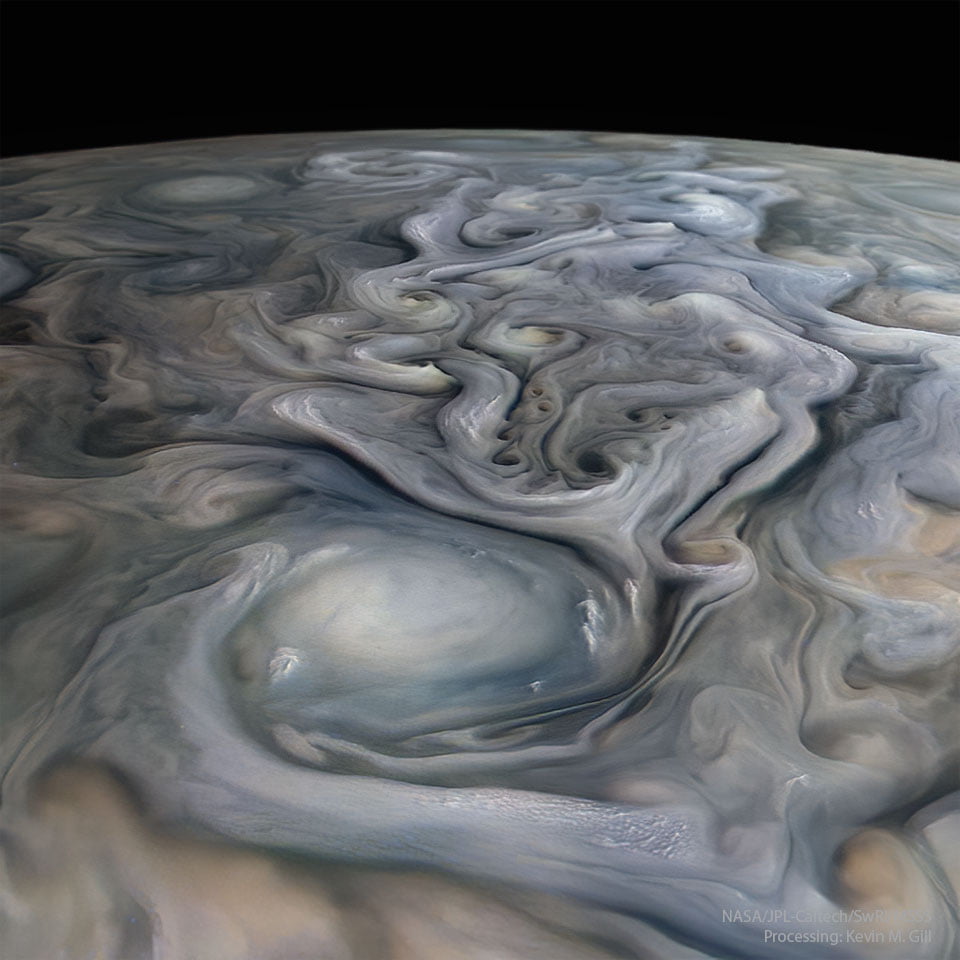
Jupiter, our solar system’s stormiest planet, shares many similarities with Earth. But where Earth’s strongest storms are cyclones centered on low-pressure regions, Jupiter’s longest and strongest storms are anti-cyclones, driven by areas of high pressure. They’re often massive — larger than the entire Earth — and persist for weeks, months, or years. This processed image comes from the JunoCam instrument and shows some of the incredible cloud structure in Jupiter’s atmosphere. Jupiter’s highest altitude clouds tend to be the lightest, while darker clouds remain lower. (Image credit: NASA/JPL-Caltech/SwRI/MSSS/K. Gill; via APOD)