Month: November 2020

  • Collecting Animal Tears

    Collecting Animal Tears

    Like humans, most vertebrates rely on tear films to keep their eyes moist and protected from the environment. But compared to humans, some animals’ tears have superior staying power. The caiman, for example, can go up to 2 hours between blinks without their eyes drying out; in contrast, humans have to blink about 15 times per minute – and sometimes even that isn’t enough to keep our eyes moist!

    Researchers are collecting animal tears and studying their composition to better understand how their tears protect vision. Subtle changes in chemical make-up can lead to large variations in performance; just look at the many dried tear patterns in Image 2. Scientists hope that understanding other species’ tears will help us develop better treatments for our own vision problems. As someone who struggles with dry eyes at times, I’d be happy for some caiman-tear-inspired eye drops! (Image credit: A. Oriá; research credit: A. Raposo et al.; via NYTimes; submitted by Kam-Yung Soh)

  • Featured Video Play Icon

    Coalescing Drops

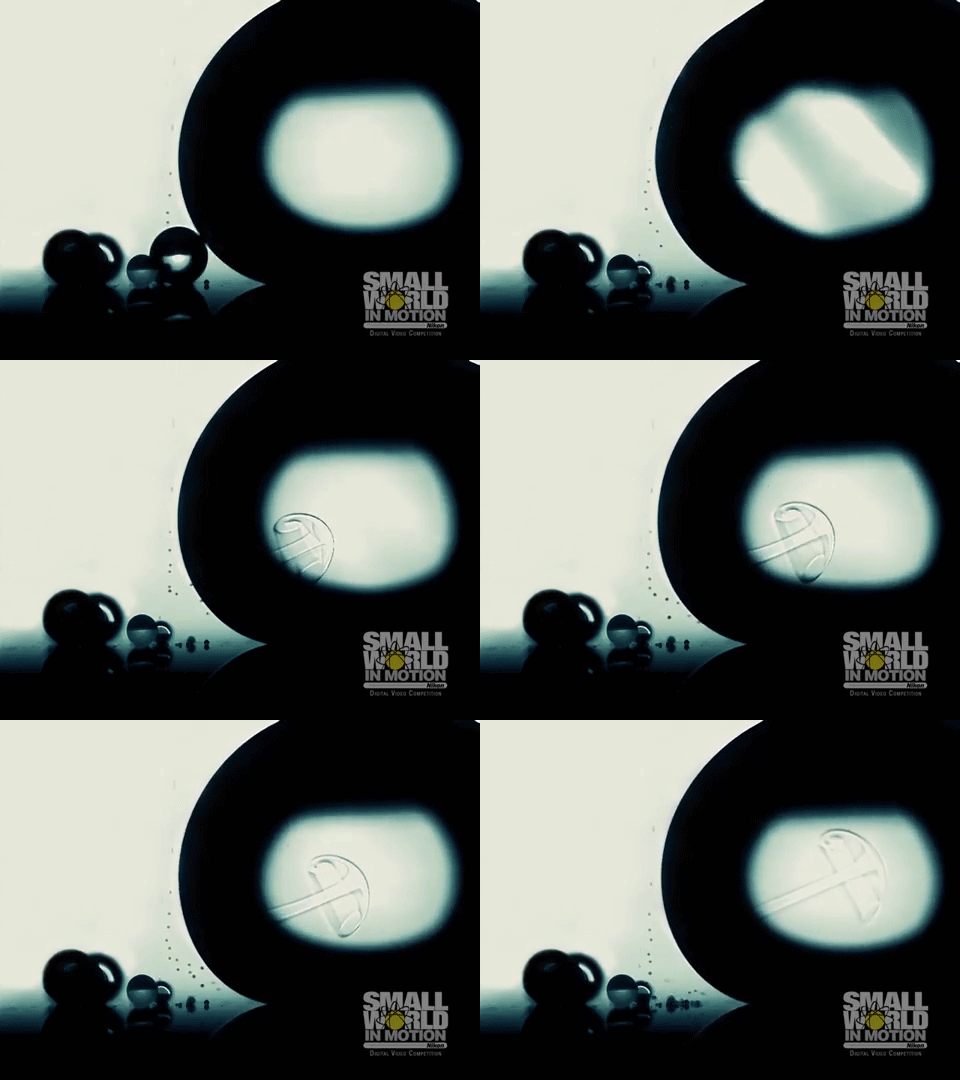
    This year’s Nikon Small World in Motion competition was won by fluid dynamics! The first place video shows droplets on a superhydrophobic surface coalescing. The droplets are a mixture of water and ethanol. Their initial merger creates a ripple of waves that’s followed by a ghostly vortex ring that jets into the interior. Previous research on coalescence during impact shows jets driven by surface tension but the jet here doesn’t appear to be confined to the surface. (Image and video credit: K. Rabbi and X. Yan; via Nature; submitted by Kam-Yung Soh)

    Droplets on a superhydrophobic surface coalescing.

  • Colorful Kelvin-Helmholtz Clouds

    Colorful Kelvin-Helmholtz Clouds

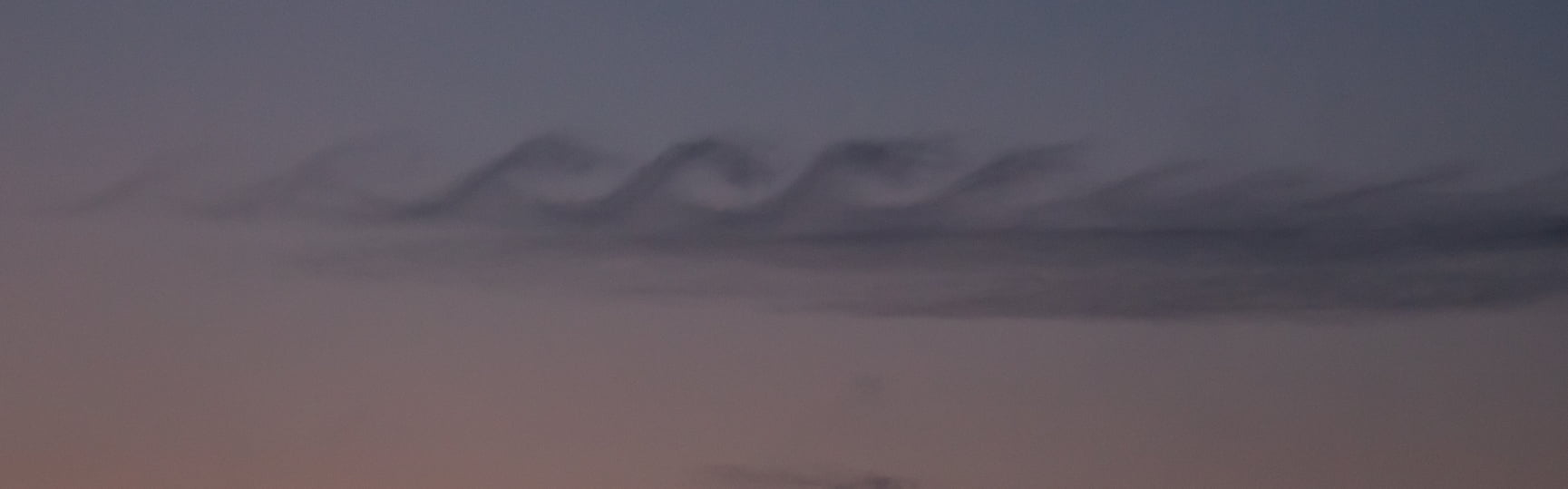
    Like breaking waves at the beach, these wavy clouds curl but only for a moment. The photo was captured near sunset on a late August evening in Arlington, MA. This short-lived cloud shape forms due to the Kelvin-Helmholtz instability, which is driven by shear forces between two layers of air moving at different speeds. The situation is a common one in the atmosphere, where air layers at altitude move in different directions and at different speeds. Most of the time we cannot see the curls that form between these air layers because of air’s transparency. But occasionally the mismatch happens right at a cloud layer and the condensation of the cloud gets pulled into these distinctive curls. (Image credit: B. Bray; submitted by Mark S.)

  • Featured Video Play Icon

    Making a Miniature River

    Despite wide differences in ecology and geology, rivers around the world share certain fundamental features. Physicists study these characteristics by creating small-scale rivers in the laboratory, like the experiment featured in this Lutetium Project video. Within these systems, scientists can carefully control variables and discover useful patterns, like the two parameters needed to describe the shape of a river’s profile! (Image and video credit: The Lutetium Project)

  • Understanding Stars’ Seismology

    Understanding Stars’ Seismology

    Our understanding of Earth’s interior is based mostly on observations of seismic waves, which travel differently through our rocky crust and the molten core. Scientists similarly use seismic waves in stars to determine their interiors. But the pressure and temperature conditions in stars are far beyond anything we have here on Earth, which makes predicting how waves will travel in such exotic material difficult.

    To better understand these extreme temperatures and pressures, scientists are using Lawrence Livermore’s National Ignition Facility (NIF) to mimic conditions similar to the outer envelope of a white dwarf star, like the one shown in the center of the image above. NIF’s laser array – shown as the blue lines in the artist’s conception above – can generate spherical shock waves that, as they converge on a solid sample, create pressures as high as 450 Mbar, more than 400 million times sea level atmospheric pressure here on Earth. Although the shock wave takes only 9 ns to travel across the sample, it’s enough to give researchers a glimpse into star-like conditions. (Image credit: NASA/ESA/C. O’Dell/D. Thompson, Lawrence Livermore National Laboratory; via Physics Today)

  • Spinning Bubbles

    Spinning Bubbles

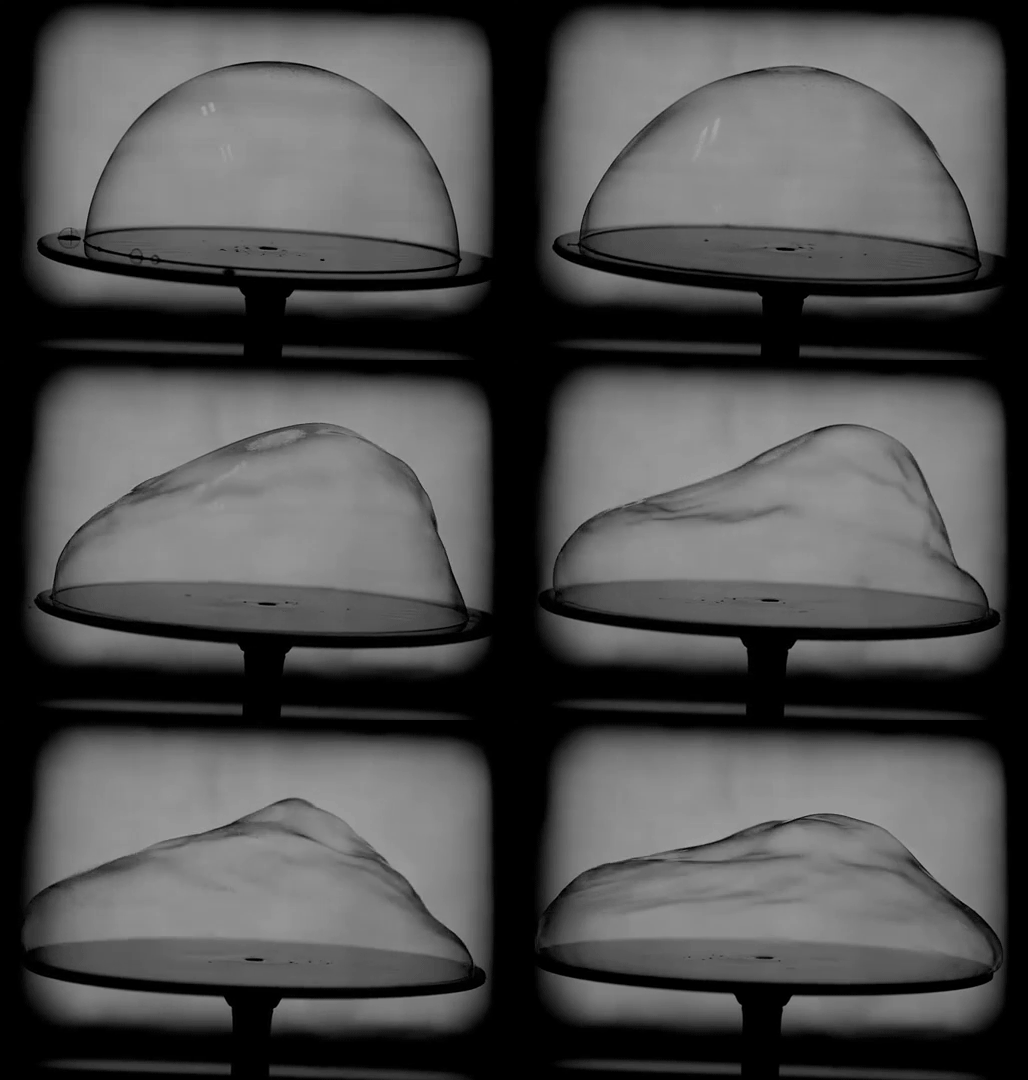
    Fluid dynamics is largely about figuring out the relationship between forces. For a soap bubble sitting still, that’s primarily the effect of gravity, which makes the fluid in the soap film drain downward, and surface tension, which tries to maintain a spherical shape for the bubble.

    Once you start spinning the bubble, though, there are new forces that come into play. One is the centrifugal force caused by the rotation, and another is the drag force between the rotating soap bubble and the air inside and outside of it. The addition of these forces drastically changes the bubble’s shape. It becomes wobbly and flattens out. Watch the contact line where the bubble meets the surface and you’ll also see it creeping outward toward the edge of the platform. (Image credit: C. Kalelkar and S. Paul, source)

  • Featured Video Play Icon

    Storm Eyes and Mushrooms in a Drop

    In industry, drying droplets often have many components: a liquid solvent, solid nanoparticles, and dissolved polymers. The concentration of that last component — the polymers — can have a big effect on the way the droplet dries, as seen in the video above.

    Without polymers, the droplet dries similarly to a coffee ring stain. But at moderate concentration, we see something very different. The droplet forms an eye in the middle, similar to a hurricane’s, and the edges of the droplet sprout mushroom-shaped plumes that grow and merge with one another along the edge. With even larger polymer concentrations, the mushrooms sweep their way inward, leaving a feathery stain behind. (Video, image, and research credit: J. Zhao et al.)

  • Granular Fingers

    Granular Fingers

    Finger-like shapes often form on fluids injected between glass plates, but what happens when that injected fluid contains particles? That’s the situation in this recent study, where researchers sandwiched a fluid between two glass plates and then injected a second, similar fluid laced with particles.

    Despite the differences from the traditional Saffman-Taylor set-up, the granular-filled fluid still forms fingers as long as there’s even a slight density difference between the original and injected fluids. It doesn’t even matter which of the two fluids has the greater density! (Image and research credit: A. Kudrolli et al.)

  • Featured Video Play Icon

    Freshwater Mussels

    Freshwater bivalves like these California floater mussels are critical species for the health of our waters. And although we don’t think of mussels as being very mobile, they’re actually quite active. As larvae, the mussels get released from their parent bivalve and attach to the fins or gills of a fish. While they develop, they cling to the fish, hitching a ride until they’re ready to strike out on their own. Considering the fluid forces typical on those areas of a fish, that means the larvae must have some impressive strength!

    Once grown, the mussels anchor themselves using their tongue-like foot and begin their filter-feeding. They draw water in through a cilia-lined inlet, filter out algae, oxygen, and other nutrients, and expel clean water. This constant cycling, though largely invisible to the naked eye, is how bivalves keep their native waterways clean. (Image and video credit: Deep Look)

  • Recreating Infinity

    Recreating Infinity

    In the ocean, tiny organisms can migrate hundreds of meters through the water column. Recreating and tracking those journeys in a lab is quite a challenge, but it’s one the researchers behind the Gravity Machine have conquered. This apparatus uses a wheel to essentially give micro-organisms an infinite water column to traverse while keeping them fixed in the lab microscope’s field of view.

    With the device, researchers can watch organisms switch naturally between rising, sinking, and feeding behaviors as they would in the wild. The group is working to make it so that anyone with a microscope can recreate their set-up for observations. (Image, video, and research credit: D. Krishnamurthy et al.; see also Gravity Machine; submitted by Kam-Yung Soh)