Month: September 2020

  • Flexible Filament Reduces Drag

    Flexible Filament Reduces Drag

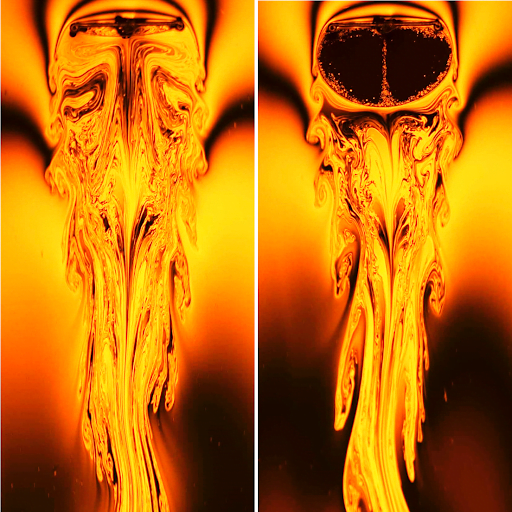
    Most shapes aren’t streamlined for fluid flow. We call these bulky, often boxy shapes, bluff bodies. Above, we see two examples of a bluff body, a flat plate, in a soap film. On the left, the plate sits perpendicular to the soap film’s top-to-bottom flow. Two large, counter-rotating vortices form behind the plate and a wide wake stretches behind it.

    On the right, we see the same flat plate but now a long, flexible filament is attached to either end. As the flow moves past, it deforms the filament, creating a rounded shape. Researchers found that, under the right conditions, this flexible afterbody could reduce drag on the object by up to 10%. (Image and research credit: S. Gao et al.)

  • Featured Video Play Icon

    Ventilation and Respiratory Disease

    In 1977, one passenger with the flu infected 38 people onboard a flight with malfunctioning ventilation. In this video, Dianna digs into the physics of respiratory disease transmission and just why ventilation is so key to preventing it.

    There are three primary modes of transmission for respiratory diseases like influence or SARS-CoV-2: 1) touching an infected surface and then oneself, i.e., self-inoculation; 2) inhaling virus-filled droplets larger than 5 nm; and 3) inhaling virus-filled droplets smaller than 5 nm. That size cut-off may seem a little arbitrary, but it’s how scientists distinguish between droplets that fall quickly to the ground and ones that can persist on buoyant air currents.

    That airborne persistence is one of the reasons ventilation — in other words, replacing the air — is so important. So many people on that 1977 flight got sick because there was no system removing the infected air and bringing in fresh air. For more on the fluid dynamics disease transmission, check out these posts. Curious about those bacterial bubble bursts? I’ve covered that, too. (Video and image credit: Physics Girl)