Year: 2017

  • Lighting Engines

    Lighting Engines

    Combustion is complicated. You’ve ideally got turbulent flow, acoustic waves, and chemistry all happening at once. With so much going on, it’s a challenge to sort out the physics that makes one ignition attempt work while another fails. The animations here show a numerical simulation of combustion in a turbulent mixing layer. The grayscale indicates density contours of a hydrogen-air mixture. The top layer is moving left to right, and the lower layer moves right to left. This sets up some very turbulent mixing, visible in middle as multi-scale eddies turning over on one another.

    Ignition starts near the center in each simulation, sending out a blast wave due to the sudden energy release. Flames are shown in yellow and red. As the flow catches fire, more blast waves appear and reflect. But while the combustion is sustained in the upper simulation, the flame is extinguished by turbulence in the lower one. This illustrates another challenge engineers face: turbulence is necessary to mix the fuel and oxidizer, but turbulence in the wrong place at the wrong time can put out an engine. (Image, research, and submission credit: J. Capecelatro, sources 1, 2)

    image
  • Moving Fluids in the Right Direction

    Moving Fluids in the Right Direction

    One challenge in creating miniature labs-on-a-chip is keeping fluids moving in the desired direction. The top image above shows red and blue droplets being moved toward one another on the top and bottom of a vibrating surface. Eventually, they meet and mix in the middle. To force the fluids in the right direction, the surface is highly textured, as seen in the lower image. These tiny posts and arcs help trap air between the surface and the drop. This makes the drop’s contact area with the superhydrophobic substrate quite small. The arcs provide directionality, and, as the surface shakes, the drops inch along, releasing the arc on the trailing edge as they make contact with a new one. In effect, the droplets walk themselves just where their designers want them to go. (Image and research credit: T. Duncombe et al.; via SciTechDaily)

  • Flow Inside Convection Cells

    Flow Inside Convection Cells

    Looking at convective cells, it’s easy to think that they are still and unmoving. But when you add particles, their inner flow becomes obvious. Warm, light fluid moves up through the center of each cell, skims along the surface, and then sinks at the edges of the cell after losing its heat at the cooling surface. Below, the fluid moves back toward the cell center, getting warmer as it’s heated by the lower surface. Once it reaches the middle of the cell, it’s light enough to rise up and start the process again. Convective cells like these are typical in cooking – watch for them forming in your miso soup or hot chocolate – but they can also be found on the sun and even in situations without heating! (Image credit: G. Kelemen, source)

  • Rheoscopic Flow Vis

    Rheoscopic Flow Vis

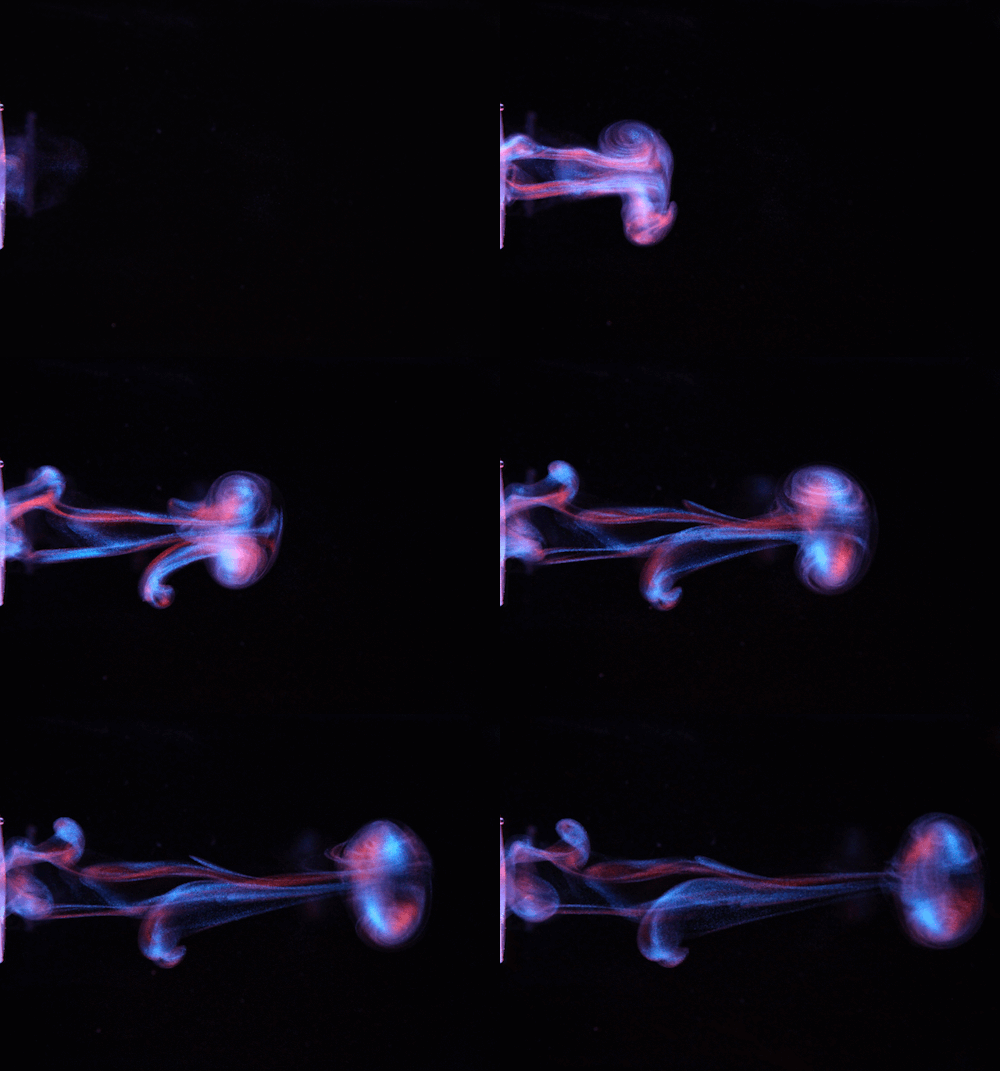
    One of the great challenges in visualizing fluid flows is the freedom of movement. A fluid particle – meaning some tiny little bit of fluid we want to follow – is generally free to move in any direction and even change its shape (but not mass). This makes tracking all of those changes difficult, and it’s part of why there are so many different techniques for flow visualization. The technique an experimenter uses depends on the information they hope to get.

    Often a researcher may want to know about fluid velocity in two or more directions, which can require multiple camera angles and more than one laser sheet illuminating the flow. An alternative to such a set-up is shown above. The injected fluid – known as a rheoscopic fluid – contains microscopic reflective particles, in this case mica, that are asymmetric in shape. Imagine a tiny rod, for example. By illuminating the rod from different directions with different colors of light, you can determine the particle’s orientation based on the color it reflects. Since the orientation of the particle depends on the surrounding flow, you can infer how the flow moves. (Image credit and submission: J. C. Straccia; research link: V. Bezuglyy et al.)

  • The Mist of Champagne

    The Mist of Champagne

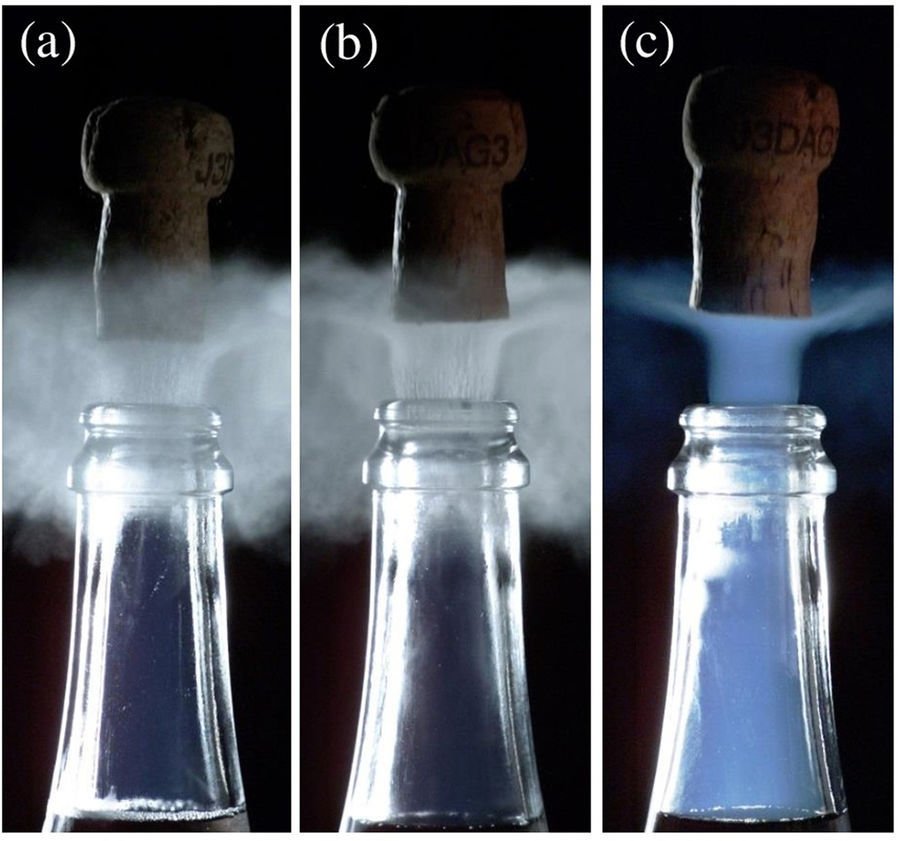
    If you’ve ever popped open a chilled bottle of champagne, you’ve probably witnessed the gray-white cloud of mist that forms as the cork flies. Opening the bottle releases a spurt of high-pressure carbon dioxide gas, although that’s not what you see in the cloud. The cloud consists of water droplets from the ambient air, driven to condense by a sudden drop in temperature caused by the expansion of the escaping carbon dioxide. Scientifically speaking, this is known as adiabatic expansion; when a gas expands in volume, it drops in temperature. This is why cans of compressed air feel cold after you’ve released a few bursts of air.

    If your champagne bottle is cold (a) or cool (b), the gray-white water droplet cloud is what you see. But if your champagne is near room temperature ( c ), something very different happens: a blue fog forms inside the bottle and shoots out behind the cork. To understand why, we have to consider what’s going on in the bottle before and after the cork pops.

    A room temperature bottle of champagne is at substantially higher pressure than one that’s chilled. That means that opening the bottle makes the gas inside undergo a bigger drop in pressure, which, in turn, means stronger adiabatic expansion. Counterintuitively, the gas escaping the warm champagne actually gets colder than the gas escaping the chilled champagne because there’s a bigger pressure drop driving it. That whoosh of carbon dioxide is cold enough, in fact, for some of the gas to freeze in that rushed escape. The blue fog is the result of tiny dry ice crystals scattering light inside the bottleneck.

    That flash of blue is only momentary, though, and the extra drop in temperature won’t cool your champagne at all. Liquids retain heat better than gases do. For more, on champagne physics check out these previous posts. (Image and research credit: G. Liger-Belair et al.; submitted by David H.)

  • Building Liquid Circuits

    Building Liquid Circuits

    Building microfluidic circuits is generally a multi-day process, requiring a clean room and specialized manufacturing equipment. A new study suggests a quicker alternative using fluid walls to define the circuit instead of solid ones. The authors refer to their technique as “Freestyle Fluidics”. As seen above, the shape of the circuit is printed in the operating fluid, then covered by a layer of immiscible, transparent fluid. This outer layer help prevent evaporation. Underneath, the circuit holds its shape due to interfacial forces pinning it in place. Those same forces can be used to passively drive flow in the circuit, as shown in the lower animation, where fluid is pumped from one droplet to the other by pressure differences due to curvature. Changing the width of connecting channels can also direct flow in the circuits. This technique offers better biocompatibility than conventional microfluidic circuits, and the authors hope that this, along with simplified manufacturing, will help the technique spread. (Image and research credit: E. Walsh et al., source)

  • Bouncing Off a Film

    Bouncing Off a Film

    Surface tension is the result of an imbalance between intermolecular forces near an interface. Imagine a water molecule far from the surface; it is surrounded on all sides by other water molecules and feels each of those pulling on it. Since all the nearby molecules are water, the tugs from every direction balance and there is no net force. Now imagine that water molecule near the air interface. Instead of being influenced on all sides by water, our molecule now feels water in some directions and air molecules in another. The water molecules tug harder on it than air, leaving a net force that pulls along the interface. This is surface tension, and, for a liquid-gas interface, it behaves somewhat like an elastic sheet. Surface tension is even strong enough to let a jet of soap solution bounce repeatedly off a soap film. Each bounce deforms the interface, like a trampoline dimpling when someone jumps on it, but surface tension keeps the interface taut enough for the jet to skip off without breaking it. (Image credit: C. Kalelkar and S. Phansalkar, source)

  • Flag Flapping

    Flag Flapping

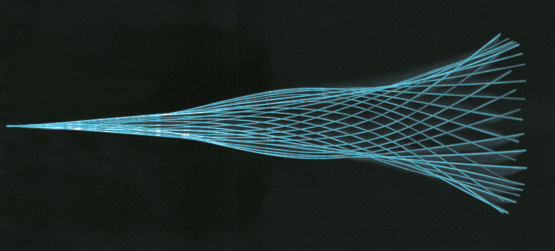
    Everyone has watched a flag flutter in the breeze, but you may not have given much thought to it. One of the earliest scientists to consider the problem was Lord Rayleigh, who wrote an aside on the mathematics of an infinite flag flapping in a paper on jets (pdf). Today researchers consider the problem in terms of fluid-solid interaction; in other words, to study a fluttering flag, you must consider both the properties of the flag – its flexibility, length, elasticity, and so on – and the properties of the fluid – air speed, viscosity, etc. The combination of these factors governs the complicated shapes taken on by a flag. The image above is a composite of several photos of a string (a 1-d flag) flapping in a flow that moves from left to right. By combining photos, the image highlights the envelope of shapes the flag takes and demonstrates at a glance just how far the flag flutters in either direction along its length. (Image credit: C. Eloy)

  • Porous Fingers

    Porous Fingers

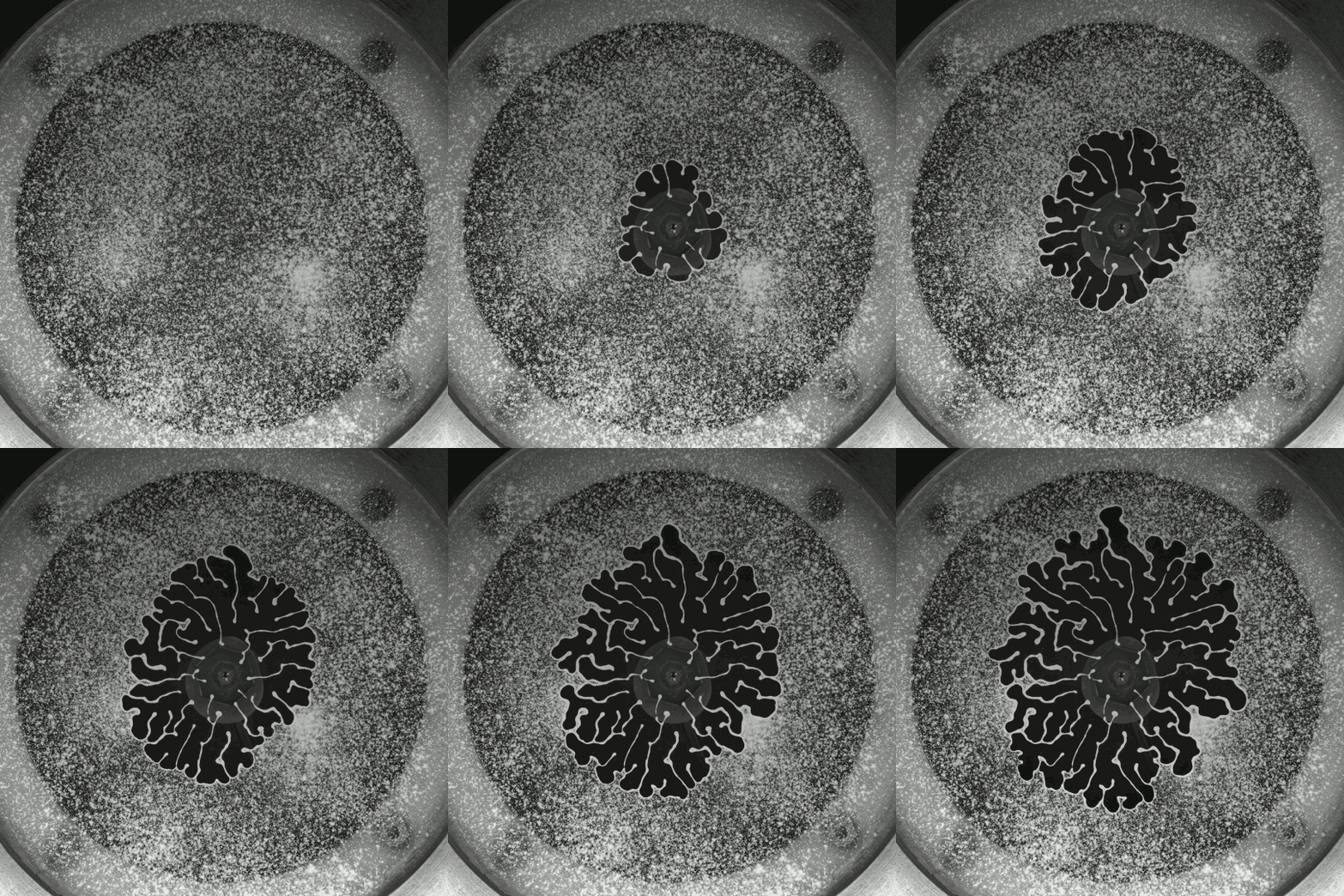
    If you inject a less viscous fluid, like air, into a narrow gap between two glass plates filled with a more viscous fluid, you’ll get a finger-like instability known as the Saffman-Taylor instability. If you invert the situation – injecting something viscous like water into air – the water will simply expand radially; you’ll get no fingers. But that situation doesn’t hold if there are wettable particles in the air-filled gap. Inject water into a particle-strewn air gap and you get a pattern like the one above. In this case, as the water expands, it collects particles on the meniscus between it and the air. Once the concentration of particles on the meniscus is too high for more particles to fit there, the flow starts to branch into fingers. This creates a greater surface area for interface so that more particles can get swept up as the water expands. (Image and research credit: I. Bihi et al., source)

  • The Rose-Window Instability

    The Rose-Window Instability

    This polygonal pattern is known as the rose-window instability. It’s formed between two electrodes – one a needle-like point, the other flat – separated by a layer of oil. The pointed electrode’s voltage ionizes the air nearby, creating a stream of ions that travel toward the flat electrode below. Oil is a poor conductor, however, so the ions build up on its surface until they’re concentrated enough to form a dimple that lets them reach the lower electrode. At higher voltages, the electrical forces driving the ions and the gravitational force trying to flatten the oil reach a balance in the form of the polygonal cell pattern seen above. Smaller cells form near the needle electrode, where the electrical field is strongest and the temperature is highest, as revealed in thermal and schlieren imaging (lower images) that shows a warm stream of gas impacting there. 

    As a final note, I’ll add that the latest in this research comes from a paper by a Pakastani teenager. It’s never too early to start contributing to research! (Image and research credit: M. Niazi; via NYTimes; submitted by Kam-Yung Soh)