Month: May 2017

  • Stabilizing Films

    Stabilizing Films

    Liquids don’t typically survive very long as thin films. If you try to make one from water, gravity drains it away immediately. (Not so in space.) To make a liquid film stick around, we add surfactants like soap. These extra molecules congregate at the surface of the film and provide a stabilizing force to oppose gravity’s drainage. Exactly what that stabilizing force is depends on the surfactant.

    Surfactants that are insoluble are often quite viscous. These molecules distribute themselves across the interface and then they stay. They resist both gravity or even just moving thanks to their high viscosity. That produces a soap film pattern like the one on the right – symmetric and slow to change.

    Other surfactants may be soluble in the film and have no appreciable viscosity themselves. These surfactants constantly move and shift on the interface as surface tension variations occur. When weak spots form, the surfactant molecules shift, via the Marangoni effect, to stabilize the film. This creates a film pattern like the familiar one on the right, with an ever-shifting palette of colors. (Image and research credit: S. Bhamla et al., source; submission by S. Bhamla)
  • Inside Ink Jet Printing

    Inside Ink Jet Printing

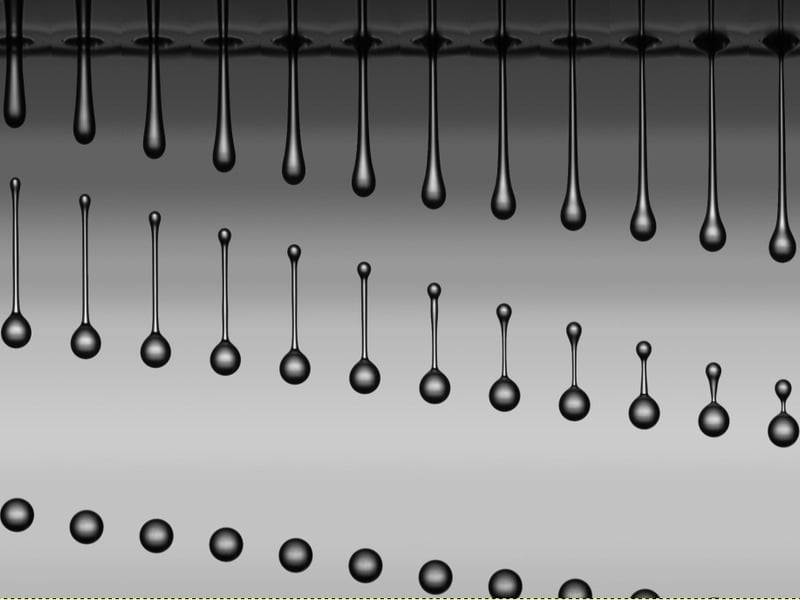
    Inkjet printers produce droplets at an incredible rate. A typical printhead generates droplets that are about 10 picoliters in volume – that is, ten trillionths of a liter – moving at about 4 meters per second. Resolving the formation of those droplets would require ultra-high speed imaging at millions of frames per second. Instead researchers devised an alternative method to capture droplet formation, based on stroboscopic techniques. In this case the strobe is a 7 nanosecond laser pulse (7 billionths of a second) that illuminates a given droplet twice. By doing this for many droplets, the researchers can create a highly detailed time series like the one above, which shows the inkjet breakup and droplet formation. Here each droplet is 23 micrometers wide – about one-third the width of a human hair. (Image credit: A. van der Bos et al., source)

  • Breaking Waves in the Sky

    Breaking Waves in the Sky

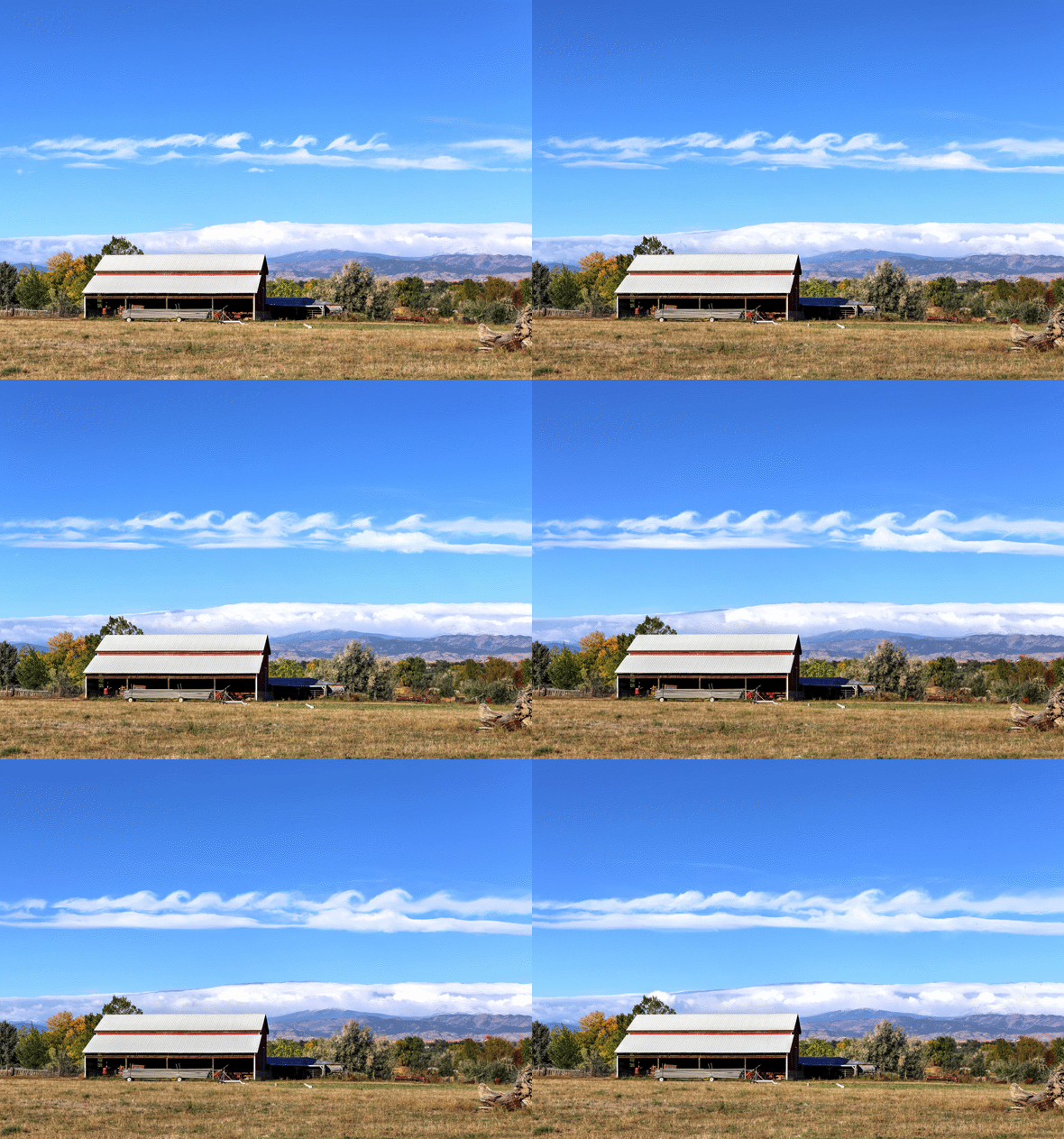
    Under the right atmospheric conditions, clouds can form in a distinctive but short-lived breaking wave pattern known as a Kelvin-Helmholtz cloud. The animation above shows the formation and breakdown of such a cloud over the course of 9 minutes early one morning in Colorado’s Front Range region. Kelvin-Helmholtz instabilities occur when fluid layers with different velocities and/or densities move past one another. Friction between the two layers moving past creates shear and causes the curling rolls seen above.

    In the background, you can also see a foehn wall cloud low to the horizon. This type of cloud forms downwind of the Rocky Mountains after warm, moist Chinook winds are forced up over the mountains, cool, and then condense and sink in the mountains’ wake. (Image credit and submission: J. Straccia, more info)

  • Featured Video Play Icon

    Quad Copter Schlieren

    Schlieren photography is a classic method of flow visualization that utilizes small variations in density (or temperature) to make otherwise unseen air motion visible. Because changing air’s density or temperature changes its index of refraction, variations in either quantity show up as dark and light regions. Here researchers use it to reveal some of the airflow around a small quadcopter, including the vortices that spiral off each propeller and help generate the lift necessary for take-off. The full video includes a couple of neat demos, including what happens when the blades are wet (shown below). In that case, the wingtip vortices are somewhat disrupted by strings of water droplets being flung off the blades by centrifugal force. Beautiful!  (Video and image credit: K. Nolan et al., source; submitted by J. Stafford)

  • A Drip’s Vortex

    A Drip’s Vortex

    Drip food coloring into water and you can often see a torus-shaped vortex ring after the drop’s impact. That vortex rings form during droplet impact has been well known for over a century, but only recently have we begun to understand the process that leads to that vortex ring. Part of the challenge is that the vortex formation is very small and very fast, but recent work with x-ray imaging has allowed experimentalists to finally capture this event.

    When a drop impacts a pool, surface tension draws some of the pool liquid up the sides of the drop. At the same time, the impact causes ripple-like capillary waves down the sides of the drop. This causes pool liquid to penetrate sharply into the drop, triggering the spirals that mark the forming vortex ring. When drops impact with even higher momentum, multiple vortex spirals can form, as seen on the lower right image. The authors observed as many as four rings during an impact. For more, check out the (open access) article.  (Image and research credit: J. Lee et al., source)

  • Featured Video Play Icon

    Ferrofluid Microlandscapes

    Ferrofluids are an ever-fascinating topic. Consisting of ferromagnetic nanoparticles suspended in a carrier fluid, ferrofluids are known for their bizarre behaviors in the presence of a magnetic field, like their tendency to form pointed peaks reminiscent of Bart Simpson’s hair. In a new Concept Zero video, photographer Linden Gledhill creates fascinating micro-landscapes using ferrofluids suspended in solvents. Driven by magnetic fields, the ferrofluids take on many shapes that change as the solvent and eventually the ferrofluid’s carrier fluid evaporate. Check out the full video above and, if you’re looking for some new decorations for your walls, you can check out the project’s fine art gallery.   (Video and image credit: L. Gledhill and Concept Zero; submitted by L. Gledhill)

  • Self-Propelled Hovercraft

    Self-Propelled Hovercraft

    When placed on an extremely hot substrate, some drops levitate and can be propelled over specially textured surfaces. Inspired by this work, researchers are using similar principles to explore manipulation of levitating plates using surface texture. Their apparatus consists of a semi-porous, grooved surface that ejects air upward to levitate Plexiglas objects – think air hockey table with grooves. With enough airflow, the Plexiglas levitates. The grooves force air in a particular direction – in the case of the herringbone pattern, this is in the direction of opening – and, as the air moves, it drags its Plexiglas hovercraft along. As shown in the second animation, grooves can do more than move the glass linearly; with patterns offset by 90-degrees, they can make the hovercraft rotate.

    Here’s an interesting next step for anyone out there with an air hockey table and a 3D printer: does the directional manipulation work if the grooves are on the object and not the table? In other words, can you create an air hockey puck that preferentially goes to your opponent’s goal? (Image and resource credit: D. Soto et al., source)

  • Superhydrophobic Splashes

    Superhydrophobic Splashes

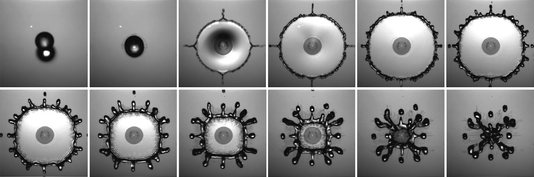
    Superhydrophobic surfaces have a complicated microscale structure that changes how water interacts with them, like the hairs on a lotus leaf or the scales of a butterfly’s wing. The photo above shows snapshots at each millisecond as a water drop hits a superhydrophobic surface covered in rows of 18 micron-tall posts. The drop hits with enough speed to drive some water into the space between posts, as shown by the dark area near the center of the splash. As the rest of the droplet spreads, four microjets form along the directions of the micropost array. Those jets remain apparent until the drop reaches its maximum radius and starts to recoil. The rectangular shape of the post array affects how the water pulls away from the surface, or depins, causing the round droplet to instead take on a square-like shape as it pulls back. (Image credit: M. Reyssat et al.)

  • Blue Man Group in Slow Mo

    Blue Man Group in Slow Mo

    In their latest video, the Slow Mo Guys team up with the Blue Man Group for some high-speed hijinks, some of which make for great fluidsy visuals. Their first experiment involves dropping a bowling ball on gelatin. The gelatin goes through some massive deformation but comes out remarkably unscathed. Gelatin is what is known as a colloid and essentially consists of water trapped in a matrix of protein molecules. This gives it both solid and liquid-like properties, which means that the energy the bowling ball’s impact imparts can be dissipated through liquid-like waves ricocheting through the gelatin before the elasticity of the protein matrix allows it to reform in its original shape.

    The video ends with buckets of paint flung at Dan. The paints form beautiful splash sheets that expand and thin until surface tension can no longer hold them together. Holes form in the sheet and eat outward until the paint forms thin ligaments and catenaries. As those continue to stretch, surface tension drives the paint to break into droplets, though that break-up may be countered to some extent by any viscoelastic properties of the paint. (Image and video credit: The Slow Mo Guys + Blue Man Group, source)

  • Featured Video Play Icon

    Sky Glow

    This short but spectacular timelapse video shows the Grand Canyon filled with fog. This phenomenon, known as a temperature inversion, occurs when a warm layer of air traps cold, moist air near the ground. As the inversion develops in the video, you can see wisps of clouds popping up in the canyon, seemingly out of nowhere, as moisture evaporated from the surface condenses in the cool air. Once fog fills the canyon, it flows and laps against the canyon’s sides, much like waves on the ocean. In fact, the physics here is quite similar, just at a much slower speed. (Video and image credit: H. Mehmedinovic / SKYGLOWPROJECT; via Gizmodo; submitted by Ian S.)