Ice is slippery. This is a fundamental fact we humans have dealt with so often that we rarely take the time to ask why. Other solids aren’t inherently slippery, so what is it that makes ice so? Remarkably, scientists only began to ask this question and propose theories within the past couple hundred years. One common suggestion is that the high pressure of an ice skate on ice locally melts the ice, creating a thin liquid layer a skater glides across. But this does not explain why ice is slippery for shoes or tires, nor why it’s possible to ice skate at more than a few degrees below freezing. Several other effects may be in play, such as frictional heating or the peculiar molecular forces between water molecules. Current research suggests that ice has a thin liquid layer tens or hundreds of nanometers thick that causes its slippery nature. For a great review of the subject, see Robert Rosenberg’s Physics Today article. (Video credit: SciShow)
Year: 2016

Paint Spilling Physics
There is a remarkable amount of physics contained in art. In this video, scientists from The Splash Lab explore some of the physics involved in pouring paint atop a rectangular post. The spreading paint transforms its shape repeatedly, and, at the corners of the post, it preserves a tiny history of all the colors poured. Paint sliding down the sides shifts from a thin sheet to a thicker jet that deposits color in waves. For tall posts, the distance the paint falls is long enough for instabilities to set in, producing a paint puddle that’s riddled with curves and waves between each color of paint. It’s a lovely reminder of the complexity inherent even within a simple action. (Video credit: R. Hurd et al.)

Erie Waves


Photographer Dave Sandford braved the cold and turbulent waters of Lake Erie in late fall to capture some remarkable wave action. Like on the ocean, waves in the Great Lakes are largely driven by winds, but lakes don’t develop the constant set of rolling waves that oceans do. Instead their waves are more erratic and unpredictable. Sandford focused on capturing the moment when wind-driven waves coming into shore collided with waves rebounding from piers or rocks along the shore. The results are waves that, through Sandford’s lens, look like exploding mountainsides. Such energetic waves mix sediment and nutrients in the lake, and the spray of droplets can even loft aerosols and pollutants from the water into the atmosphere. (Photo credit: D. Sandford; via Flow Vis)

Superhydrophobic Coatings


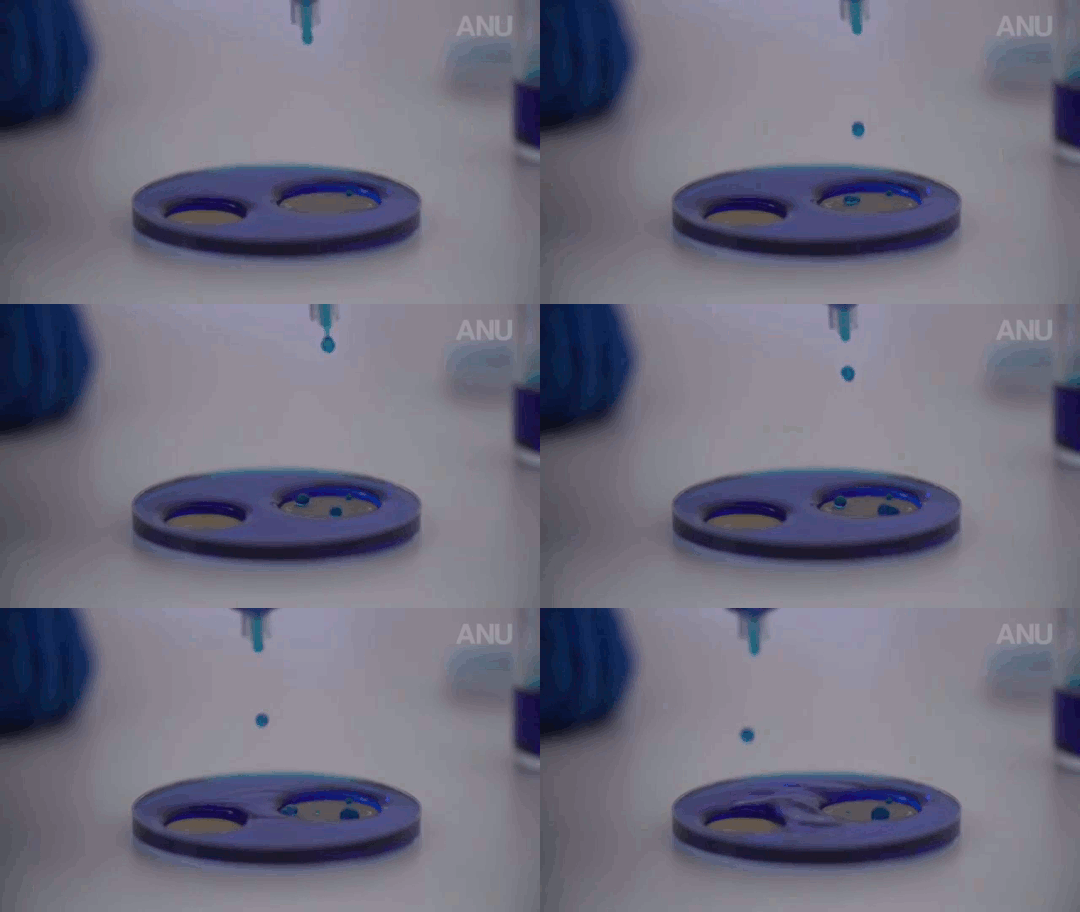
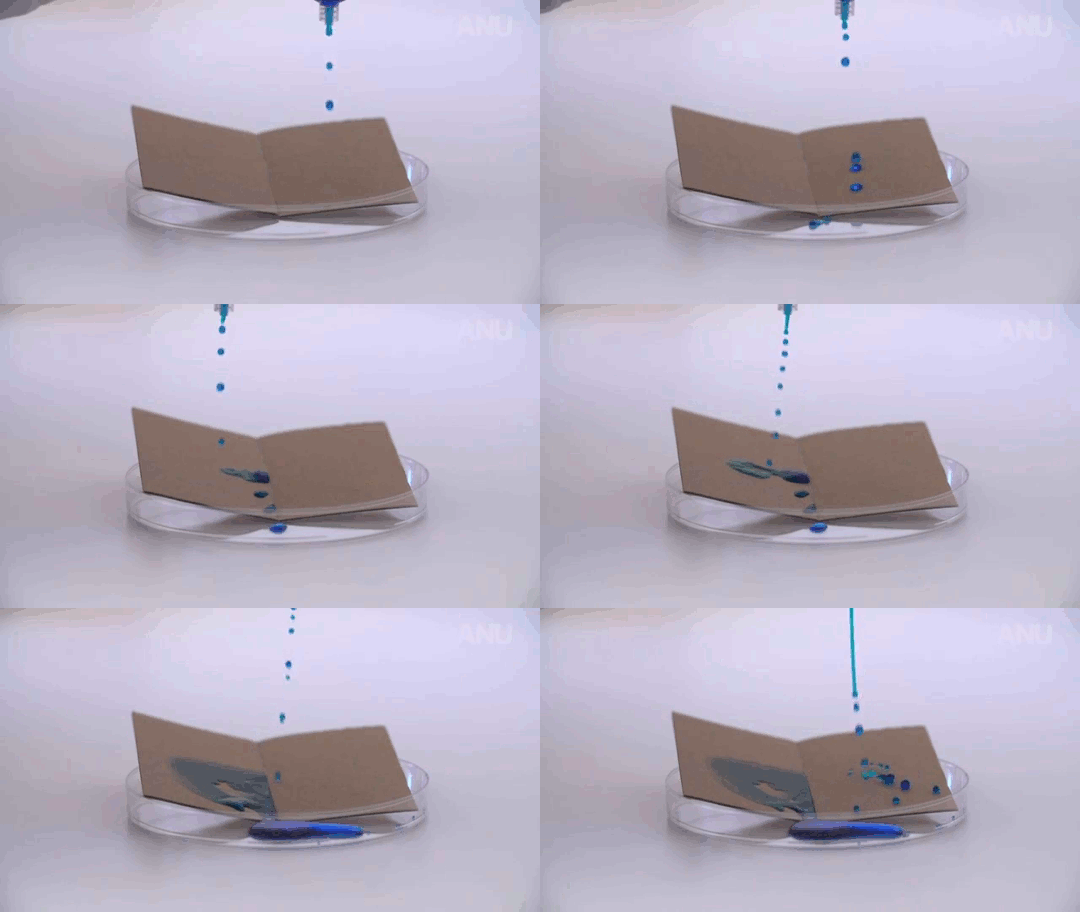
Superhydrophobic–or water repellent–materials are much sought after. Their remarkable ability to shed water is actually mechanical in nature–not chemical. Surfaces with a highly textured microstructure, like a lotus leaf or a butterfly wing, shed water naturally because air trapped between the high points prevents the water from contacting most of the solid surface. The result is that a drop sitting on the surface will have a very high contact angle and be nearly spherical. Instead of wetting the surface and spreading out, it can slide right off, as seen in the animations above. Here researchers have treated the coins and the right half of the cardboard with a spray-on coating that creates superhydrophobic microscale roughness. Similar coatings are commercially available, but such coatings are delicate and lose their hydrophobicity over time as the microstructure breaks down. (Image credits: Australian National University, source)
Growing Snowflakes
Watching a snowflake grow seems almost magical–the six-sided shape, the symmetry, the way every arm of it grows simultaneously. But it’s science that guides the snowflake, not magic. Snowflakes are ice crystals; their six-sided shape comes from how water molecules fit together. The elaborate structures and branches in a snowflake are the result of the exact temperature and humidity conditions when that part of the snowflake formed. The crystals look symmetric and seem to grow identical arms simultaneously because the temperature and humidity conditions are the same around the tiny forming crystals. And the old adage that no two snowflakes are alike doesn’t hold either. If you can control the conditions well enough, you can grow identical-twin snowflakes! (Video credit: K. Libbrecht)

When Jets Collide
Two liquids that collide don’t always coalesce. The image above shows two jets of silicone oil colliding. On the left, the jets collide and bounce off one another. On the right, at a slightly higher flow rate, the two jets coalesce. This bouncing, or noncoalescence, observed at lower speeds is due to an incredibly thin layer of air separating the two jets. This air layer is constantly being replenished by air that gets dragged along by the flowing oil. But if the oil flows too quickly, that air layer becomes unstable–in the same way that a droplet that falls too quickly will splash on impact. When the separating air layer becomes unstable and breaks down, the jets collide and merge. (Image credit: N. Wadhwa et al., pdf)
Simulating the Earth
Computational fluid dynamics and supercomputing are increasingly powerful tools for tracking and understanding the complex dynamics of our planet. The videos above and below are NASA visualizations of carbon dioxide in Earth’s atmosphere over the course of a full year. They are constructed by taking real-world measurements of atmospheric conditions and carbon emissions and feeding them into a computational model that simulates the physics of our planet’s oceans and atmosphere. The result is a visualization of where and how carbon dioxide moves around our planet.
There are distinctive patterns that emerge in a visualization like this. Because the Northern Hemisphere contains more landmass and more countries emitting carbon, it contains the highest concentrations of carbon dioxide, but winds move those emissions far from their source. As seasons change and plants begin photosynthesizing in the Northern Hemisphere, concentrations of carbon dioxide decrease as plants take it up. When the seasons change again, that carbon is re-released.
These visualizations underscore the fact that these carbon emissions impact everyone on our planet–nature does not recognize political borders–and so we share a joint responsibility in whatever actions we take. (Video credit: NASA Goddard; h/t to Chris for the second vid)

Falling Atop Sheets


A sphere falling into water is a classic problem in fluid dynamics, but scientists are becoming increasingly interested in what happens when they introduce new dimensions to the problem. Here researchers float an extremely thin elastic sheet atop water and study how it wrinkles when a steel sphere impacts it. Despite its elasticity, the sheet does not stretch when the ball hits. Instead it compresses and forms wrinkles. Some of those wrinkles deepen into folds, but the wrinkle pattern that forms right at impact determines the way the film will bunch up. If the ball is heavy enough, it will drag the sheet entirely underwater; if not, the sheet will catch the ball and continue floating. Scientists are interested in these interactions between liquids and thin solids because sheets could be used to encapsulate liquids for applications like targeted drug delivery. (Image credit: M. Inizan et al., source)

Resonating with the Windows Down
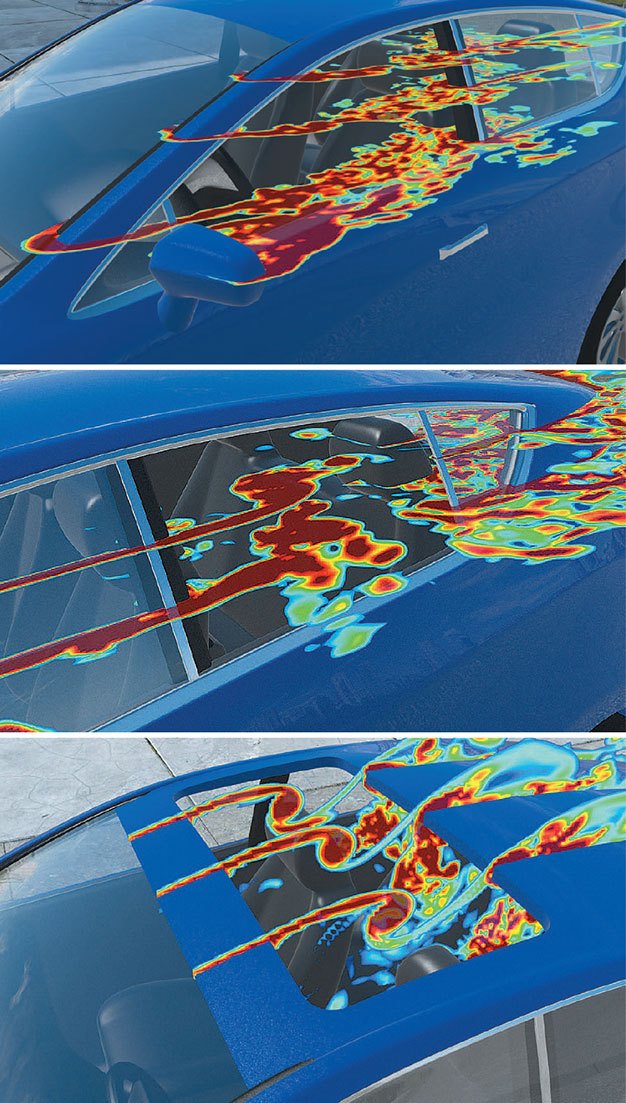
Ever roll down your window a bit while driving and immediately hear a terrible, rhythmic noise? That awful whum-whum-whum is–oddly enough–an example of the same physics that allows you to make an open bottle whistle by blowing over it. Fluid dynamicists call it Helmholtz resonance. Air flowing over the bottle neck or around the car makes the air inside the container vibrate with a frequency that depends on the bottle or car’s characteristics. That vibration generates noise that we hear as a hum or whistle for a bottle or a lower frequency whum-whum for a car window.
The images above show flow past different open windows on a car. Air flow remains relatively steady past the side-view mirror and front window of a modern car, so the noise from opening the front window is not usually too bad. But flow separation and reconnection near the rear window of a car creates very unsteady airflow there which exacerbates this resonance issue. This is why lowering the rear window usually causes more noise. Fortunately, the solution is relatively simple: open more than one window and it disrupts the resonance! (Image credit: Car and Driver; submitted by Simon H.)
Visualizing Flow with Snowfall
One of the challenges in engineering and operating wind turbines is that full-scale turbines rarely behave as predicted in smaller-scale laboratory experiments and simulations. One way to reconcile these differences (and discover what our experiments and simulations are missing) is to take the experiments out into the field. One research group has done this by using snowfall to visualize the flow around wind turbines. In this video, they share some of their observations, which include interactions of tip vortices with one another and with the vortex from the tower. My favorite part starts around 1:50 where you can observe tip vortices leap-frogging one another behind the wind turbine! (Video credit: Y. Liu et al.)