Month: November 2015

  • Ignition

    Ignition

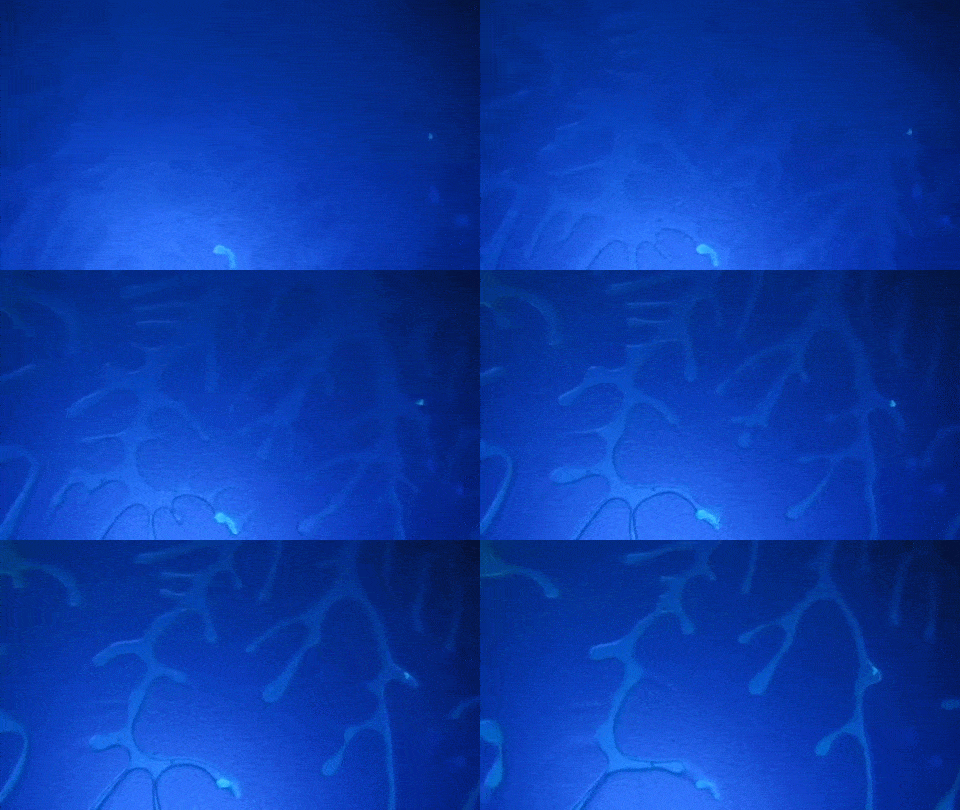
    Shown here are the first instants after a bubble full of methane gas is ignited via laser. Using the schlieren optical method and a high-speed camera, scientists recorded the deflagration at 10,000 frames per second. Because schlieren imaging is very sensitive to small changes in density, we see not only the expanding flame front as the methane ignites but also the subtle waviness of the methane expanding into the surrounding air as the bubble bursts. (For comparison, check out what bursting a water balloon looks like at high-speed.) Be sure to head over to ScienceTake for the full schlieren video, and also check out this award-winning video of a match lighting made by the same researcher.  (Image credit: V. Miller et. al.; full video: The New York Times; submitted by Rebecca M.)

    ETA: An earlier version of this post mistakenly said the demo used a balloon full of methane rather than a bubble. Thanks to jump-first-think-later for the correction.

  • Featured Video Play Icon

    The Droplet Slide

    One of the joys of science is the sense of discovery that can come even from looking at something seemingly simple. Take, for example, a water droplet sitting on a plate. If you slowly tilt the plate, the droplet’s shape will shift until a critical angle where it starts sliding down the plate. But what happens to two initially different droplets? As this video shows, tilting two droplets of initially different shapes and returning them to horizontal causes the droplets to assume the same shape. There’s a universal behavior at work here–like nature has a kind of reset button that makes gravity and surface tension work together such that a droplet will assume a preferred shape. For an experimentalist, it’s certainly a handy way to create repeatable experiments! (Video credit: M. Musterd et al.)

  • Viscous Fingers

    Viscous Fingers

    Take a viscous fluid, like laundry detergent, and sandwich it between two plates of glass. Fluid dynamicists call this set-up a Hele-Shaw cell. If you then inject a less viscous fluid, like air, between the plates–or if you try to pry them apart–you’ll see a distinctive pattern of dendritic fingers form. This viscous fingering, also known as the Saffman-Taylor instability, occurs because the interface between the two fluids is unstable. Invert the problem, though–inject a more viscous fluid into a less viscous one–and no special shapes will form because the interface will remain stable. (Image credit: Random Walk Studios, source)

  • Featured Video Play Icon

    Cream in Coffee

    Pouring cream in coffee produces some of the most mesmerizing displays of fluid dynamics. The density difference between the two fluids sets up Rayleigh-Taylor instabilities that mushroom out and help create the turbulence that eventually mixes the drink. You can learn more about Rayleigh-Taylor instabilities in this FYFD video, and, if you need more awesome caffeine-filled examples of fluids, check out the coffee dynamics blog. (Video credit: S. Geraldine and L. Kang)

  • Waves Over the Rockies

    Waves Over the Rockies

    These spectacular wave-like clouds are the result of the Kelvin-Helmholtz instability. When two layers of air move past one another at different velocities, an unstable shear layer forms at their interface. Disturbances in this shear layer grow exponentially, creating these short-lived overturning waves that quickly turn turbulent. The strong resemblance of these clouds to breaking ocean waves is no coincidence–the Kelvin-Helmholtz instability occurring between the wind and water is what generates many ocean waves. Kelvin-Helmholtz patterns are also common on other planets, like Jupiter, Saturn, and Mars. (Image credit: Breckenridge Resort; submitted by jshoer)