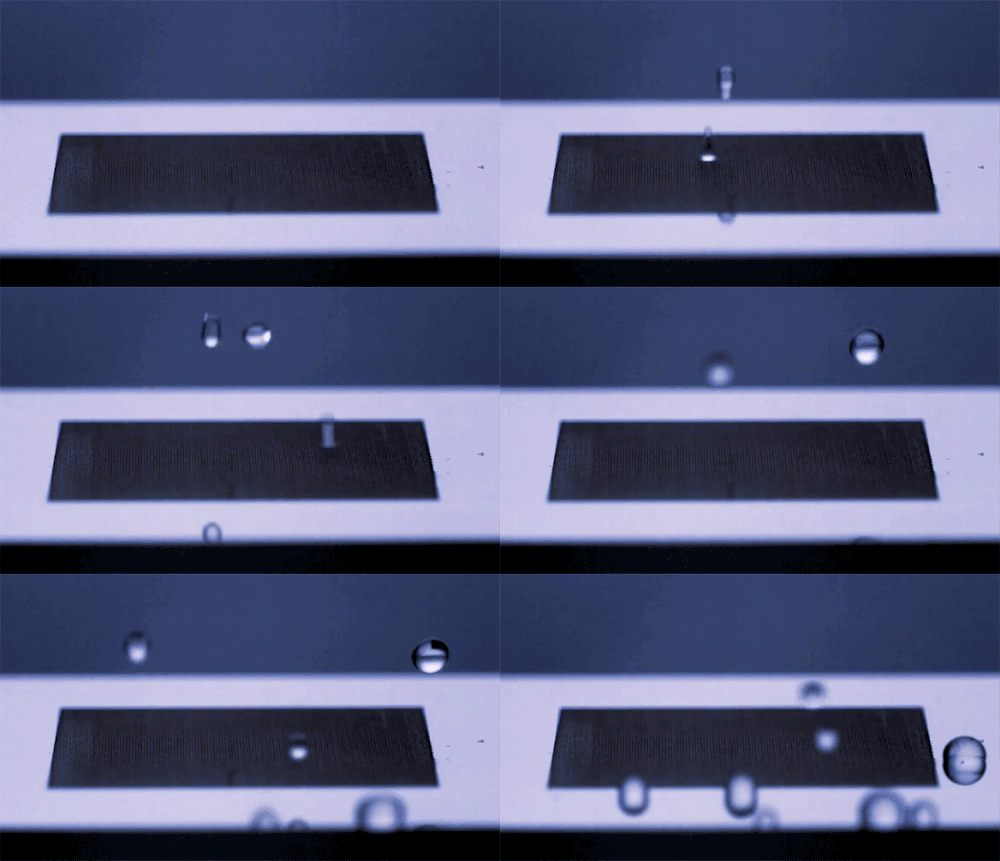
Many gases are stored in liquid form at high pressures. This video takes a look at tetrafluoroethane, better known as the substance in compressed air cans used for dusting electronics. At atmospheric pressure, tetrafluoroethane boils at about -26 degrees Celsius, but in an air duster, at around 7 atmospheres of pressure, it is a liquid. As demonstrated in the video, releasing the pressure causes the liquid to boil off. Even exposed to atmospheric pressure, though, the liquid doesn’t boil off instantly – the act of boiling requires thermal energy and, without a sufficient source of heat, the liquid consumes its own heat until it drops to a temperature below the boiling point. As it warms up from the surrounding air, it will start boiling again. I don’t recommend trying to open up an air duster can at home, though. High-pressure containers can be dangerous to open up, and tetrafluoroethane is now being phased out in some parts of the world due to its high global warming potential. (Video credit: N. Moore)
Month: January 2015

Below a Surfer’s Wave
From below a plunging breaking wave–the classic surfer’s wave–looks like a giant vortex tube. Smaller rib vortices, the rings around the main vortex in the photo above, can form where there are variations along the breaking wave. As the wave rolls on, it stretches the vorticity variations along the wave’s span. When stretched, vortices spin up and intensify; this is a result of conservation of angular momentum. Check out more amazing photos of waves in Ray Collins’ portfolio. (Photo credit: R. Collins; via The Inertia)

Melt Fracture in Plastics
Liquid plastics are often extruded–or pressure-driven through a die–during manufacturing. Early on manufacturers discovered that they could only extrude plastic at low flow rates, otherwise the plastic’s surface begins undulating in what became known as melt fracture. These corrugations result from the viscoelasticity of the plastic. Viscoelastic fluids have a response to deformation that is part viscous–like any fluid–and part elastic. At low flow rates, viscous forces dominate in the plastic, but at higher speeds, elasticity increases and the polymers in the plastic get stretched along the direction of flow. In response to this stretching, the polymers exert normal stresses, much like a rubber band that’s being stretched. Because this force acts only along the flow direction, different parts of the fluid are experiencing different forces, and these internal stresses cause the plastic to change shape. (Image credit: D. Bonn et al.)

Laser-Made Superhydrophobics

Superhydrophobic surfaces are so repellent to water that liquids often cannot wet them. Today these surfaces are usually created with chemical coatings or deliberate manufacturing to create micro- and nanoscale structures that trap air between the drop and the surface in order to prevent adhesion. Researchers recently announced they’ve made metals superhydrophobic with laser treatments. The process is still time-consuming, but they hope it can be scaled up for wider applications. Because drops bounce so readily off the treated surfaces, it takes very little water to clean them, which may be especially useful for sanitation purposes in the developing world. Superhydrophobic materials are also good for preventing icing on aircraft wings. To learn more about the research, check out the University of Rochester’s video explanations. (Image credit: C. Guo et al., source videos 1,2; submitted by entropy-perturbation and buckitdrop)

Lava Coiling
It’s tough to get much closer to flowing lava than this video of freshly forming coastline in Hawaii. Lava is complex fluid, with viscous properties that vary significantly with chemical composition, temperature and deformation. Here, despite being very viscous, the lava flows quickly–perhaps even turbulently. Several times it forms a heap and even shows signs of the rope-coiling instability familiar from viscous fluids like honey. All in all, it’s quite mesmerizing. (Video credit: K. Singson; submitted by Stuart B.)
How Rain Gets Its Smell
Light rain after a dry spell often produces a distinctive earthy scent called petrichor that is associated with plant oils and bacteria products. How these chemicals get into the air has been unclear, but new research suggests that the mechanism may come from the rain itself. When water falls on a porous surface like soil, tiny air bubbles get trapped beneath the drop. These bubbles rise rapidly due to buoyancy and, upon reaching the surface, burst and release tiny droplets known as aerosols. Depending on the surface properties and the drop’s impact speed, a single drop can produce a cloud of aerosol droplets. The research team is now investigating how readily bacteria or pathogens in the soil can spread through this mechanism. Other human-focused research has already shown that these tiny aerosol droplets can persist in the air for remarkably long periods and may help spread diseases. (Video credit: Massachusetts Institute of Technology; research credit: Y. Joung and C. Buie; submitted by Daniel B and entropy-perturbation)
Swimming Through Sand
Shovel-nosed snakes and sandfish lizards both swim through granular materials like sand. Researchers at Georgia Tech used x-rays to observe their subsurface motions. Despite their different shapes, the long, slender snake and the shorter, wider lizard both move under the sand by projecting traveling waves along their bodies. The snake’s long, skinny body allows it to have more bends along its length, which increases its transport efficiency because it allows the snake to move mostly through the tunnel created by its head’s passage. In contrast, the sandfish’s motions fluidize the sand around it, enabling it to swim. Although the snake is faster, both animals have optimized their motions for fast, low-energy transit according to their body type. (Video credit: Georgia Tech; research credit: S. Sharpe et al.; via io9)

“Heavy Metals”


Photographer Alberto Seveso’s “Heavy Metals” series builds on his previous works capturing fluid dynamics. By dropping mixtures of ink, liquids, and metallic powder through different fluids, he creates ethereal, billowing forms that turn the processes of diffusion and turbulent mixing into something one could almost touch. Be sure to check out the rest of the series and his online portfolio for more examples. (Photo credits: A. Seveso; via Colossal; submitted by jshoer and @catnogood)
Fire-Breathing
In this high-speed video, the Slow Mo Guys demonstrate fire-breathing. Rather than using a liquid fuel like kerosene, they utilize cornstarch, which is both easily flammable and non-volatile thanks to its powdered form. Blowing out the cornstarch creates a turbulent jet of cornstarch and air. Combine that with a combustion source, and the cornstarch quickly deflagrates, meaning that the flame propagates via heat transfer. When neighboring regions of cornstarch become hot enough, they ignite and the flame front expands. You can observe this in the flame growth shown in the video; just after ignition the cornstarch jet is much wider than the fire and it takes some time for the flames to catch up with the jet. Although a liquid-fueled fireball operates by the same principles, it can look rather different. For comparison, check out this high-speed video of a WD-40 fireball. And, hopefully it goes without saying, but don’t try this stuff at home. (Video credit: The Slow Mo Guys)

Hand Dryers and Atomization
Some newer electric hand dryers, like the Dyson Airblade, use jets of high-speed air to dry hands faster than traditional models. Much of their effectiveness comes from the rapid atomization–or break-up into tiny droplets–of water on one’s hands. This is demonstrated in the animation above, which comes from a high-speed video of a water drop falling through the jets of a homemade dryer. Breaking up the water quickly disperses the microdroplets but it also speeds up evaporation by greatly increasing the exposed surface area of the water. This is similar to how you can get instant snow from throwing boiling water if it’s cold enough outside. (Image credit: tesla500, source video; submitted by Nick)