Month: February 2014

  • Featured Video Play Icon

    Sochi 2014: Making Snow

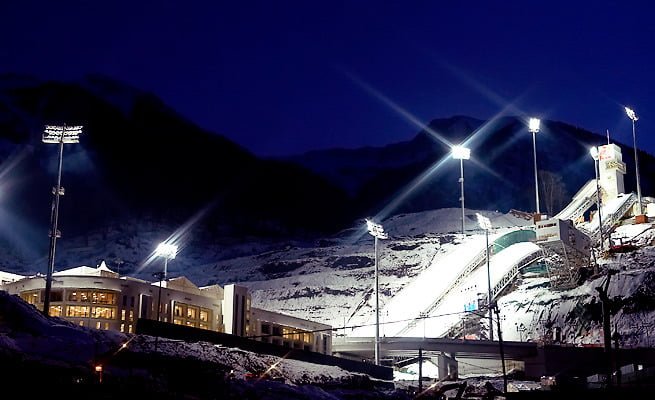
    Much attention ahead of the Sochi Winter Olympics has been dedicated to the question of how this subtropical resort town would provide and maintain adequate snow cover for the Games. Officials promised a combination of natural snow, snow transported from elsewhere, snow stored from the previous year, and, of course, artificial snow. These days many ski resorts rely heavily on snow guns producing artificial snow. There are two main types of snow gun–those which use compressed air and those which have an electrically-driven fan–but the principles behind each are the same. The snow guns provide a continuous spray of air and water, atomizing the water into tiny droplets which freeze rapidly. The effectiveness of snow guns depends on both the temperature and humidity of the surrounding air. With sufficiently dry air, artificial snow can be made even several degrees above freezing. Sochi itself is relatively humid (72% on average for February), but most of the outdoor events are held in Krasnaya Polyana, higher in the mountains where temperatures are typically much lower and artificial snow can be manufactured. That said, temperatures have reached as high as 15 degrees Celsius during the Games so far, and athletes have complained about the changing snow conditions in several events. (Video credit: On The Snow)

    FYFD is celebrating #Sochi2014 with a look at the fluid dynamics of the Winter Games. Check out our previous posts, including how lugers slide fast, how wind affects ski jumpers, and why ice is slippery.

  • Sochi 2014: Speedskating Redux

    Sochi 2014: Speedskating Redux

    Since we wrote about the US team’s speedskating suits last week, they have become the subject of major controversy. After six events, the US team had not placed higher than seventh despite strong World Cup results during the autumn. The Wall Street Journal reported that three people familiar with the team suggested a design flaw:

    Vents on back of the suit, designed to allow heat to escape, are also allowing air to enter and create drag that keeps skaters from staying in the low position they need to achieve maximum speed, these people said. One skater said team members felt they were fighting the suit to maintain correct form. #

    To address this, some members had seamstresses sew fabric over the vent. The upper left image shows the original suit and the one on the right shows a team member in a modified suit. The change made no apparent impact on the skaters’ finish. The US team has no gone so far as to get a special dispensation to switch back to their older suits but still the podium eluded skaters in Saturday’s events. 

    Now, to be clear, I have not seen any data on the development of Under Armour’s suits beyond the public coverage, and I have no connections to any of the parties involved. However, given the extensive nature of the wind tunnel development that went into these suits, I would be exceptionally surprised if there was a design flaw capable of slowing skaters down by nearly 1 second over 1000 meters. It would require a major flaw in the testing design and methodology to overlook such a substantial drag effect.

    At the same time, there are other factors that may be affecting the US team adversely. Sochi’s races are taking place at low altitudes, where the air is denser and drag is greater. This does affect all competitors, but it is worth noting that many of the US speedskaters train at altitude in Salt Lake City and that the entire team had their training camp at high altitude in Italy prior to Sochi.  Another factor is the ice conditions. Salt Lake has what is considered fast ice that permits longer glides between each step, whereas Sochi has soft ice, which requires a faster tempo and does not glide as easily. (Image credits: Under Armour, Getty Images, P. Semansky/AP)

  • Featured Video Play Icon

    Happy Valentine’s Day!

    What can you do with a 7 x 7 grid of miniature vortex cannons? Why, make floating vortex hearts, of course. Happy Valentine’s Day from FYFD! (Video credit: D. Schulze/bitsbeauty; via Colossal)

  • Sochi 2014: Ski Jump, Part 2

    Sochi 2014: Ski Jump, Part 2

    Yesterday we talked about the technique ski jumpers use to fly farther. Generating lift without too much drag is the key to a good jump. But jumpers are subject to ever-changing wind conditions, and those can help or hurt them. Unlike most sports, in ski jumping a headwind is desirable. This is because the added relative air velocity increases the jumper’s lift and helps them fly farther. A tailwind, on the other hand, saps their speed. Since 2009, ski jumping competitions have included a wind compensation factor that tries to account for these effects. Wind velocity is measured at five points along the jumper’s flight path and the tangential (i.e. head- or tailwind) components are weighted and averaged. The weighting factors seem to be individual to each hill – not all hills are built with the same profile. This average tangential wind speed is then a linear variable in an equation for wind factor. The goal of the wind factor is as much to make the competition run smoothly as it is to increase fairness. The trouble is that the wind speed effect is non-linear; in other words, a headwind does not help a jumper as much as a tailwind can hurt them. In one simulation study, researchers found a 3 m/s headwind carried jumpers 17.4 m further while a tailwind of the same magnitude shortened the jump by 29.1 m. The wind differences in competition may not be as drastic, but truly evening the playing field may require a more complicated compensation system. (Photo credit: B. Martin/Sports Illustrated)

    FYFD is celebrating the Games with a look at fluid dynamics in the Winter Olympics. Check out our previous posts on the aerodynamics of speed skatingwhy ice is slippery and how lugers slide so fast.

  • Sochi 2014: Ski Jump

    Sochi 2014: Ski Jump

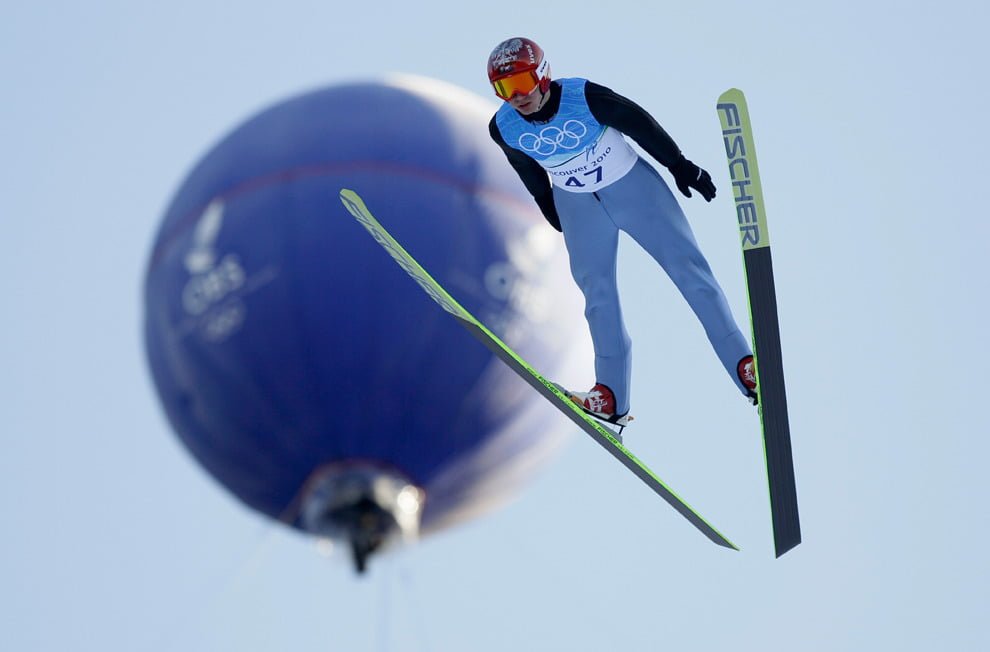
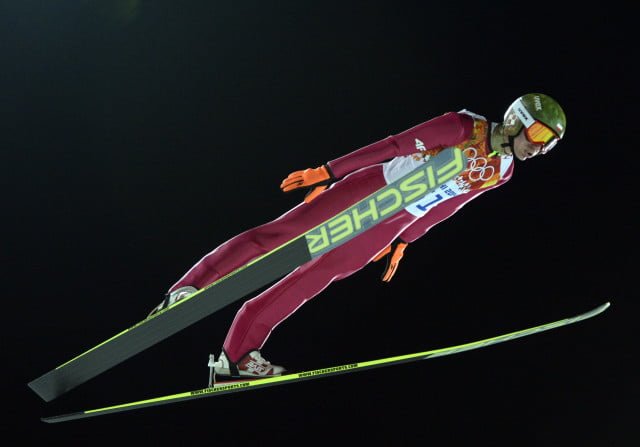
    Great ski jumpers are masters of aerodynamics. There are four main parts to a jump: the in-run, take-off, flight, and landing. An athlete’s aerodynamics are most vital in the in-run and, naturally, the flight. During the in-run, the athlete is trying to gain as much speed as possible, so she tucks down and pulls her arms behind her back to streamline her body and keep her frontal area as small as possible. This limits her drag so that she can maximize her speed at take-off. Once in the air, though, the jumpers act like gliders. In flight, there are three forces acting on the the jumper: gravity, lift, and drag. Gravity pulls the jumper down, and drag tends to push her backwards up the hill, but lift, by counteracting gravity, helps keep jumpers aloft for a greater distance. To maximize lift, a jumper angles her skis outward in a V and holds her arms out from her sides. This configuration turns the jumper’s body and skis into a wing. The best jumpers will tweak their positions with training jumps and wind tunnel time to maximize their lift while minimizing their drag in flight and on the in-run. Technique is critical in ski jumping, but conditions play a significant role as well. Tomorrow’s post will discuss why and how judges account for changing conditions. (Photo credits: L. Baron/Bongarts/Getty Images; D. Lovetsky/AP; E. Bolte/USA Today)

    FYFD is celebrating the Games with a look at fluid dynamics in the Winter Olympics. Check out our previous posts on the aerodynamics of speed skatingwhy ice is slippery and how lugers slide so fast.

  • Sochi 2014: Speedskating Suits

    Sochi 2014: Speedskating Suits

    Long track speed skating is a race against the clock. Skaters reach speeds of roughly 50 kph, so drag has a significant impact. This is why skaters stay bent and spend straightaways–their fastest segments on the ice–with their arms pulled behind them. It’s also why their speedsuits have hoods to cover their hair. This year the U.S. speed skaters are wearing special suits designed by Under Armour and Lockheed Martin especially for their aerodynamics. The suits feature a mixture of fabrics including raised surface features on the hood and forearms. These bumps are designed to trip turbulent flow in these regions. It seems counterintuitive, but drag is actually lower for a turbulent boundary layer than a laminar one at the right Reynolds number range. This is because turbulent boundary layers are better at staying attached to non-streamlined bodies. The longer flow stays attached to the skater, the smaller the pressure difference between the air in front of the skater and the air in his wake. The suit’s seams and even its hot-rod-like flames were placed with this effect in mind. Only time will tell whether the suits really give skaters a competitive edge, but since Sochi’s low-altitude increases drag on skaters, they will appreciate some extra speed. For more, NSF has an inside look at the suit’s development. (Photo credits: Under Armour)

    FYFD is exploring the fluid dynamics of the Winter Olympics. Check out previous posts on how lugers slide fast and why ice is slippery, and be sure to stay tuned for more!

  • Sochi 2014: Luge

    Sochi 2014: Luge

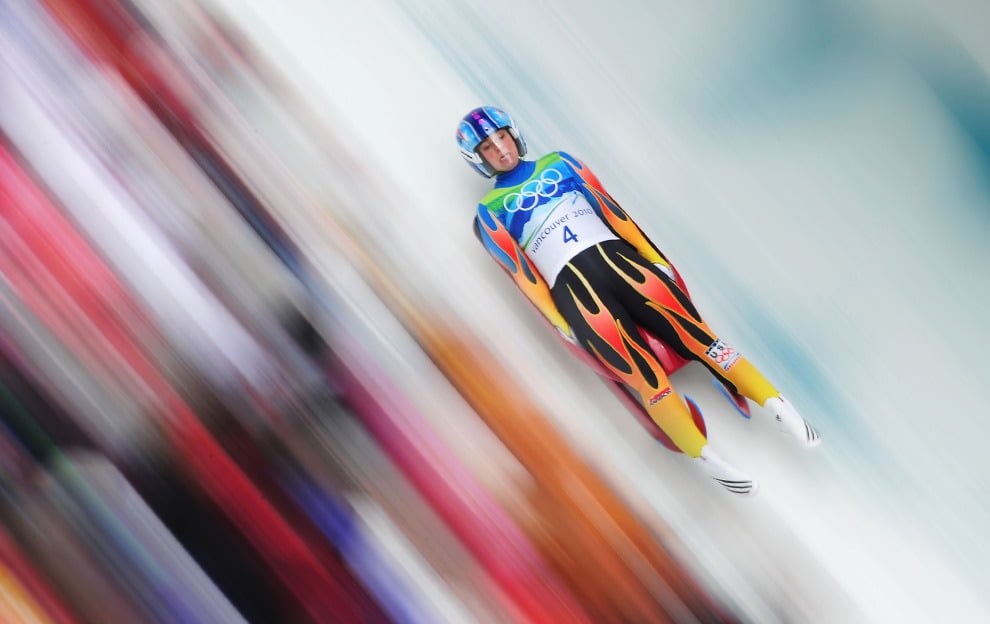
    Like athletes in many of the gravity sports in the Winter Olympics, lugers want to be as aerodynamic as possible to minimize their drag. Once a luger has started sliding, only gravity can increase their speed – every other force, from friction to drag, pulls away valuable time. Luge sleds are built on sharp runners and athletes slide feet-first in a position much more streamlined than the head-first position of skeleton. Both contribute to the much higher speeds in luge – up to 140 kph (87 mph). Luge is also the only sliding sport measured down to thousandths of a second, so every gram of drag* makes a difference. Lugers keep their heads pulled back and wear full helmets to keep the air flow consistent and attached as much as possible. It is also typical for them to spend time in the wind tunnel, testing their sled’s aerodynamics, adjusting their position, and even testing their suits. (Photo credit: S. Botterill)

    * For those wondering, yes, drag is a force and a gram is a unit of mass, not force. However, it is not unusual when testing athletes in wind tunnels to compare drag between configurations in terms of grams.

    FYFD is celebrating the Games with a series on fluid dynamics in the Winter Olympics. Stay tuned for more!

  • Sochi 2014: Why is Ice Slippery?

    Sochi 2014: Why is Ice Slippery?

    Ice is a key component of many Winter Olympic disciplines, including figure skating, hockey, speed skating, curling, and the sliding sports. The low friction and slippery nature of the ice are vital to the events, but oddly enough, scientists don’t yet fully understand why ice is slippery. A common explanation is that the narrow blades on which athletes compete cause extremely high pressures that locally melts the ice, creating a thin layer of water upon which the athlete glides. The trouble with this explanation is that it only accounts for ice being slippery within a few degrees of its melting point. Not only that, anyone who has fallen when walking on ice knows that it is slippery even without ice skates. In 1859 physicist Michael Faraday suggested that ice may be covered in a thin liquid-like layer even at temperatures well below freezing. Experiments since then suggest that this layer is tens or hundreds of nanometers thick, depending on the purity of the surface film. Robert Rosenberg has an excellent review of the subject in Physics Today. (Image credit: Reuters/D. Gray via The Big Picture)

    This post opens up our series on fluid dynamics in the Winter Olympics. Stay tuned for more over the next two weeks. Got a question in mind? Seen a great article? Feel free to ask questions or submit links on Tumblr, Twitter, or by email.

  • Sochi 2014 Incoming

    Sochi 2014 Incoming

    The Winter Olympics are underway in Sochi, Russia, and here at FYFD, I am busy preparing a special series of posts on fluid dynamics in the Winter Games. Look for the first of those starting on Monday.  In the meantime, you can check out some of FYFD’s previous themed series now compiled into a special archive. (Photo credit: B. Armangue)

  • Convective Impressionism

    Convective Impressionism

    Buoyant convection, driven by temperature-dependent changes in density, is a major force here on Earth. It’s responsible for mixing in the oceans, governs the shape of flames, and drives weather patterns. The images above show flow patterns caused by buoyant convection. The colors come from liquid crystal beads immersed in the fluid; red indicates cooler fluid and blue indicates warmer fluid. You can see plumes of warmer fluid rising in some of the photos. At the same time, though, the images are beautiful simply as art and are strongly reminiscent of works by Vincent van Gogh. (Image credit: J. Zhang et al.)