Month: September 2013

  • Fluids Round-up – 7 September 2013

    Fluids Round-up – 7 September 2013

    Lots of great links in this week’s fluids round-up!

    (Photo credit: L. L. A. Adams)
  • Rebounding Jets

    Rebounding Jets

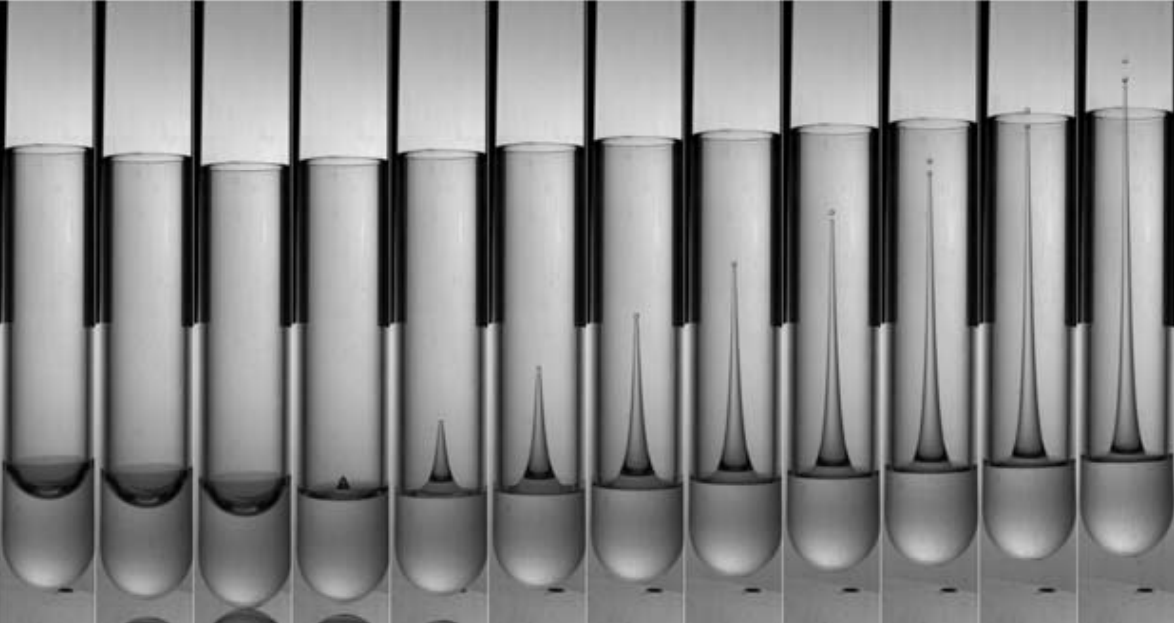
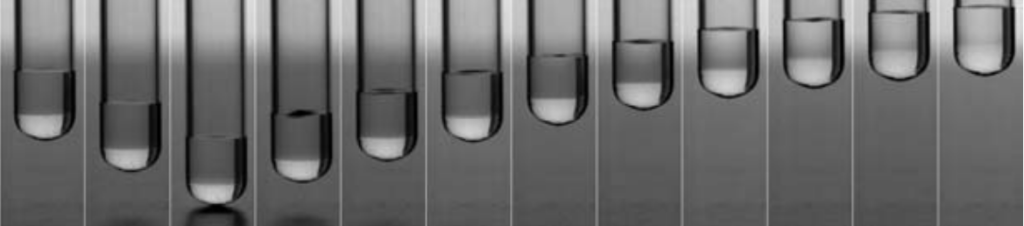
    The photo sequence in the upper image shows, left to right, a fluid-filled tube falling under gravity, impacting a rigid surface, and rebounding upward. During free-fall, the fluid wets the sides of the tube, creating a hemispherical meniscus. After impact, the surface curvature reverses dramatically to form an intense jet. If, on the other hand, the tube is treated so that it is hydrophobic, the contact angle between the liquid and the tube will be 90 degrees during free-fall, impact, and rebound, as shown in the lower image sequence. The liquid simply falls and rebounds alongside the tube, without any deformation of the air-liquid interface. (Photo credit: A. Antkowiak et al.)

  • Featured Video Play Icon

    Stingray Wakes

    This numerical simulation shows a swimming stingray and the vorticity generated by its motion. Stingrays are undulatory swimmers, meaning that the wavelength of their motion is much shorter than their body length. Manta rays, in contrast, move their fins through a wavelength longer than their body length, making them oscillatory swimmers. Observe the difference in this video. To swim faster, stingrays increase the frequency of their undulation, not the amplitude. This is quite common among swimmers because increasing the amplitude also increases projected frontal area, which causes additional drag. Increasing the frequency of motion does not affect the projected area, making it the more efficient locomotive choice. (Video credit: G. Weymouth; additional research credit: E. Blevins; submitted by L. Buss)

    Also, FYFD now has a Google+ page for those who prefer to follow along and share that way. – Nicole

  • Ink Diffusion

    Ink Diffusion

    Alberto Seveso’s gorgeous high-speed photos of ink diffusing in water have a dramatic sense of texture to them. Though still delicate, the whorls of fluid seem almost solid enough to touch. Watch the edges, though, and you can see thin wisps of color and hints of instabilities. Like cream poured into coffee, these ink sculptures are short-lived. Some of his works are available as prints or wallpapers (zip file). (Photo credit: Alberto Seveso)

  • The Real Raindrop

    The Real Raindrop

    What is the shape of a falling raindrop? Surface tension keeps only the smallest drops spherical as they fall; larger drops will tend to flatten. The very largest drops stretch and inflate with air as they fall, as shown in the image above. This shape is known as a bag and consists of a thin shell of water with a thicker rim at the bottom. As the bag grows, its shell thins until it ruptures, just like a soap bubble. The rim left behind destabilizes due to the surface-tension-driven Plateau-Rayleigh instability and eventually breaks up into smaller droplets. This bag instability limits the size of raindrops and breaks large drops into a multitude of smaller ones. The initial size of the drop in the image was 12 mm, falling with a velocity of 7.5 m/s. The interval between each image is 1 ms. (Photo credit: E. Reyssat et al.)

  • Featured Video Play Icon

    10 Years of Weather

    This timelapse video captures the past 10 years’ worth of weather as seen by the GEOS-12 satellite during its service. It’s a mesmerizing look at the large-scale convective flow of Earth’s atmosphere. The prevailing winds for each region are clear from the motion of the clouds, but short-term effects are visible as well. June through November marks the Atlantic hurricane season, and you can see as storm after storm gets generated near western Africa and shoots westward toward North and Central America. You can also see the pattern tracks of these storms in these maps, which show 170 years’ worth of worldwide hurricane tracks.  (Video credit: NOAA; via Scientific American)