[original media no longer available]
This video gives a neat introduction to some common and uncommon techniques used to visualize fluid flows.
[original media no longer available]
This video gives a neat introduction to some common and uncommon techniques used to visualize fluid flows.
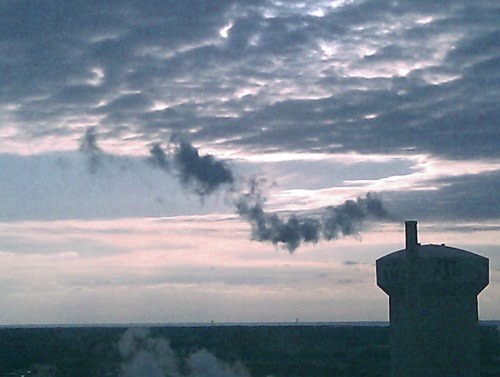
On a cold and windy day, the plume from a smokestack sometimes sinks downstream of the stack instead of immediately rising (Figure 1). This isn’t an effect of temperature–after all, the exhaust should be warm compared to the ambient, which would make it rise. It’s actually caused by vorticity.

In Figure 2, we see a simplified geometry. The wind is blowing from right to left, and its velocity varies with height due to the atmospheric boundary layer. Mathematically, vorticity is the curl of the velocity vector, and because we have a velocity gradient, there is positive (counterclockwise) vorticity generated.

According to Helmholtz, we can imagine this vorticity as a bunch of infinite vortex lines convecting toward the smokestack, shown in Figure 3. Those vortex lines pile up against the windward side of the smokestack–Helmholtz says that vortex lines can’t end in a fluid–and get stretched out in the wake of the stack. If we could stand upstream of the smokestack and look at the caught vortex line, we would see a downward velocity immediately behind the smokestack and an upward velocity to either side of the stack. It’s this downward velocity that pulls the smokestack’s plume downward.

Now Helmholtz’s theories actually apply to inviscid flows and the real world has viscosity in it–slight though its effects might be–and that’s why this effect will fade. The vortex lines can’t sit against the smokestack forever; viscosity dissipates them.

I discovered this interesting bit of icing a couple years ago near the foot of a waterfall in Ithaca, NY. The predominant wind was always heading toward the falls (left to right in these pictures), while the falls were always throwing spray up into the wind. The result was that ice airfoils (center) formed in the wake of each tree branch throughout most of the gorge (top).

There’s more to non-Newtonian fluids than shear-thickening and shear-thinning. The viscosity of some fluids can also change with time under constant shear. A fluid that becomes progressively less viscous when shaken or agitated is called thixotropic. The opposite (and less common) behavior is a fluid that becomes more viscous under constant agitation; this is known as a rheopectic fluid. This video demonstrates both types of fluids using a rotating rod as the agitator. The rheopectic fluid actually appears to climb the rod–similar to the Weissenberg effect–while the thixotropic fluid moves away from the rod.