Tag: Zanclean Flood

  • Flooding the Mediterranean

    Flooding the Mediterranean

    Nearly 6 million years ago, the Mediterranean was cut off from the ocean and evaporated faster than rivers could replenish it. This created a salty desert that persisted until about 5.3 million years ago. One hypothesis — the Zanclean megaflood — suggests that the Mediterranean refilled rapidly through an erosion channel near the Strait of Gilbraltar. A new study bolsters the concept by identifying geological features near Sicily consistent with the megaflood.

    The team point to a grouping of over 300 ridges near the Sicily Sill, once a land bridge dividing the eastern and western Mediterranean and now underwater. The ridges are layered in debris but aren’t streamlined, suggesting they were rapidly deposited by turbulent waters, and date to the period of the proposed flooding. For more on the Zanclean Flood, check out this older post. (Image credit: R. Klavins; research credit: A. Micallif et al.; via Gizmodo)

    Fediverse Reactions
  • Featured Video Play Icon

    When the Mediterranean Dried Up

    Geological evidence shows that millions of years ago, the Mediterranean Sea nearly dried out. In fluid mechanics, we’d describe this problem using one of our fundamental equations: conservation of mass, also known as continuity.

    Imagine a volume containing the entire Mediterranean. To describe the amount of sea water in that volume, you need to keep track of two major quantities: how much water is flowing into the volume and how much is leaving it. For the prehistoric (as well as today’s) Mediterranean, the sources feeding the sea are 1) an inflow from the Atlantic through the Strait of Gibraltar; 2) inflows from rivers; and 3) rainfall. Water is lost primarily to evaporation.

    As explained in the video, the Mediterranean’s dry spell was heralded by tectonic changes that sealed the Strait of Gibraltar, depriving it of its largest source of inflow. At the same time, warmer temperatures and less rainfall reduced influx from rivers and the atmosphere while increasing evaporation rates. The result? Water levels in the Mediterranean dropped by hundreds of meters, creating massive salt deposits, wiping out native marine life, and allowing mass migration by land-dwelling animals. Eventually, though, the Strait re-opened, creating what might have been a massive flood. (Video and image credits: PBS Eons)

  • When the Mediterranean Flooded

    When the Mediterranean Flooded

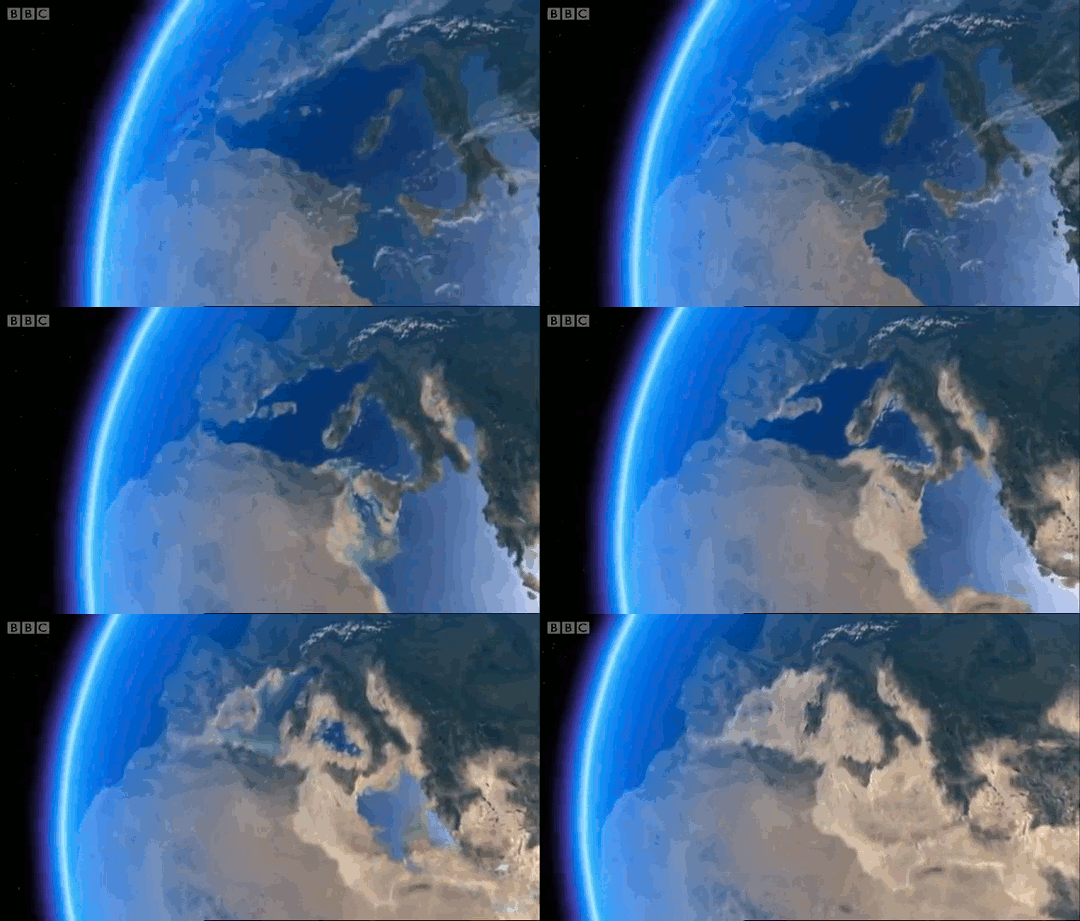
    Around 6 million years ago, the African and Eurasian plates moved together, cutting the Mediterranean Sea off from the Atlantic. Without an influx of water from the Atlantic, evaporation began removing more water from the Mediterranean than rivers could replace. The sea dried out almost completely over the course of a couple thousand years.

    About 5.3 million years ago, the Straits of Gibraltar reopened, creating a massive flood into the Mediterranean known as the Zanclean Flood. Water rushed down the straits and into the Mediterranean at speeds as high as 40 m/s (90 mph). At its peak, the Zanclean Flood is estimated to have reached rates 1000 times greater than the volumetric flow rate of the Amazon River.

    A similar breach flood occurred in the Black Sea within the past 10,000 years when the Bosporus became unblocked. That flood likely had a devastating impact on Neolithic societies in the area and may be the inspiration for the floods described in the Epic of Gilgamesh and the Bible. (Image credit: BBC, source)