Tag: sound waves

  • Featured Video Play Icon

    Making Sound Visible

    Sound is not something we can typically see, though there are ways to visualize it, including cymatics and special acoustic cameras. This video pursues a different tactic: using schlieren photography and stroboscopic lighting to show how sound waves reflect and deflect. It’s no easy feat, but one worth enjoying–especially when others have already done the hard part for you! (Video and image credit: All Things Physics; submitted by David J.)

  • Absorbing Sound with Moth Wings

    Absorbing Sound with Moth Wings

    Manmade soundproofing tends to be porous and bulky or very limited in the range of frequencies it can handle. In contrast, moths are natural absorbers of ultrasound, having evolved to avoid reflecting those frequencies back to the bats hunting them. Researchers took the structures from a moth wing and applied them to an aluminum disk to see how the coating performed. They found that the moth wing’s structures reduced sound reflection by as much as 87% at the lowest frequency tested (20kHz, still beyond human hearing.) As researchers explore how the individual structures of the wing perform, they hope to adapt the moth’s prowess to soundproof within the human range of hearing. (Image and research credit: T. Neil et al.; via Physics World)

  • Featured Video Play Icon

    Seismic Events Reveal Ocean Temperatures

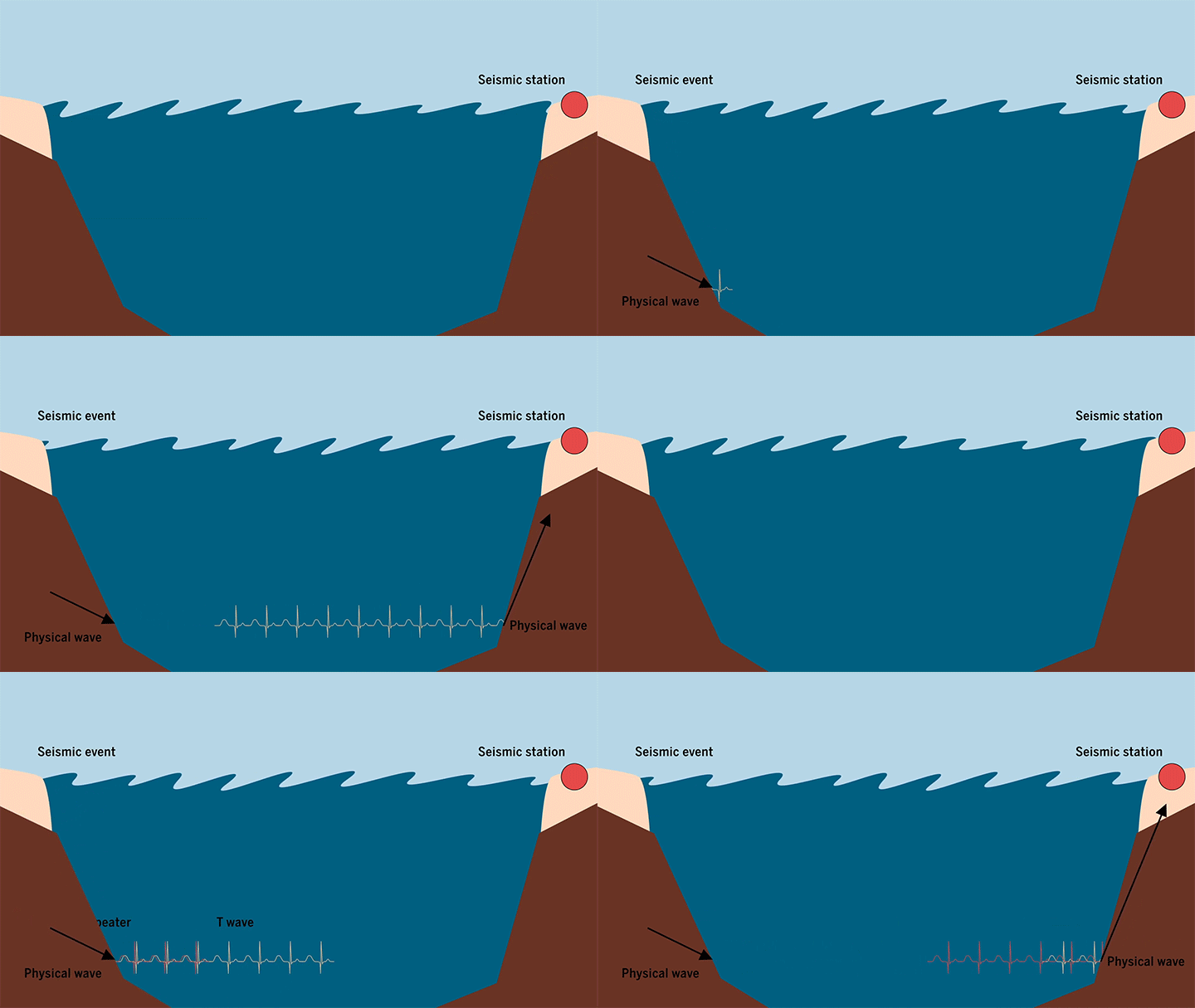
    Decades ago, researchers proposed sending sound waves through the ocean to measure its temperature. Although the technique worked, it ran into noise pollution issues, but now it’s back, using naturally-occurring seismic events as the sound source.

    When fault lines shift, they generate seismic waves that travel through the ocean as sound. When they reach a land mass, the waves get converted back into seismic energy that’s then picked up by a receiver. Knowing the distance from the source to the receiver and the time necessary for the wave to travel, scientists can then determine the average temperature of the water based on the speed of sound.

    The technique can track temperature changes down to thousandths of a degree. Based on more than a decade of seismic data from the Indian Ocean, researchers found almost double the temperature increase measured by a different sensor network. (Image and video credit: Science; research credit: W. Wu et al.; submitted by Kam-Yung Soh)

  • Seeing Sound

    Seeing Sound

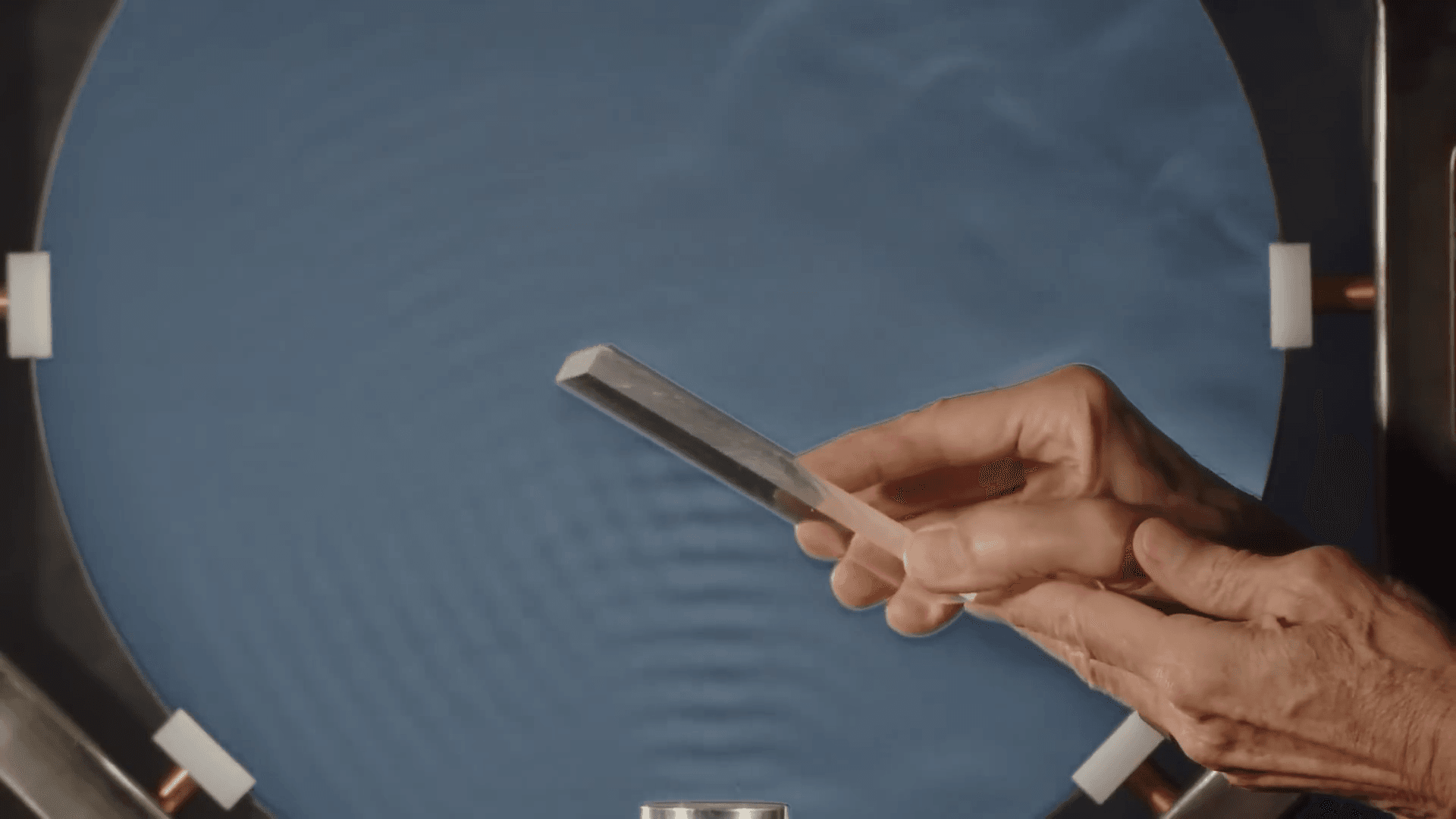
    It’s not always easy to imagine how waves travel, but with this demonstration, you can see sound waves and how they reflect and defract. The set-up uses schlieren optics that show light and dark bands where strong changes in density take place. This, combined with a stroboscopic light, makes it possible to see the wave fronts from the acoustic transducer on the left side of the screen. Once the wave is apparent, introducing a reflective object lets us see exactly how sound waves bounce, reflect, and interfere. (Image and video credit: Harvard Natural Sciences Lecture Demonstrations)

  • Featured Video Play Icon

    When Walls Chirp

    If you’ve ever clapped near a wall with a corrugated surface, you may have noticed some strange echoes. Surfaces like these can cause a chirping sound to observers. The reason, as Nick Moore explains in the video above, is that the original sound reflects off the corrugations at different times and travels back to the observer such that the first reflections to arrive are closely spaced (and thus higher pitched) while the later reflections are spread further out. This creates a chirp that starts at a high pitch and then falls to lower ones. Have you ever come across structures that do this? (Video credit: N. Moore)

  • Featured Video Play Icon

    Hearing in Space

    Everyone knows that, in space, no one can hear you scream. Sound is a wave that requires a medium to travel through, and if space is empty, there’s no medium to carry that sound. Except, as Mike from The Point Studios explains, empty is a relative term. Space is full of dust and gas and plasma, just not as full of that matter as we’re used to. Thus, the question of whether sound can travel through space turns into a matter of scale. If the scale–the wavelength–of a sound is much larger than the distance between molecules, then the sound can propagate. So there CAN be sound in space – it just has to have a very long wavelength and, thus, a very low frequency. Check out the video for the full story! (Video credit: The Point Studios)

  • Featured Video Play Icon

    How Loud Can Sound Get?

    Sound and acoustics often intersect with fluid dynamics. Most of the sounds we experience are pressure waves traveling through air. In this video, Joe of It’s Okay To Be Smart takes a closer look at sound: what it is; how we measure it; and just how loud a sound can get. For air at sea level, the loudest possible sound is 194 dB. Add any more energy and it distorts the pressure wave from what we recognize as sound into what’s known as a shock wave. (Video credit: It’s Okay To Be Smart/PBS Digital Studios)

  • Featured Video Play Icon

    Extinguishing Fires With Sound

    Engineering students from George Mason University have built a fire extinguisher that uses sound to put out flames. Since sound waves are mechanical pressure waves, they can move the air surrounding a burning material. Through trial and error the students found the high-frequency sound had little effect, but at frequencies between 30-60 Hz the sound waves could jostle enough oxygen away from the flame to extinguish the fire. They’re hoping the solution is scalable and can be applied to larger fires. For other wild ideas for chemical-less fire extinguishers, check out how researchers put out fires with explosions.  (Video credit: George Mason University; submitted by @isanaht)

  • Featured Video Play Icon

    Sound and Harmonics

    The vibrations we perceive as sound, whether in air, water, or any other fluid, are tiny pressure waves emanating from a source, transmitting like ripples across a pond, and finally being caught by our ears and translated by our brains. In this video, the mechanisms and mathematics of sound and harmonics are explained. Although we’re most familiar with these concepts in acoustics, the same principles are used when studying other oscillatory motions, including pendulums, mass-spring systems, disturbances in boundary layers, and the vibrations of a diving board. All of these things rely on the same fundamental principles and mathematics.

  • Featured Video Play Icon

    The Sound of Helium

    Gases of different density are good for more than just physics demonstrations. They also affect the transmission of sound waves, thereby altering our perception of pitch. As fun as sulfur hexafluoride is, though, don’t go playing with it at home; it’s an extremely potent greenhouse gas.