These days artificial snow-making is a standard practice for ski resorts, allowing them to jump-start the early part of the season. Snow guns continuously spray a mixture of cold water and particulates 5 or more meters in the air to generate artificial snow. The tiny droplet size helps the water freeze faster and the particles provide nucleation sites for snow crystals to form. As with natural snow, the shape and consistency of the snow depends on humidity and temperature conditions. Pyeongchang is generally cold and dry, so even the artificial snow there tends to be similar to snow in the Colorado Rockies. Recreational skiers tend to look down on artificial snow, but Olympic course designers actually prefer it. With artificial snow, they can control every aspect of an alpine course. For them, natural snowfall is a disruption that puts their design at risk. (Video credit: Reactions/American Chemical Society)
Tag: snow

PyeongChang 2018: Moguls


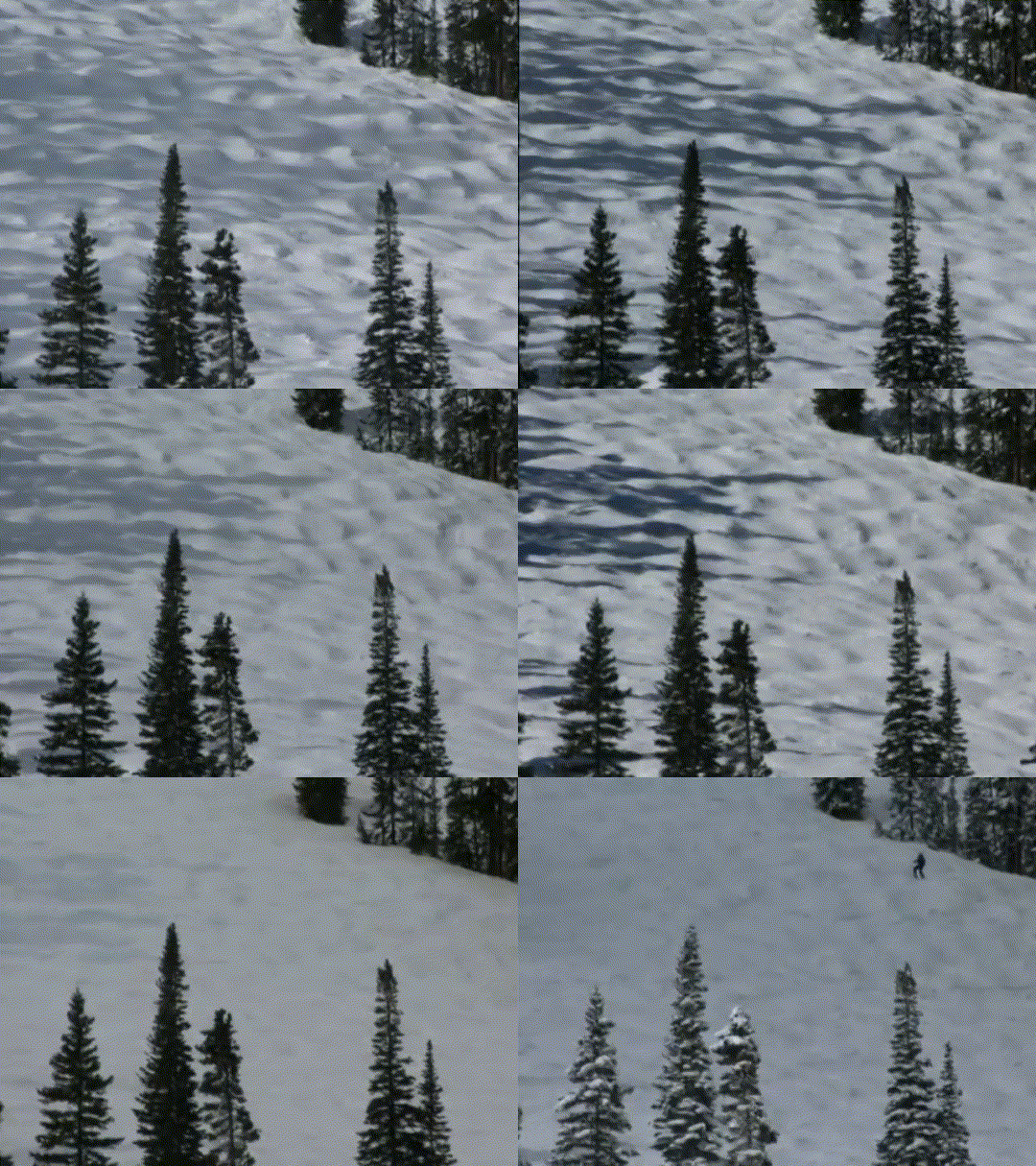
Moguls are bump-like snow mounds featured in freestyle skiing competitions and also frequently found on recreational ski courses. Although competition runs are man-made, most mogul fields form naturally on their own. As skiiers and snowboarders carve S-shaped paths down the slope, their skis and snowboards remove snow during sharp turns and deposit it further downhill. Over a surprisingly short amount of time, these random, uncoordinated actions form bumps large enough that they force skiers and snowboarders to begin turning on the downhill side of the bump. That action continues to carve out snow on the uphill side and deposit it downhill, effectively causing the downhill bumps to migrate uphill, as seen in the timelapse animation below. As more moguls form, their motion organizes them into a checkerboard-pattern that moves in lockstep. Observations show that mogul fields can move about 10 meters uphill over the course of a season. Seemingly, the only way to prevent mogul formation on steep slopes is to regularly groom them back to a flat state! (Image credits: J. Gruber/USA Today; J. Huet; D. Bahr; research credit: D. Bahr et al.)


Growing Snowflakes
Watching a snowflake grow seems almost magical–the six-sided shape, the symmetry, the way every arm of it grows simultaneously. But it’s science that guides the snowflake, not magic. Snowflakes are ice crystals; their six-sided shape comes from how water molecules fit together. The elaborate structures and branches in a snowflake are the result of the exact temperature and humidity conditions when that part of the snowflake formed. The crystals look symmetric and seem to grow identical arms simultaneously because the temperature and humidity conditions are the same around the tiny forming crystals. And the old adage that no two snowflakes are alike doesn’t hold either. If you can control the conditions well enough, you can grow identical-twin snowflakes! (Video credit: K. Libbrecht)
Visualizing Flow with Snowfall
One of the challenges in engineering and operating wind turbines is that full-scale turbines rarely behave as predicted in smaller-scale laboratory experiments and simulations. One way to reconcile these differences (and discover what our experiments and simulations are missing) is to take the experiments out into the field. One research group has done this by using snowfall to visualize the flow around wind turbines. In this video, they share some of their observations, which include interactions of tip vortices with one another and with the vortex from the tower. My favorite part starts around 1:50 where you can observe tip vortices leap-frogging one another behind the wind turbine! (Video credit: Y. Liu et al.)

Fluids Round-Up
New year, new (or renewed) experiments. This is the fluids round-up, where I collect cool fluids-related links, articles, etc. that deserve a look. Without further ado:
- Above is a new music video from the Julia Set Collection, featuring all non-CGI, fluids-based visuals. I spy soap films, vibrating liquids, and lots of cool effects with reflection and refraction. We featured some of their previous work, too.
- The Atlantic has a great piece about jellyfish and how they might just change our understanding of efficient swimming.
- Check out the wild shape-shifting of these drops of oil during freezing and learn about the plastic crystal phase some matter experiences.
- Nature has an interesting article on active matter, an intersection of physics and biology exploring how matter self-organizes, whether at the level of cells or the flocking of birds. (submitted by 1307phaezr)
- Ever wonder what the human face looks like in 457 mph winds? Wonder no more.
- Gizmodo has a beautiful set of macro photos of snowflakes. Interested in how snowflakes form and why there are so many different shapes? We’ve got you covered.
- Wired takes a look at the surf forecaster who predicts the waves for the Mavericks big-wave competition.
- Robert Krulwich (and friends) took a closer look at our fish in microgravity. Here’s what they learned!
(Video credit and submission: Julia Set Collection/S. Bocci; image credit: IRPI LLC, source)
Snowy Deserts
Windblown snow bears a certain resemblance to desert sands or a Martian landscape. Many of the same aeolian processes–like erosion, transport, and deposition–take place in each. The animation above shows an example of suspension, where fine snowflakes are lifted and carried along near the ground. Larger snowflakes may bounce or skip along the surface in a process called saltation. For more, check out some of the crazy things snow does or learn about how dunes form. (Image credit: Redemption Designs, source video)
Grow Your Own Snowflakes
If your Christmas holiday was a little too green (like mine was), Science Friday has just the activity for you – grow your own snowflakes! With a few materials you probably already have and some dry ice from the store, you can grow and observe ice crystals at home. Although these crystals form from water vapor instead of water droplets like proper snowflakes, they do exhibit different structures depending on temperature and humidity, just the way natural snowflakes do. (Video credit: Science Friday/F. Lichtman)
Growing Snowflakes
It’s easy to miss the beauty of a snowflake if you don’t take a close look. These tiny crystals form when water freezes onto a dust particle or other nucleation site, and they grow as water vapor freezes on to the nucleus. The structured appearance of a snowflake comes from the bonds formed between water molecules, but the exact type and shape of crystal formed–not all snowflakes are six-sided!–depends on the local temperature and humidity during freezing. This microscopic timelapse video by Vyacheslav Ivanov lets you watch the process in action. (Video credit: V. Ivanov; via io9)
Sochi 2014: Making Snow
Much attention ahead of the Sochi Winter Olympics has been dedicated to the question of how this subtropical resort town would provide and maintain adequate snow cover for the Games. Officials promised a combination of natural snow, snow transported from elsewhere, snow stored from the previous year, and, of course, artificial snow. These days many ski resorts rely heavily on snow guns producing artificial snow. There are two main types of snow gun–those which use compressed air and those which have an electrically-driven fan–but the principles behind each are the same. The snow guns provide a continuous spray of air and water, atomizing the water into tiny droplets which freeze rapidly. The effectiveness of snow guns depends on both the temperature and humidity of the surrounding air. With sufficiently dry air, artificial snow can be made even several degrees above freezing. Sochi itself is relatively humid (72% on average for February), but most of the outdoor events are held in Krasnaya Polyana, higher in the mountains where temperatures are typically much lower and artificial snow can be manufactured. That said, temperatures have reached as high as 15 degrees Celsius during the Games so far, and athletes have complained about the changing snow conditions in several events. (Video credit: On The Snow)
FYFD is celebrating #Sochi2014 with a look at the fluid dynamics of the Winter Games. Check out our previous posts, including how lugers slide fast, how wind affects ski jumpers, and why ice is slippery.

Snow Rollers


Snow rollers are nature’s snowballs, formed when high winds roll a chunk of snow along the surface, allowing it to accumulate more and more material. They occur relatively rarely because their appearance is the culmination of several specific meteorological factors. To form rollers, the ground needs to be icy, with a layer of loose, wet snow above the ice. And, of course, it needs to be windy enough to move the snow without being so windy that snow breaks up. In the photos above, the snow roller got too large for the wind to continue moving it, but the wind didn’t stop blowing. Instead, the snow roller became an obstacle to the flow and a horseshoe vortex formed at its base. The spinning of the vortex dug out the trench in front of and along the sides of the snow roller. This same effect is often seen on the windward side of trees in winter. (Photo credit and submission: S. Benton)