Snakes’ forked tongues have long inspired fear, but, in reality, they are part of a highly-effective sensory system. When snakes flick out their tongues, they waggle them up and down about 15 times a second. That motion draws air inward toward the tongue (Image 2), allowing scent molecules to stick to the saliva on either side of the tongue. Once those molecules are gathered, the snake pulls its tongue back into its mouth, where it settles into two grooves (Image 3). Each one has its own path to the snake’s olfactory organs, giving the snake independent spots to evaluate the left and right forks. That means the snake knows which side has a stronger scent and is better able to track its prey. (Video and image credit: Deep Look)
In many ways, smell is a strange sense. The very act of sniffing – pulling air and odor molecules into our noses – changes what remains behind in a way that sight and sound do not. Humans aren’t great sniffers, but dogs have an exquisite sense of smell, and in this video, Deep Look describes how and why that is. From special scent organs to their experimental protocols, dogs are well-adapted to reading the world by smell. (Image and video credit: Deep Look)
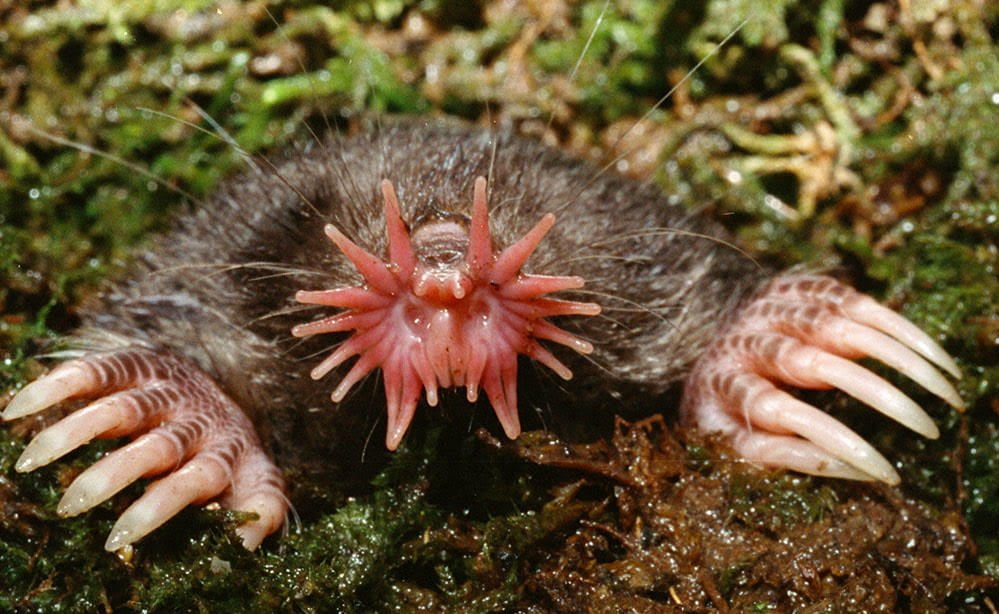
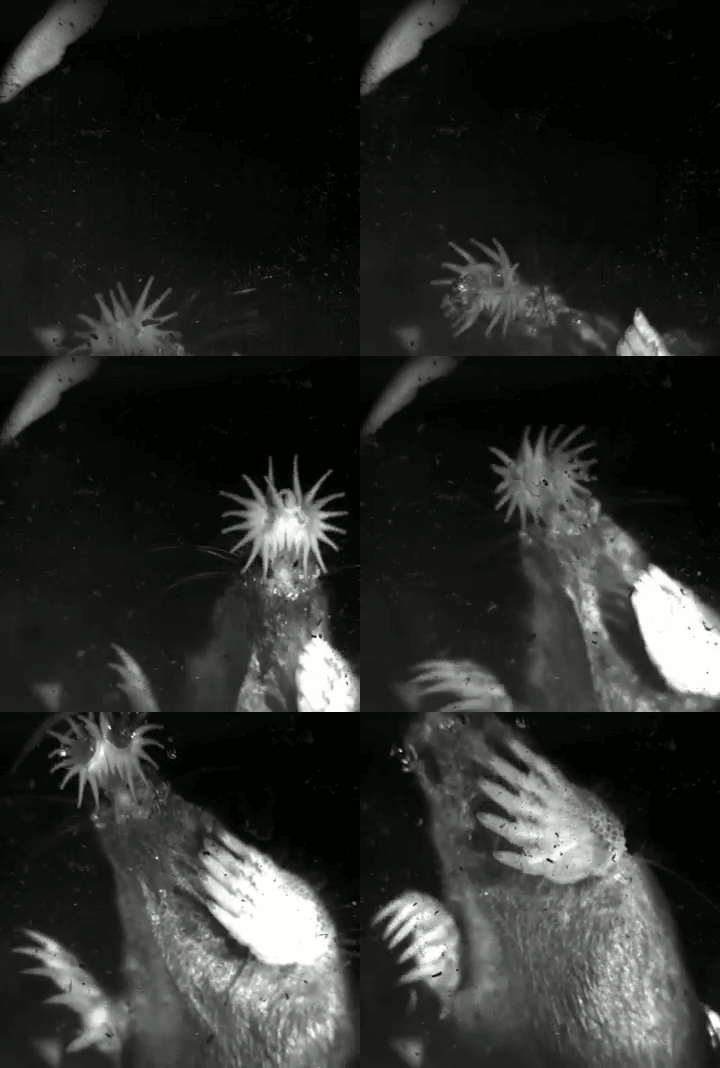
Star-nosed moles – tiny mammals native to the northeastern United States – have an underwater superpower: sniffing. To seek prey underwater, the moles blow bubbles and suck them back into their nostrils in about a tenth of a second. Their eponymous noses seem to be key to this, as seen in newly published research. Researchers built model star noses from plastic (lower right) to explore how well different shapes could hold the bubble in place, a necessary ingredient for the mole to sniff them back up.
With a perfectly flat plate, any small tilt makes the bubble slide toward the edge and float away. Star-shaped ones, on the other hand, can hold a bubble even up to a 7-degree tilt angle, a 40% improvement. The spacing of the gaps is also important. If they’re too wide, buoyancy can pull the bubble up through them. But if they’re too narrow for the bubble to deform upward through them, they make poor anchors.
Understanding the mechanics of underwater sniffing is good for more than just appreciating this funny-looking mammal, though. The researchers hope their findings will help develop underwater chemical sensors that use bubble sniffing instead of exposing their components directly to sea water, which would significantly extend their usable life. For more, check out the paper and my interview with the lead author in the video below. (Image credits: top and lower left – K. Catania; lower right – A. Lee; research credit: A. Lee and D. Hu; video credit: N. Sharp and T. Crawford)
In this month’s FYFD/JFM video, we explore some intersections between the animal kingdom and our own lives. Learn about designing better buildings with inspiration from termites; see the fascinating superpower of the star-nosed mole; and learn what goes into products like the toothpaste you (hopefully) use daily. All this and more in the latest video! Missed one of our previous ones? Good news: we’ve got you covered. (Image and video credit: N. Sharp and T. Crawford)
You’d be forgiven for thinking that the star-nosed mole looks funny. Its distinctive star-shaped nose is a highly-sensitive organ, but the mole doesn’t just use it for finding its way through the underground tunnels it lives in. These moles can actually sniff underwater. By exhaling a bubble and then re-inspiring it, the moles collect scent particles that they can use to locate food. In experiments, both star-nosed moles and water shrews could use this technique to successfully follow a scent trail, demonstrating exploring and pausing behaviors similar to terrestrial sniffing as they did. To learn more about this impressive mammal, listen to the latest episode of Science Friday, where research Ken Catania describes his work with them. (Image credits: K. Catania; via Science Friday)
Every day we’re surrounded by an invisible world of smells. Like the fluorescein dye in the animation above, these odors drift and swirl in the background flow. What you may not have stopped to consider when you smell the roses, though, is how the very act of sniffing changes the scent. When you inhale, filaments of the odor are drawn into your nose, and, likewise, when you exhale, your breathe mixes with the scent and sends it swirling outward in turbulent eddies. To see more about the science of scent, check out PBS News Hour’s full video below. (Video credit: PBS News Hour; GIF via skunkbear)