Tag: slippery

  • Featured Video Play Icon

    A Pitcher Plant’s Rain-Triggered Trap

    Pitcher plants all use slippery rims and sticky digestive juices to capture and trap their insect prey. But two species of pitcher plant independently evolved an extra trap: a rain-activated springboard lid. Both the Seychelles pitcher plant and the slender pitcher plant — separated geographically by 6000 kilometers — have a springy, near-horizontal “lid” that sticks out over their pitcher. The underside of the surface is slippery, though less so than the pitcher’s lip and walls. Unsuspecting ants crawl under the lid, confident that they can keep their footing, and then — bang — a rain drop hits the springboard. That impact catapults the insect directly into the drink. There’s no escaping now.

    How did two widely separated, independently evolving plants both settle on this technique? Scientists think it was random chance. Pitcher plants are highly variable in their pitcher size, shape, and features. The scientists suggest that by trying lots of random combinations, these two species hit upon a particular arrangement that works really well for them. (Video and image credit: Science)


    Fediverse Reactions
  • Beijing 2022: Why Are Ice and Snow Slippery?

    Beijing 2022: Why Are Ice and Snow Slippery?

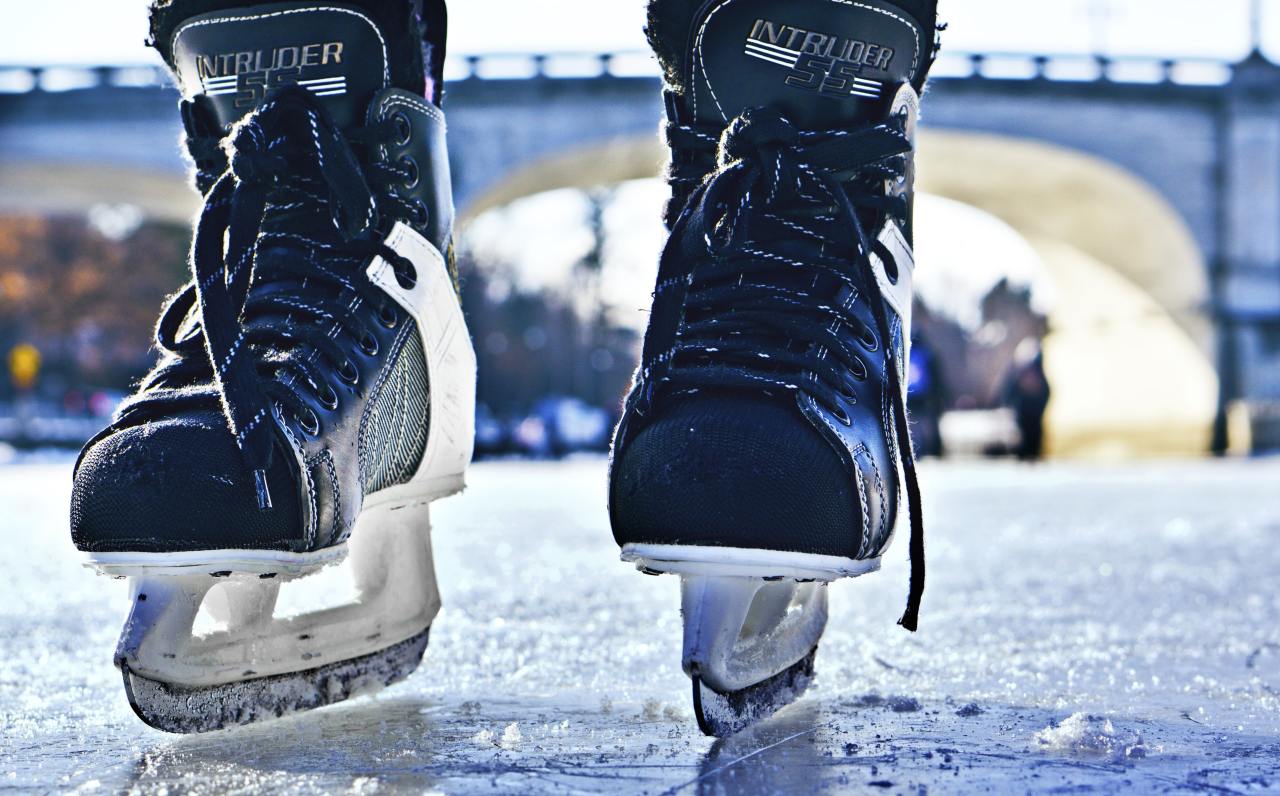
    Although every Olympic winter sport relies on the slippery nature of snow and ice, exactly why those substances are so slippery has been an enduring mystery. Michael Faraday hypothesized in the nineteenth century that ice may have a thin, liquid-like layer at its surface, something that modern studies have repeatedly found.

    One recent study used an entirely new instrument to probe the characteristics of this lubrication layer and found that it is only a few hundred nanometers thick. But the fluid in this layer is nothing like the water we’re used to. Instead it has a viscosity more akin to oil and its response to deformation is shear-thinning and viscoelastic, more like the complex fluids in our kitchens and bodies than pure, simple water. They found that using a hydrophobic probe modified the interfacial viscosity even further, which finally provides a hint at the mechanism behind waxing skis and skates. 

    Fortunately for us, we’ve found plenty of ways to employ and enjoy water’s slipperiness, even as the mystery of it slowly gives way to understanding. (Image credit: M. Fournier; research credit: L. Canale et al.; via Physics World; submitted by Kam-Yung Soh)

  • Sliding Down a Pitcher Plant

    Sliding Down a Pitcher Plant

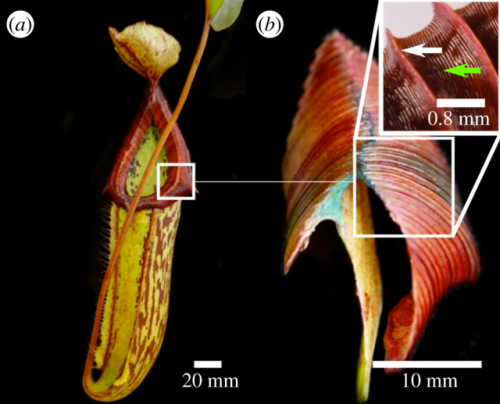
    Carnivorous pitcher plants supplement their nutrient-poor environments by capturing and consuming insects. The viscoelastic fluid inside them helps trap prey, but fluid dynamics plays a role elsewhere on the plant as well. The inner and outer surfaces of the pitcher are covered in macroscopic and microscopic grooves, seen above, oriented toward the interior of the plant. 

    Researchers found that these grooves trap droplets on the slippery plant through capillary action. Once adhered, the droplet cannot easily move across the grooves, but it can slip along them, carrying the droplet and any insect stuck to it, into the plant. By replicating pitcher-plant-inspired grooves on manmade surfaces, researchers found they were able to better control droplet motion on slippery, lubricant-infused surfaces than in previous work. (Image and research credit: F. Box et al.; via Royal Society; submitted by Kam-Yung Soh)