
Sudden changes in the pressure or temperature in a liquid can create bubbles in a process known as cavitation. Underwater explosions are just one of the ways to induce cavitation in a liquid. As identified in the above video, the shock waves traveling through the liquid force a change in pressure that creates bubbles. When these bubbles collapse, the container is subjected to an enormous oscillation in pressure, which often results in damage. The same phenomenon is responsible for damage on boat propellers as well as this beer bottle smashing trick. Check out these other high-speed videos of cavitation in a bottle: (Video credit: Destin/Smarter Every Day; submitted by Juan S.)
Tag: shockwave

Vapor Cone
This stunning National Geographic photo contest winner shows an F-15 banking at an airshow and a array of great fluid dynamics. A vapor cloud has formed over the wings of the plane due to the acceleration of air over the top of the plane. The acceleration has dropped the local pressure enough that the moisture of the air condenses. Some of this condensation has been caught by the wingtip vortices, highlighting those as well. Finally, the twin exhausts have a wake full of shock diamonds, formed by a series of shock waves and expansion fans that adjust the exhaust’s pressure to match that of the ambient atmosphere. (Photo credit: Darryl Skinner/National Geographic; via In Focus; submitted by jshoer)

The Veil Nebula
There is no grander scale for the observation of fluid dynamics than that of the astronomical. Here Hubble astronomers discuss the formation of the Veil Nebula, a supernova remnant formed some 5,000-10,000 years ago. Wisps of gas and plasma remain, creating stunning astronomical landscapes that are the result of shock waves, turbulence, diffusion, and other processes familiar to us here on Earth. (Video credit: ESA/Hubble)

Martian Landing Physics

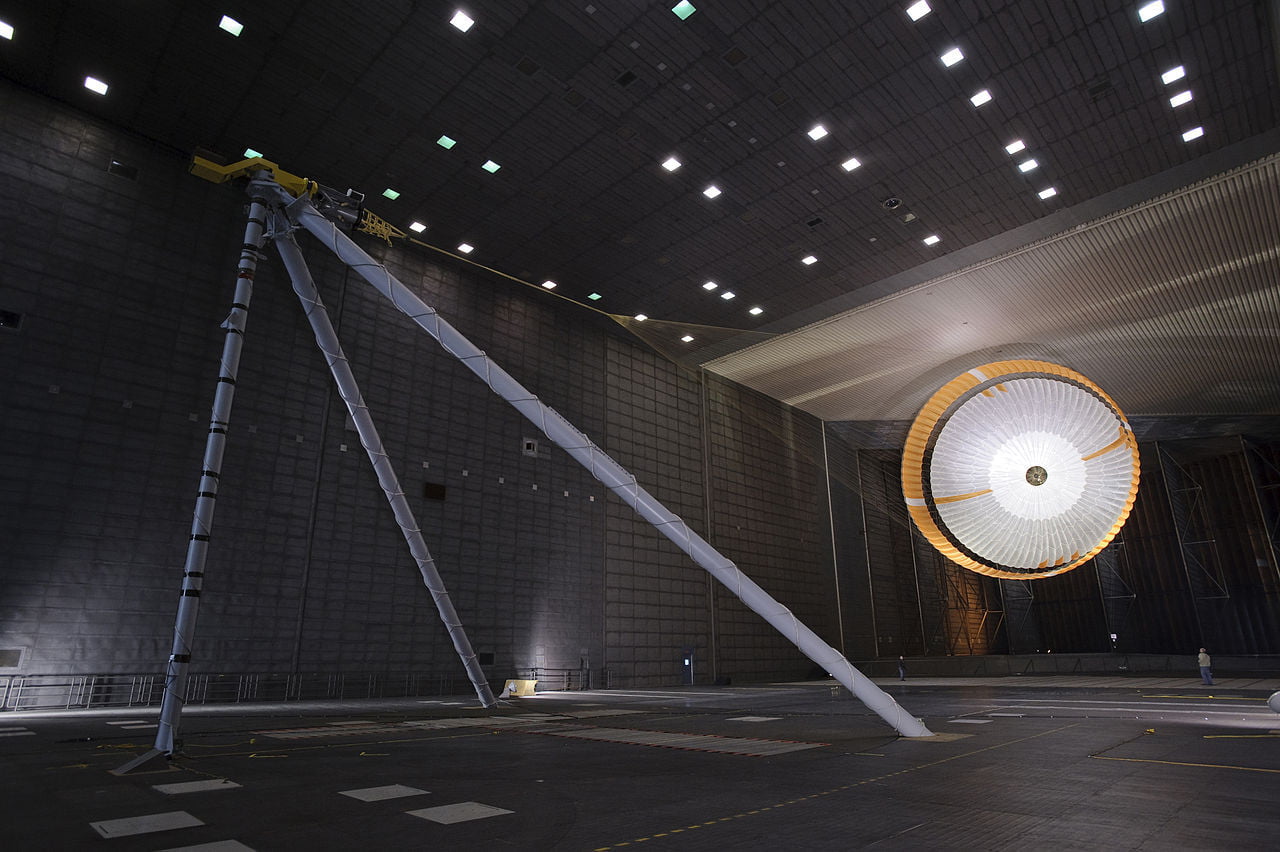
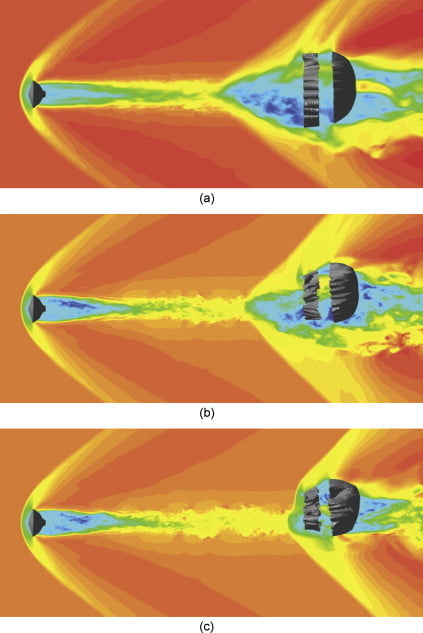
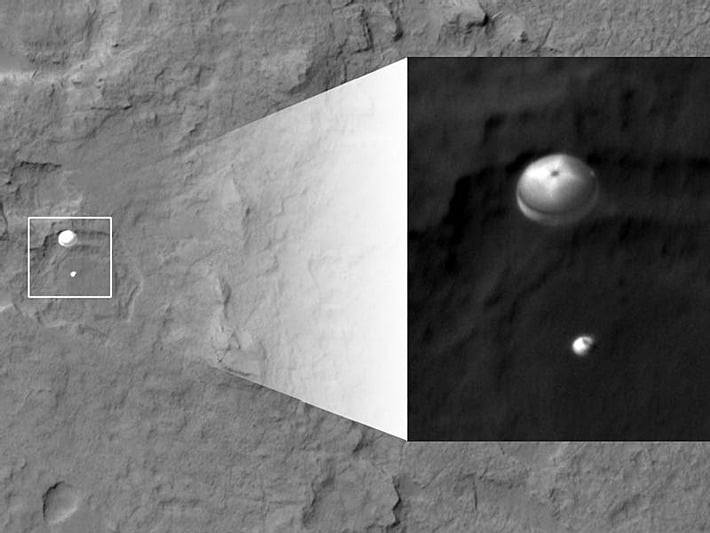
A little over a week ago, NASA’s Curiosity rover landed on Mars, the culmination of years of engineering. The mission’s landing, in particular, was the subject of intense scrutiny as Curiosity’s size necessitated some new techniques in the final segments of the landing sequence. As it hit the Martian atmosphere at 13,000 mph, the compression of the carbon dioxide behind the capsule’s shock wave slowed the descent. At roughly 1,000 mph–speeds still large enough to be supersonic–Curiosity deployed its parachute. Shown above are the parachute in numerical simulation (from Karagiozis et al. 2011), wind tunnel testing at NASA Ames, and during descent thanks to the Mars Reconnaissance Orbiter. The simulation shows contours of streamwise velocity at different configurations; note the bow shock off the capsule and the additional shocks off the parachute. These help generate the drag needed to slow the capsule. For an interesting behind-the-scenes look at the wind tunnel testing for Curiosity’s parachute check out JPL’s four–part video series. Congratulations to all the scientists and engineers who’ve made the rover a success. We look forward to your discoveries! (Photo credits: K. Karagiozis et al., NASA JPL, NASA MRO)
Traffic Fluid Dynamics
What does traffic have to do with fluid dynamics? Rather a lot, actually! Many parallels exist between traffic and compressible fluid flow. One such example, the concept of a shock wave, is demonstrated in the video above. As the traffic jam develops, the cars experience sudden changes in their velocity and relative distance (in a fluid, this would be density). This change travels backward through the traffic in the form of a shockwave, just the same as discontinuous changes in a fluid.
Road construction provides another common example of compressible-flow-like behavior in cars. For an incompressible fluid like water, reducing the area of a pipe would increase the velocity, but just the opposite happens when a road is reduced from two lanes to one. Traffic slows down and clumps together. When the road opens back up from one lane to two, suddenly the speed and the distance between cars increases. This is exactly what happens in a rocket nozzle–it’s the expanding bell-like shape that causes air to accelerate supersonically. (Video credit: New Scientist)
Schlieren Montage
Dr. Gary Settles, a world-reknown expert in schlieren photography, shows here a montage of some of his lab’s results, including shockwaves from musical instruments, dogs sniffing, guns firing (both sub- and supersonic), and even snapping a wet towel going supersonic. As Settles jokes, schlieren is all mirrors and hot air. Mirrors are used to shine collimated light on the object to be imaged; then the light focused with a lens. By placing a knife-edge at the focal point, part of the light is blocked and the density variations in the final image become visible, thanks to their differing refractive indices. (Video credit: G. Settles et al.)
Supersonic Flow
This video shows a sphere in a small supersonic wind tunnel at Mach 2.7. Once the tunnel starts, a curved bow shock forms in front of the sphere, close to but not touching the model’s surface. Areas of low pressure are visible behind the sphere, as is a weak shock wave caused by overexpansion in those low pressure areas. Contrast this with a sharp cone in the same tunnel at the same Mach number. In the case of the cone, the shock wave is attached at the nose of the model. The attached shock follows the body more closely, resulting in a shock that impacts the walls of the tunnel further downstream than in the sphere’s case.

Seeing Shock Waves
In this still image from a video of a 2008 demonstration of a U.S. Navy railgun, the shock waves in front of the projectile are momentarily visible. When travelling faster than the speed of sound in air, information (in the form of pressure waves) is unable to travel ahead of the projectile, meaning that the air cannot deform around the object as it does at low speeds. Instead, a front known as a shock wave forms on or in front of the object, depending on its speed and shape. Across this shock wave, thermodynamic properties of the gas are discontinuous; the pressure, temperature, and density of the air rise drastically, but the air is also deformed so that it passes around the object. (See also: bullet from a gun.)
Supersonic Flow Around a Cylinder
This numerical simulation shows unsteady supersonic flow (Mach 2) around a circular cylinder. On the right are contours of density, and on the left is entropy viscosity, used for stability in the computations. After the flow starts, the bow shock in front of the cylinder and its reflections off the walls and the shock waves in the cylinder’s wake relax into a steady-state condition. About halfway through the video, you will notice the von Karman vortex street of alternating vortices shed from the cylinder, much like one sees at low speeds. The simulation is inviscid to simplify the equations, which are solved using tools from the FEniCS project. (Video credit: M. Nazarov)


