Mars is quite dusty. It periodically gets swallowed by planet-spanning dust storms, but it’s also home to regular dust devils whose size can put Earth’s to shame. Exactly how so much dust gets picked up by Mars’ incredibly thin atmosphere — only 1% of Earth’s — is still something of a mystery. So scientists were excited after the Ingenuity helicopter’s fourth flight, where cameras on the Perseverance rover caught a billowing dust cloud following Ingenuity as it flew. Knowing how the helicopter flies, they may be able to unravel just how its wake picks up and carries dust. Since Ingenuity’s only purpose was to demonstrate flight on another planet, this would be a big scientific bonus for an already successful mission! (Image credit: NASA/JPL-Caltech/ASU/MSSS/SSI; via Nature; submitted by Kam-Yung Soh and jpshoer)
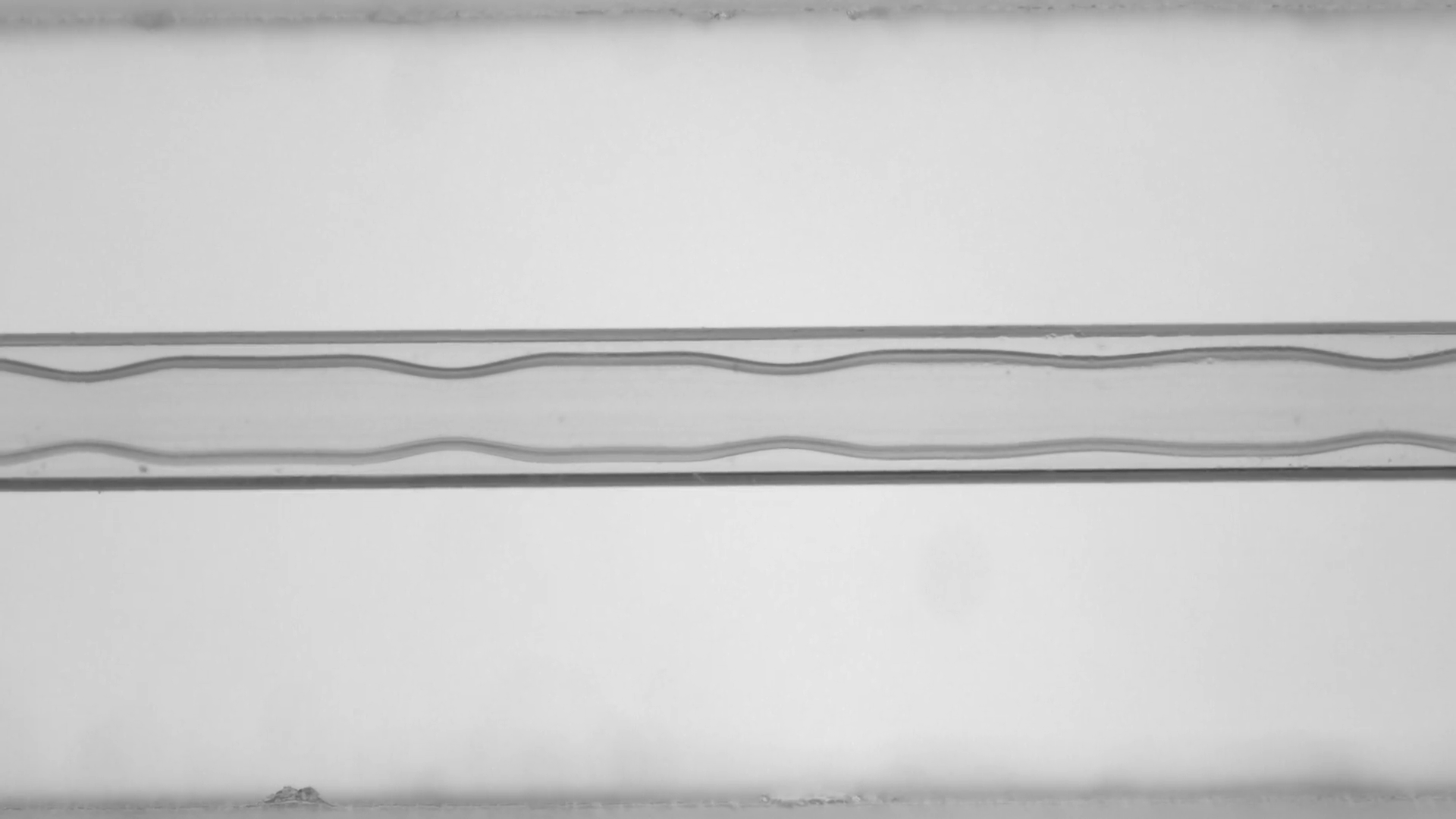
To coat the interior of a capillary tube, you typically fill the tube with a viscous liquid, then pump air in to displace the liquid, leaving behind a thin film of the viscous fluid. Keeping that film uniform and thin is a challenge, though, since the pumps used often struggle to keep a consistent low flow rate. Instead, a team of researchers used spin coating to treat the interior of capillary tubes.
Their apparatus consisted of a repurposed computer fan, stripped of its blades and fitted with a 3D-printed platform that could hold capillary tubes (left). When spinning, an oil slug inside each tube gets forced outward from the center of the platform, leaving behind a thin, uniform film coating in the tube. The group found that some fluids develop a wavy, Plateau-Rayleigh instability in the film once spinning stops (right), which is useful for creating a consistent wavy interior for the tube, particularly when using curable polymers for the coating. (Image, research, and submission credit: B. Primkulov et al.)
For a long time, people thought baseball aerodynamics were simply a competition between gravity and the Magnus effect caused when a ball is spinning. But the seams of a baseball are so prominent that they, too, have a role to play. Here’s a baseline image of flow around a non-spinning baseball:
An non-spinning baseball with a straight, unaltered wake.
As in our previous post on golf, the colors indicate the direction of vorticity but don’t matter much to us here. What’s important is that the wake behind the ball is straight, indicating that there is no additional force beyond gravity and drag acting on the ball. Contrast this to the spinning baseball below:
Flow around a baseball spinning clockwise.
This ball is spinning in a clockwise motion, which causes flow to separate from the ball earlier on the advancing (bottom) side and later on the retreating (top) side. As a result, the wake is tilted downward. This indicates an upward force on the ball, caused by the Magnus effect.
But what if the seams fall in a place where they affect the flow? Here’s another baseball that’s not spinning:
Flow around a non-spinning baseball with a seam-shifted wake caused by early separation on the top surface of the baseball.
Notice that seam sitting just past the widest point on the top of the baseball. Flow around that wide point (called the shoulder) is very sensitive to disturbances essentially because the boundary layer is just barely hanging on to the ball. The blue arrow marks where the boundary layer separates from the ball on the top, which takes place earlier than the flow separation on the bottom, marked by the red arrow. As a result, the wake of the ball is tilted upward, indicating a downward force on the ball. The researchers who first proved this effect call it a seam-shifted wake, and it turns out to be a very common effect in baseball. They’ve got a great blog dedicated to baseball aerodynamics where you can learn tons more if you’re interested. (Image credit: top – Pixabay, others – B. Smith; research credit: B. Smith; see also Baseball Aerodynamics)
Today wraps up our Olympic coverage, but if you missed our earlier posts, you can find them all here.
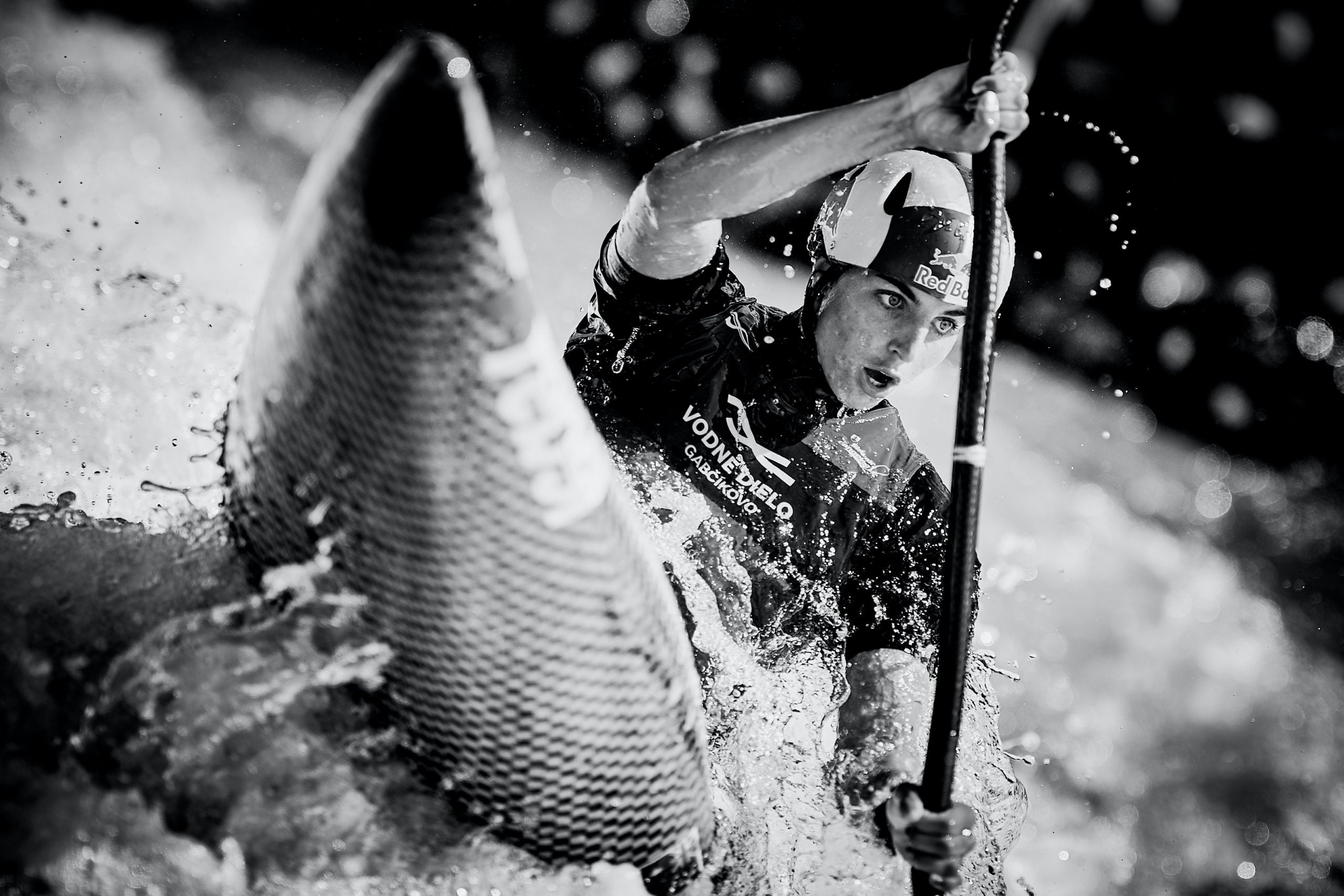
The Kasai Canoe Slalom Course is Japan’s first man-made whitewater venue. To test the design and its multiple configurations, engineers at CTU in Prague built this large-scale hydraulic model. Check out the video below to see it under construction and in action.
The course is adaptable so that it can be used for high-level competitions like the Olympics, then reconfigured for recreational use. You can even see what it’s like to run part of the course in a multi-person raft, thanks to a miniature, GoPro-equipped boat! (Image credit: top – M. Trizuliak, others – CTU Prague; video credit: CTU Prague)
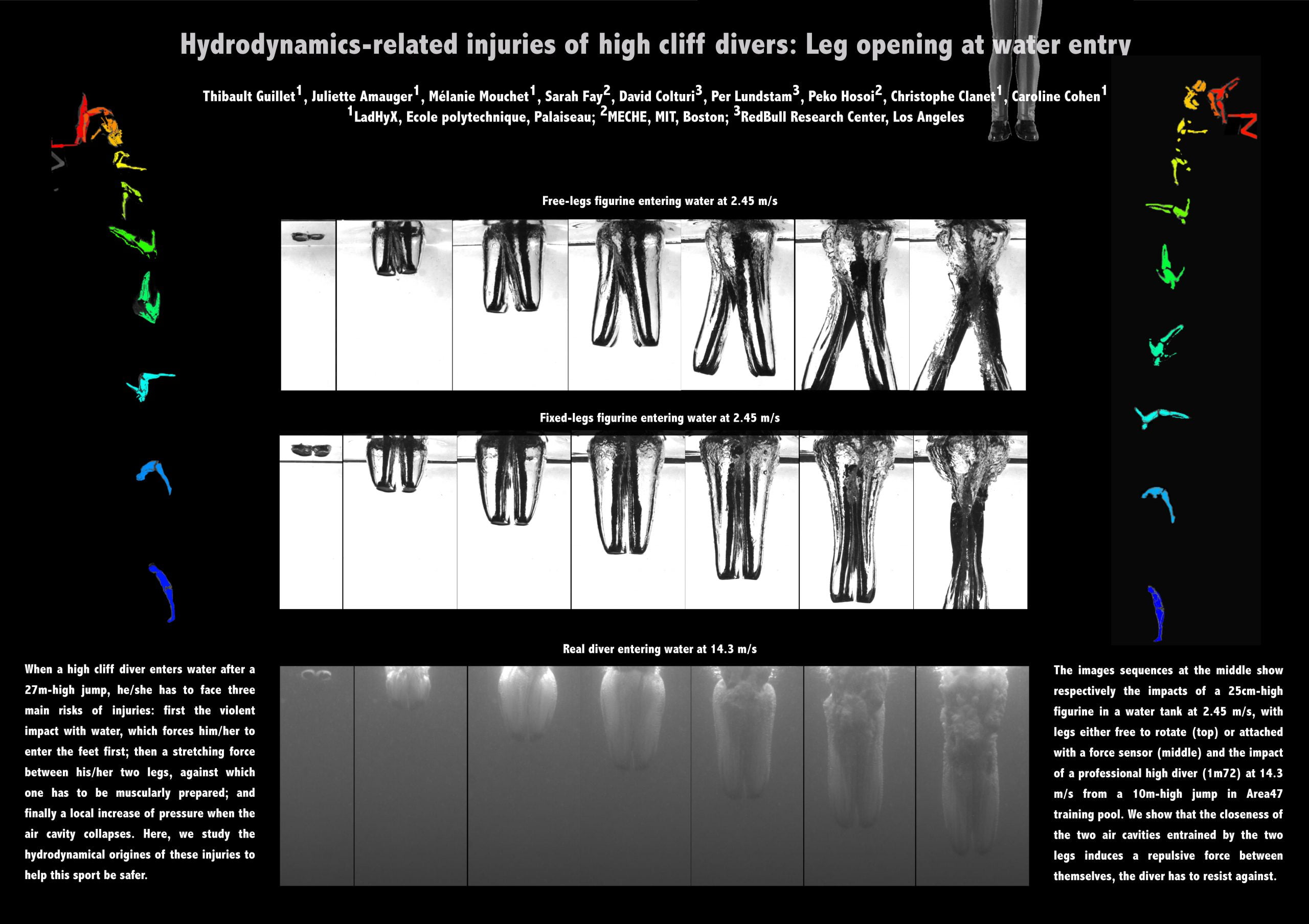
In Olympic high-diving, athletes leap from a maximum of 10 meters above the water. Although the force of their water impact is substantial, it’s small enough that they can enter the water head first. For cliff divers — who may jump from 27 meters! — the impact force is too great to risk a head-first entry, so they enter the water feet first. But this does not eliminate their risk of injury.
As the diver’s body enters the water, each leg creates its own cavity, and the proximity of the two cavities generates a repulsive force. If the diver isn’t prepared to resist that force, it will force their legs apart, potentially injuring them. (Image and research credit: T. Guillet et al.)
It’s a bit mindboggling, but by exploiting physics and geometry, a sailboat can reach speeds faster than the wind propelling it. Steve Mould demonstrates how in this video using some cool tabletop set-ups. Like a wing, a sail generates force by changing the direction of the incoming air. But the optimal speed for a sail is the one where the the flow doesn’t get deflected from its initial path at all (middle). If the sail were moving slower than this, the air would get pushed aside, creating a force that accelerates the boat. If the sail were moving faster, the air’s deflection would generate low pressure that would slow the boat down. Given this ideal match, it’s straightforward to show that, with the right sail angle, a boat can cover more distance than the air pushing it does in the same amount of time (right). Part of the mark of a great sailor is knowing how to manipulate this relationship to maximize your boat’s speed! (Image and video credit: S. Mould)
Golf returned to the Olympics in 2016 in Rio and is back for the Tokyo edition. Golf balls — with their turbulence-promoting dimples — are a perennial favorite for aerodynamics explanations because, counterintuitively, a dimpled golf ball flies farther than a smooth one. But today we’re going to focus on a different aspect of golf aerodynamics, namely, what happens when a golf ball is spinning. Here’s an animation showing the difference between flow around a non-spinning golf ball and flow around a golf ball spinning at 3180 rpm. Both balls are moving to the left at 30 m/s.
Animation toggling between a non-spinning and spinning golf ball moving at 30 m/s.
The colors in this image indicate the direction of vorticity (which is unimportant for us at the moment). What matters are the blue and red arrows, which mark where flow is leaving the surface of the golf ball, in other words, where the wake begins. For the non-spinning golf ball, flow leaves the ball at the same streamwise position on both sides of the ball. This gives a symmetric wake that is neither tilted upward nor downward.
On the spinning ball, though, the blue arrow on top of the ball moves backward, indicating that separation occurs later. On the lower surface, the red arrow moves forward, so separation happens earlier. These shifts cause the golf ball’s wake to tilt downward, which — by Newton’s Third Law — tells us that the ball is experiencing an upward force. This is known as the Magnus effect, and it plays a big role in soccer, volleyball, tennis, and any other sports with spinning balls.
The sleek hulls of racing boats are designed to minimize drag, but there’s optimization to the oars as well. Mathematical models – and the history of rowing – indicate that shorter oars are more ideal for the sprint-style races seen in the Olympics. Shorter oars may be less efficient at transferring energy, but they’re easier to move quickly, and an athlete’s higher stroke rate more than makes up for the loss of efficiency. (Note that the advantage only holds for sprint events; in endurance events, a longer oar is preferable because holding a high stroke rate for a long time is difficult.)
Physicists have taken this a step further by building a mathematical model that predicts the optimal oar length for a given athlete, based on their height, strength, and other characteristics. They validated their modeling with a robotic rowboat. They note, however, that the effects are really only useful for elite rowers. Amateurs are better served by learning proper technique than they are by using an optimal length oar. (Image credit: J. Calabrese; research credit: R. Labbé et al.; via APS Physics)
Surfing is making its Olympic debut this year with a shortboard competition held at Shidashita Beach, with the event’s timing determined by weather and wave quality. The fluid dynamics involved in surfing could easily fill their own series of posts, so we’ll just scratch the surface here. Check out the video embedded below for a nice overview.
We sometimes think of waves as enormous walls of water moving on the ocean, but the truth is that individual water particles move very little when a wave passes. Instead waves are a method of transferring energy through the water, and surfers harness this energy while negotiating a delicate balance of forces between gravity, buoyancy, and hydrodynamics.
So how do surfers catch a wave? After all, anyone who’s been to the beach or in a wave pool knows that waves can easily pass without carrying you along with them. To ride a wave, surfers orient themselves in the direction the wave is traveling, then they paddle to bring their velocity close that of the incoming wave. Their surfboard helps by providing a large surface for the water to push, accelerating the surfer as the wave approaches. The longer and larger a surfboard is, the less speed the surfer themself has to provide. This is one reason it’s easier to catch a wave on a longboard than on a shortboard. But shortboards — like those used by competitors in the Tokyo Olympics — are far more maneuverable, allowing surfers more freedom in the moves they choose to make as they ride. (Image credit: B. Selway; video credit: TED-Ed; see also M. Grissom and Science Connected)
Recent controversies over swimsuit technologies haven’t damped the creativity of Speedo’s marketing staff. They recently unveiled Fastskin 4.0, a futuristic concept designed for the swimmers of 2040*. They’ve envisioned a custom-made, biodegradable, self-powered swimsuit that looks like a superhero’s costume. Some of the technologies strike me as extremely pie-in-the-sky, but a few of them have at least some basis in reality. Of particular interest to us, of course, are the Dynamic Flow Zones and the Shark Skin Boosters, two features intended to minimize drag and boost speed.
The Dynamic Flow Zones seem to be part of a built-in exoskeleton around the swimmer’s midriff, and they are apparently inspired by the underbelly of whales. At least one study shows that similar ridges on whale sharks help reduce flow separation on their bodies, but — given the vastly different swim styles of a human and a whale shark — it’s unclear to me that these structures would help a human swimmer. It also seems as though their helpfulness would be strongly dependent on what stroke the swimmer was using.
As for the Shark Skin Boosters, a shark’s skin does, in fact, helps its speed and agility. Individual denticles on the shark can (passively) bristle when flow near the skin tries to reverse direction. The adaptation helps them shut down flow separation before it happens, thereby maintaining flow control and low drag. Additionally, studies of 3D-printed shark skin have shown that the right texture can provide a speed boost. It would take some work to figure out just the right texture to adapt the shark’s ability to a human swimmer, but this is one feature of Fastskin 4.0 that isn’t just science fiction. (Image and video credit: Speedo; via Gizmodo)
*To be 100% clear, this product does not exist and likely never will.
Join us all this week for more Olympic-themed fluid dynamics!















![The swimsuit's arms, legs, and (possibly?) shoulders feature a "shark skin texture [that] maximizes propulsion".](https://fyfluiddynamics.com/wp-content/uploads/2021/06/fastskin40C.png "The swimsuit's arms, legs, and (possibly?) shoulders feature a \"shark skin texture [that] maximizes propulsion\".")


![The swimsuit's arms, legs, and (possibly?) shoulders feature a "shark skin texture [that] maximizes propulsion".](http://fyfluiddynamics.com/wp-content/uploads/2021/06/fastskin40C.png)