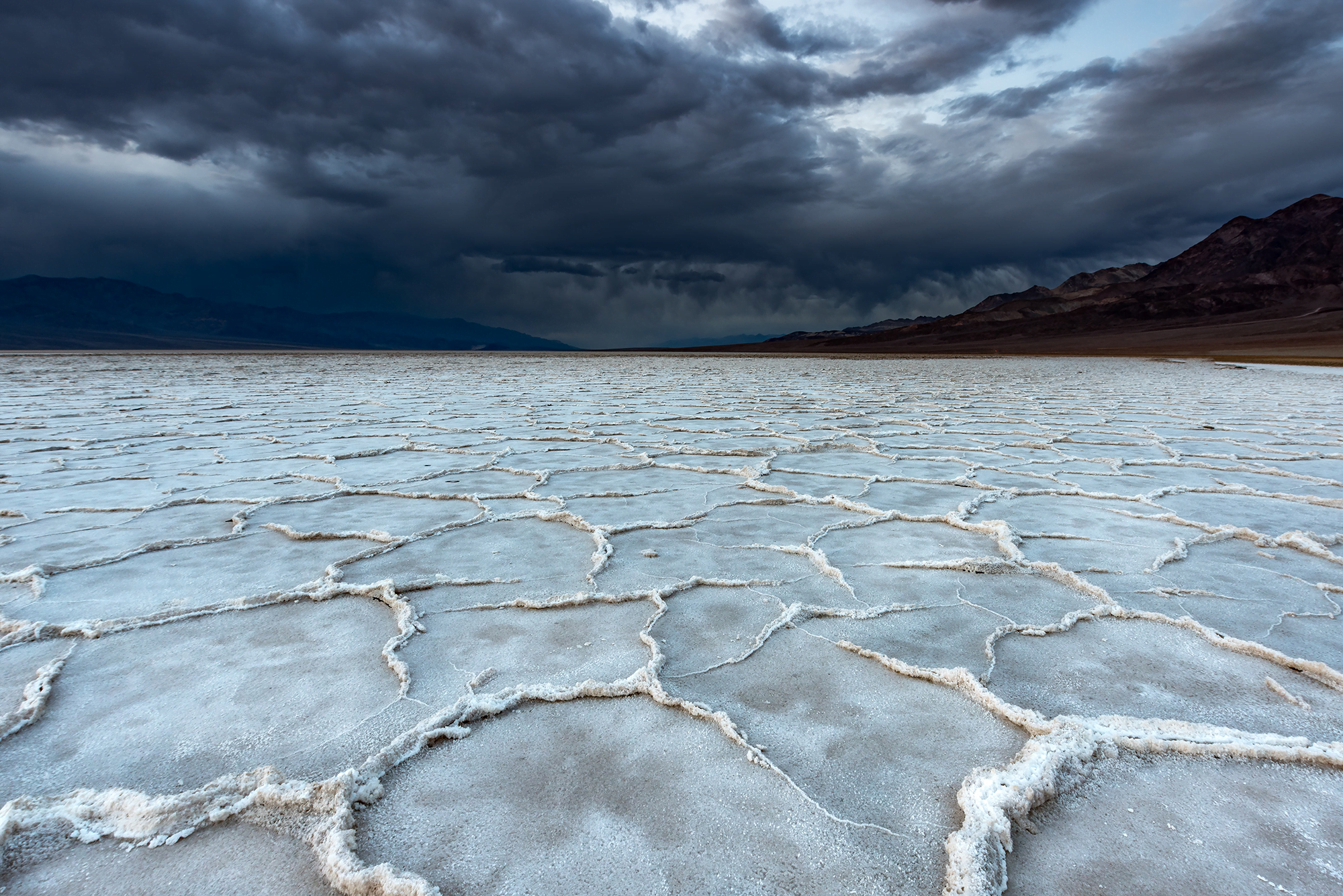
Around the world, salt playas are criss-crossed with meter-sized polygons formed by ridges of salt. The origins of these structures — and the reason for their consistency across different regions of the world — have been unclear, but a new study shows that salt polygons form due to convection happening in the soil underground.
Through a combination of numerical modeling, simulation, lab-scale experiment, and field work, the team revealed the mechanism underlying salt polygons. Areas that form polygons have much greater rates of evaporation than precipitation, and, as water evaporates, these areas draw groundwater from nearby. Salt gets carried with this groundwater.
With strong evaporation, the lake bed forms a highly-concentrated layer of salty water near the surface. Convection cells form, with some regions drawing less saline water upward, while denser, saltier water sinks in other areas. The subsurface convection lines up exactly with the surface structures. The interior regions of polygons are areas where less salty water rises, and salt instead concentrates along the edges of polygons, where saltier water sinks below the surface while evaporation draws solid salt to the surface.

It’s a beautiful result that matches the size, shape, and development time observed for salt polygons in the real world. The team even excavated below salt polygons in Death Valley to confirm that the salt content below ground matched their model’s patterns. Since salt playas are a major source for dust and aerosols that affect climate, their work will be an important factor in future climate modelling. (Image credit: feature – T. Nevidoma, simulation – J. Lasser et al.; research credit: J. Lasser et al.; via APS Physics; submitted by Kam-Yung Soh)
