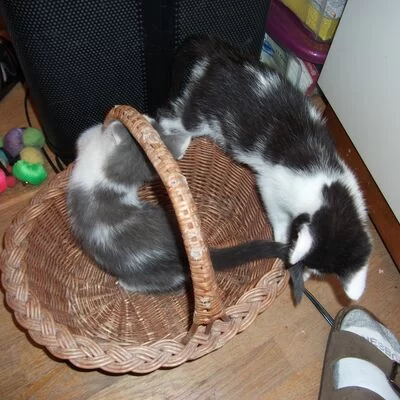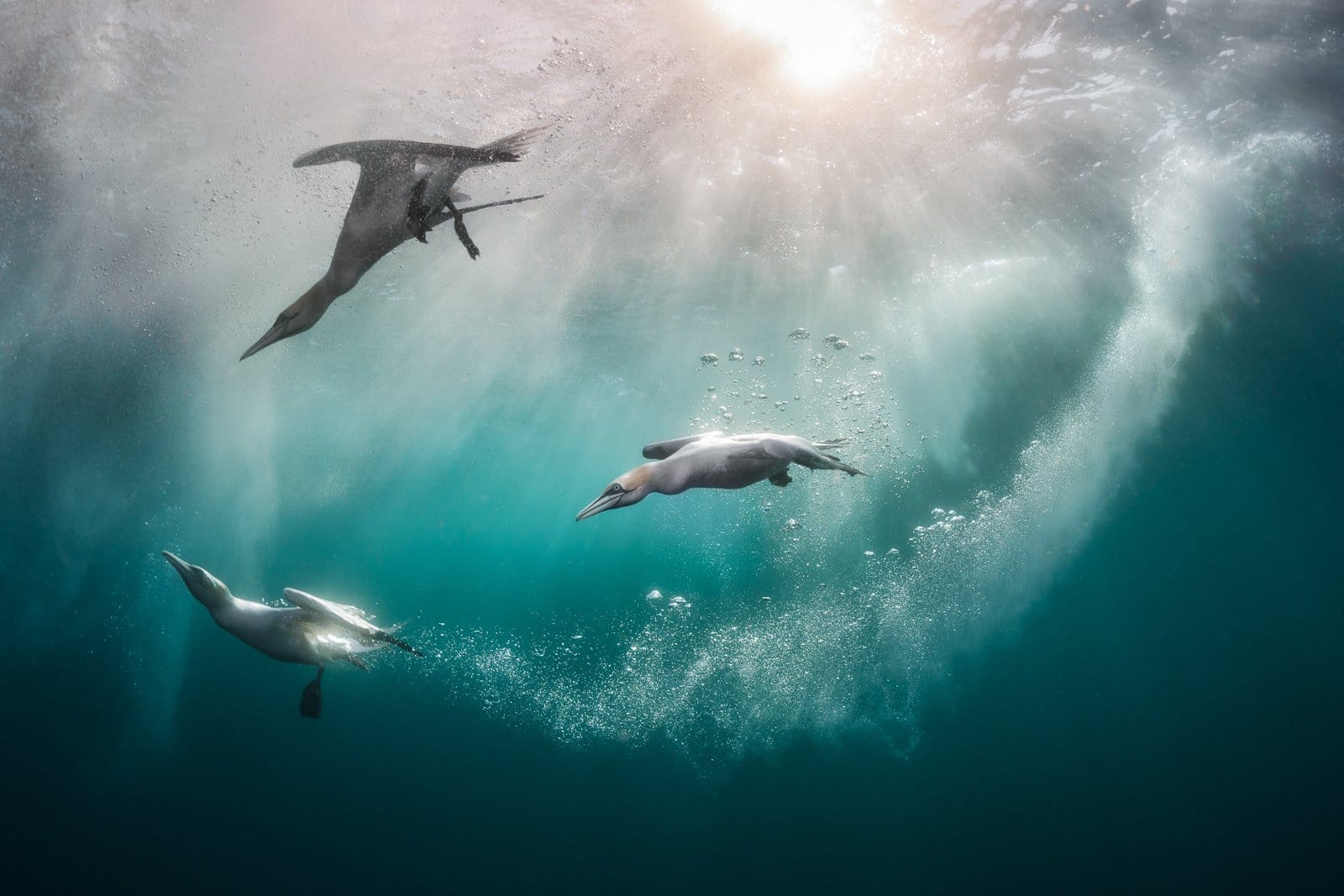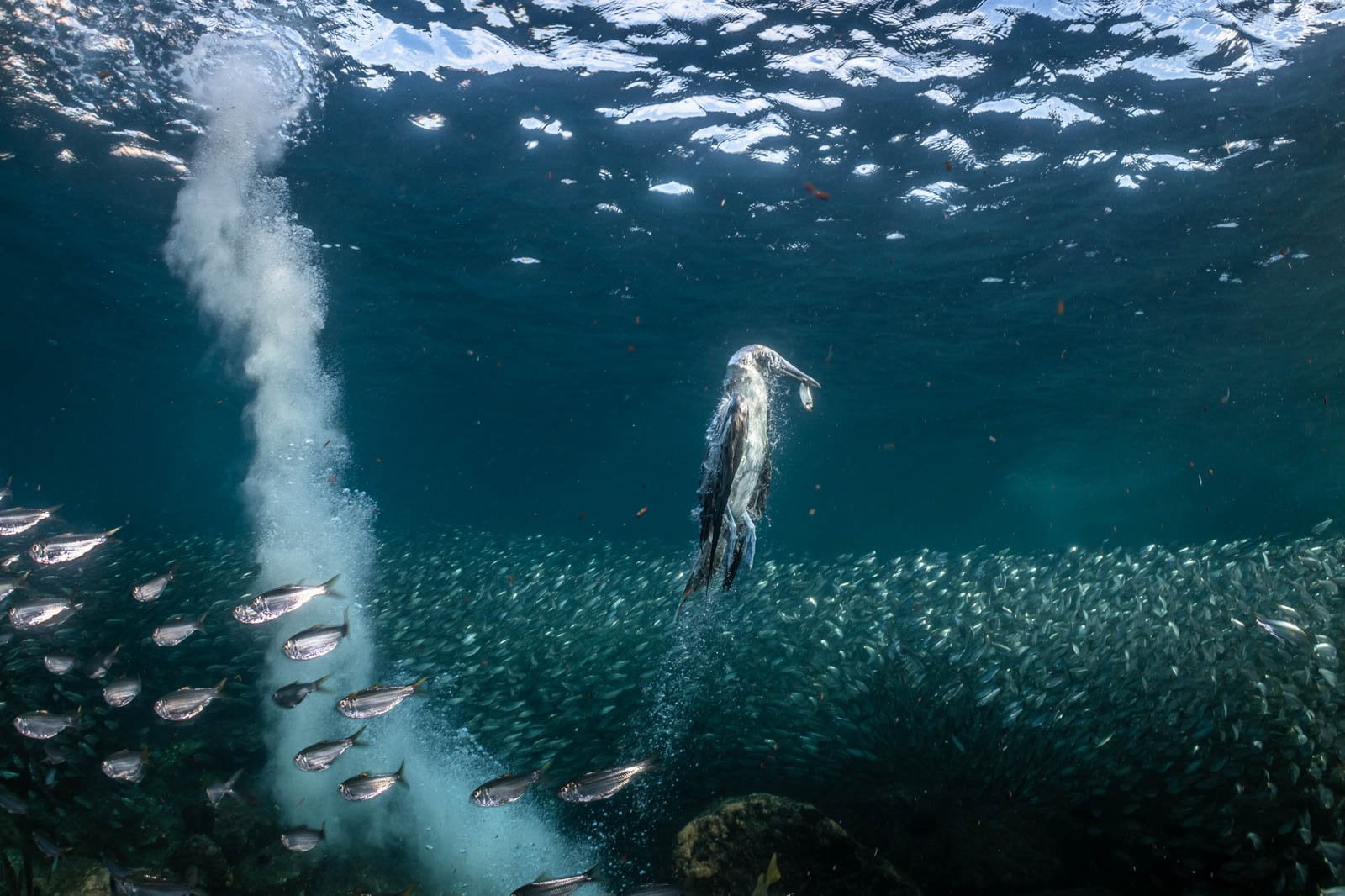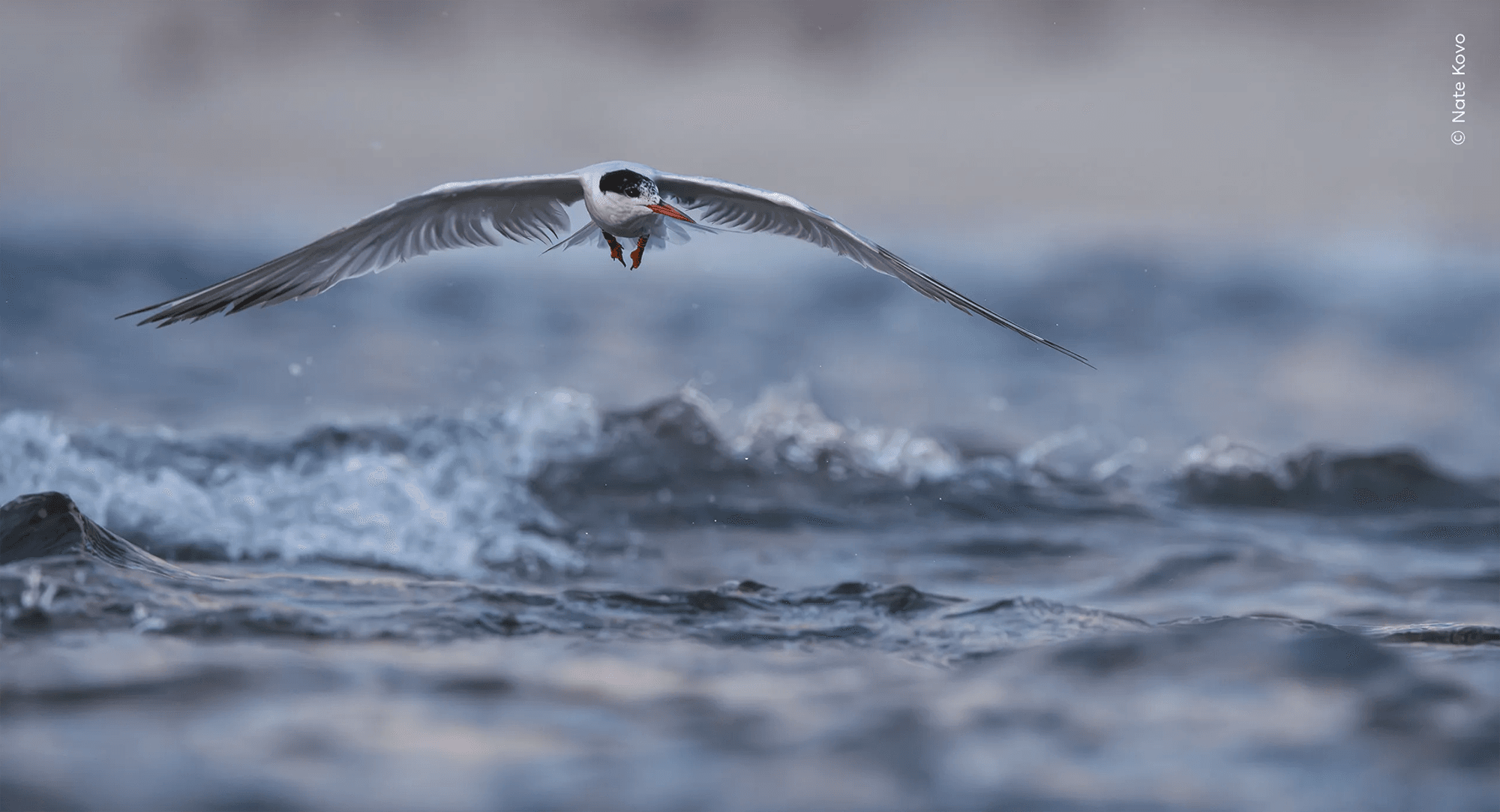
Common terns are gregarious sea birds that cruise low over the water to fish. When they spot prey, they will dip down to grab a fish from the surface, or they will fold their wings to plunge-dive to depths of half a meter. Compared to gannets and boobies, these are slower, shallower dives that involve less impact risk. Presumably the birds’ choice of dive height reflects the typical swim depth of their preferred fish. (Image credit: N. Kovo/WPOTY; via Colossal)
Tag: plunge diving

“Immersion”
Some seabirds, including gannets and boobies, feed by plunge diving. From high in the air, they fold their wings and dive like darts into the water, impacting at speeds around 24 m/s to help them reach the depths where their prey swim. With their narrow beaks and necks, the critical moments in this feat come when the bird’s head is submerged but its body remains out of the water. At this point, the bird’s head is decelerating quickly and its body is still moving at full speed; if the neck cannot withstand this combination of forces, it will buckle.
But plunge divers, it turns out, have a secret weapon that helps them handle impact: their head shape. A study of water entry dynamics using 3D-printed models of birds’ heads found that plunge divers have a shape that increases the amount of time it takes to enter the water. The impact forces stretch out over that longer period of contact, which also stretches out the time it takes for the bird to reach its maximum deceleration. The end result? That extended contact time protects birds from unsafe levels of deceleration, just like a crumple-zone in a crashing car keeps its occupants from experiencing the worst decelerations. (Image credit: K. Zhou/BPOTY; research credit: S. Sharker et al.; via Colossal)

“Through the Bubbles”
Many seabirds catch their prey through plunge diving, where they fly to a particular height, then fold their wings, and dive into the ocean. In busy waters, bubbles from all this diving can help obscure the birds from hapless fish. Some birds even use bubbles to escape from their own predators; some penguin species, for example, release trapped air from beneath their feathers as they surface, creating a flurry of bubbles that reduce the drag they have to overcome as they make their exit from the water. The fast exit and bubbly wake help them escape prowling seals. (Image credit: H. Spiers; via BWPA)

“Divebomb”
Seabirds like gannets and boobies are engineered for diving. They fly to a certain altitude, locate fish underwater, and then fold themselves into a streamlined projectile. With this, they plunge into the water at high-speed, positioned to protect themselves from the forces of impact. Under the water, they dart among their prey, hunting with singular purpose. Photographer Kat Zhou’s “Divebomb” captures the underwater side of this behavior, while showing off the energetic bubbles (and bubble rings!) created by the birds. (Image credit: K. Zhou; via UPY 2024 and Colossal)

Diving From Above
Blue-footed boobies, like many other seabirds, climb to a particular altitude before folding their wings and diving head-first into the water. This acrobatic feat balances the bird’s force of impact and the depth it can reach to ensnare fish swimming there. It’s an incredible process to watch, a fascinating one to study, and, here, a beautiful glimpse of the natural world from a perspective we don’t typically see. (Image credit: H. Spiers, Bird POTY; via Colossal)

Audubon Photography Awards


Several of this year’s Audubon-Photography-Award-winning photos feature birds interacting with fluids. The Grand Prize Winner, by Joanna Lentini, features a diving double-crested cormorant. Like many other species, these cormorants launch themselves into shallow waters from above and endure some incredible forces to do so. They’re no slackers underwater, either; when I encountered a flightless cormorant while snorkeling in the Galapagos, it outswam me in an instant.
The other prize winners above are a little more splashy. The American dipper’s splash curtain comes from sticking its head underwater in search of prey. The Anna’s hummingbird seen in the last image is playing in the spray of a fountain and showing off its aerial agility while doing so! (Image credits: cormorant – J. Lentini, dipper – M. Fuller-Morris, hummingbird – B. Ghosh; via DPReview; submitted by Kam-Yung Soh)

Pelican Diving
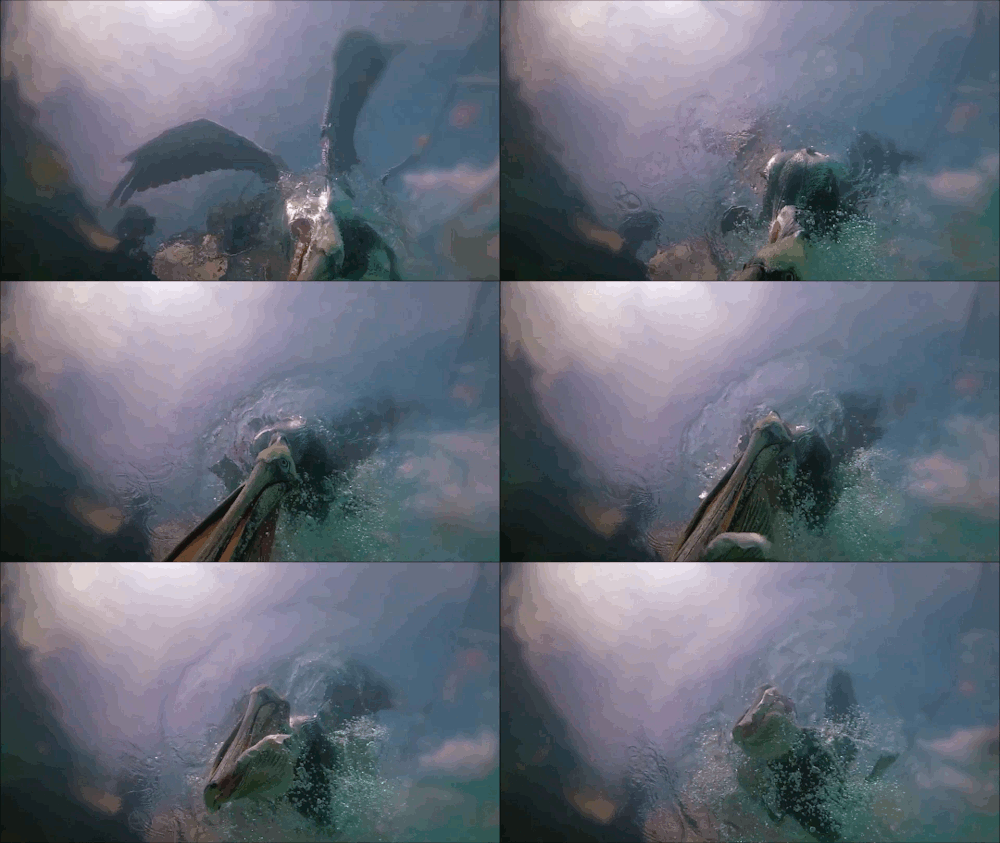
Pelicans, like many sea birds, are aerial divers. They spot their prey from high above, bank, and dive into the water to catch the fish. Although they hit the water at high speeds, pelican diving techniques differ somewhat from plunge divers like gannets or boobies. Pelicans are only aiming for a shallow dive, so they have features – like their expandable neck pouch – that help them decelerate quickly instead of taking a full-body plunge. The goal is to increase drag after the head enters, slowing everything down. That can add more stress to the bird’s neck – the rest of the body is still moving quickly even after the head begins to slow. To counter this compression, the birds must have strong neck muscles to stabilize their spines during the impact process. (Video and image credit: Deep Look)


Galapagos Week: Diving Birds


One of my favorite things to do while we were sailing along the Galapagos was watching the blue-footed boobies hunt. Like the gannets shown above, boobies are plunge divers. They circle overhead until they spot their prey, then they fold their wings and dive headfirst into the water, impacting at speeds of more than 20 m/s (~45 mph). It’s absolutely incredible to watch. The physics involved are impressive, too, especially considering how badly a human would be injured diving at their speeds!
Fluid dynamically speaking, there are three important phases to the birds’ entry. The first is the impact phase, which lasts from initial contact until the bird’s head is underwater. In the second phase, an air cavity forms behind the head and around the neck as it enters the water. Finally, when the chest – the widest point of the bird – hits the water, the bird reaches the submerged phase.
Mechanically, the most interesting part is the air cavity phase. During this time, the bird’s head is slowing down due to high hydrodynamic drag from the water, but the rest of the bird is still moving fast. That means the bird’s slender neck experiences strong compressive forces, which would tend to make it buckle. Researchers at Virginia Tech examined this very problem and found that the birds’ sizing – its head shape, neck length, and so forth – combined with their typical diving speeds kept these birds well away from the conditions that would cause their necks to buckle. With the added stabilization from the birds’ neck muscles, they estimated that gannets and other plunge divers might be able to safely dive at speeds twice what would kill a human! Check out the BBC video below to see high-speed footage of gannets diving. (Image credits: G. Lecoeur; B. Chang et al.; research credits: B. Chang et al., pdf; video credit: BBC)
Tomorrow will be the final day of Galapagos Week. Catch up on previous posts here.