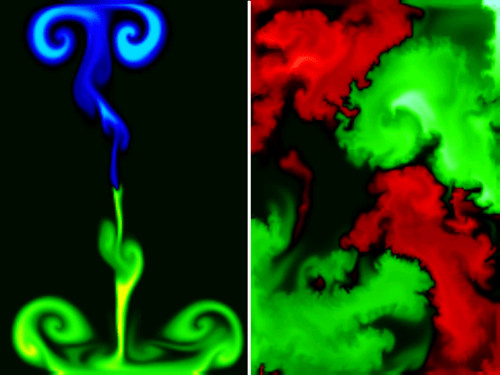
This photo from the Mars Reconnaissance Orbiter stares almost straight down a dust devil on Mars. Like their earthbound brethren, Martian dust devils form when the surface is heated by the sun, causing warm air to rise. The rising air causes a low pressure area that the surrounding air flows into. Any rotational motion of the air intensifies as it is entrained. This is a consequence of conservation of angular momentum. Just as a spinning ice skater spins faster when he pulls his arms in, the vorticity of the inward-flowing air increases, forming a vortex. In addition to dust devils, this same physical mechanism applies to waterspouts and fire tornadoes, although the heating source for those is different. (Photo credit: NASA; via APOD)
Tag: Mars

Martian Barchans
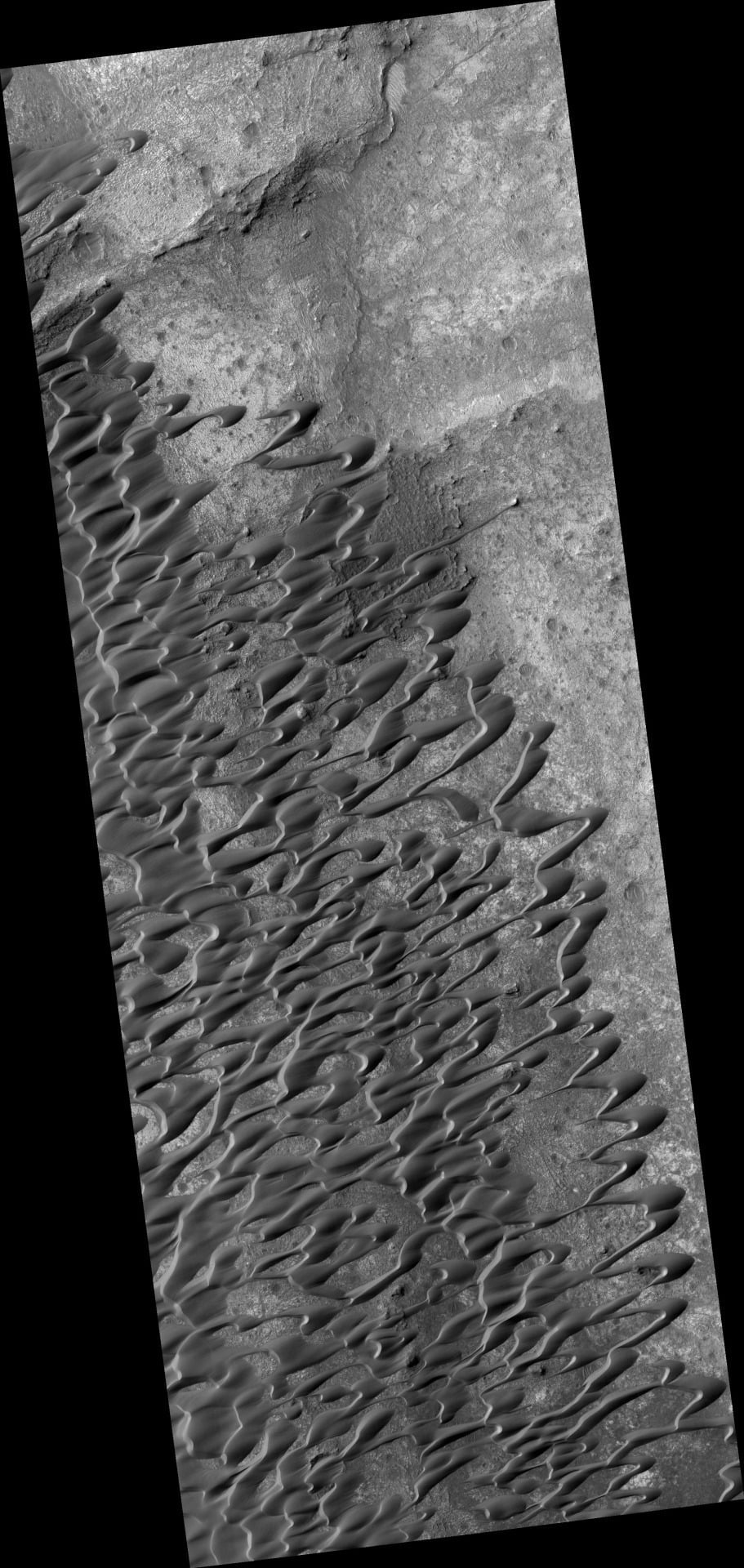
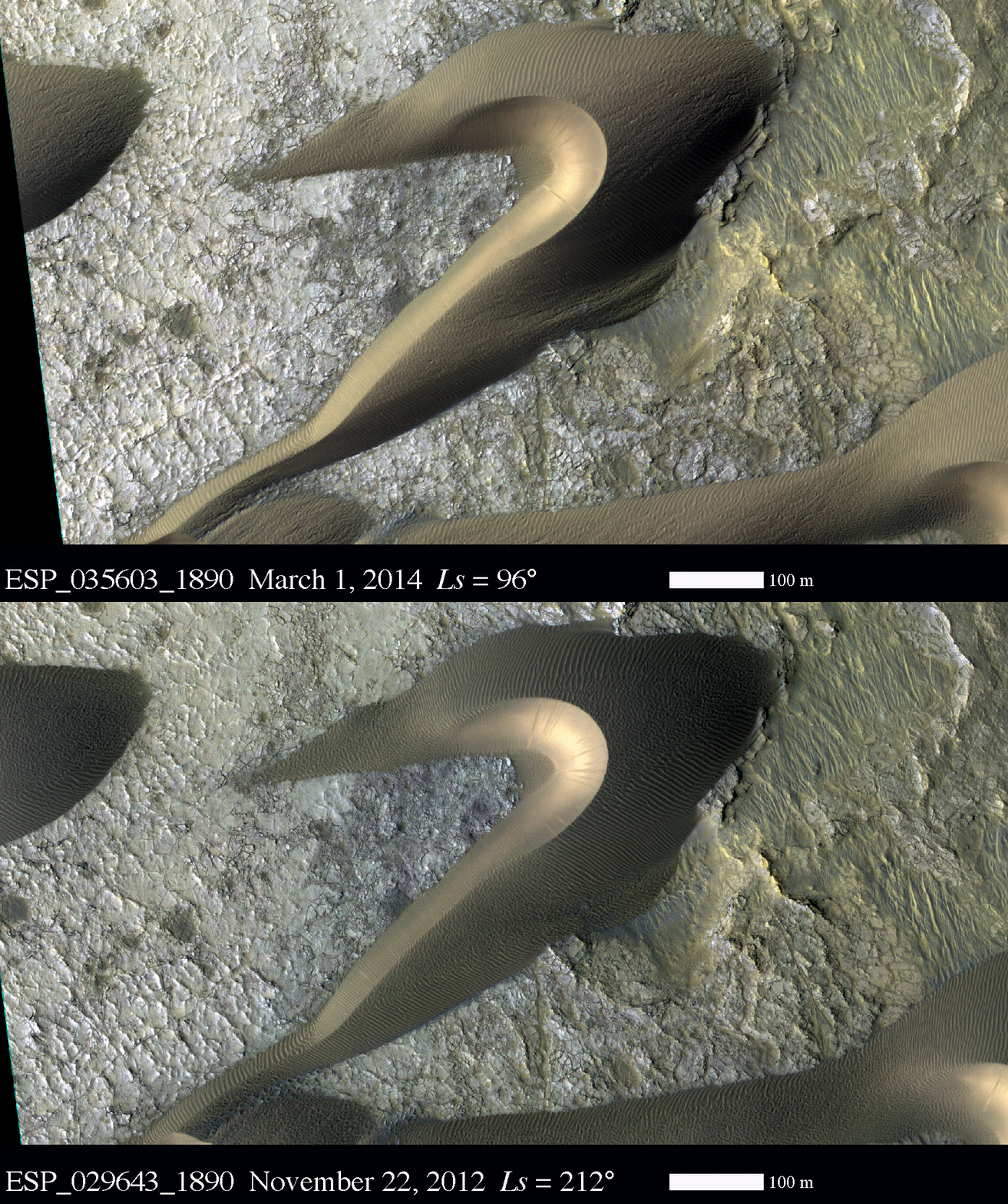
Dunes are a fascinating interplay between fluid and granular flow. This satellite photo shows a dune field on Mars, Nili Patera. The dominant direction of wind flow is from the upper right, pushing the dunes themselves slowly toward the left. Many of the dunes along the edge are barchans, crescent-shaped dunes with a long, gradual slope facing the wind and a steeper leeward side. As the wind blows, it erodes the sand on the windward slope and deposits it on the leeward side. This is how the dune migrates. Check out this close-up of a barchan to see the changes in its ripples and shape over the past couple months. (Photo credit: NASA/JPL/Univ. of Arizona)

Fluids Round-up – 23 June 2013
Time for another round-up! Here are the recent fluidsy links I’ve collected:
- A new study on Mars suggests that dry ice may be forming gullies in dunes in a fashion akin to the Leidenfrost effect. Personally, I’m reminded of Death Valley’s roaming rocks.
- A recent episode of It’s Okay to Be Smart explains what wind is.
- xkcd’s What If blog explores what would happen if you row a boat on different fluids such as mercury, bromine, and liquid helium (for you superfluid aficionados).
- Those who love microfluidics may want to follow Physics in Drops for some small-scale fluid fun.
- Not explicitly fluid dynamical, but this video of a peregrine falcon chasing a downhill mountain biker has some great examples of aerodynamics and the in-flight agility of birds.
- For the Android users among you, be sure to check out Fleya, a multi-touch, real-time fluids simulator. (via Jeremy M/Flow Visualization)
(Photo credit: Fixed Point Code)

Martian Landing Physics

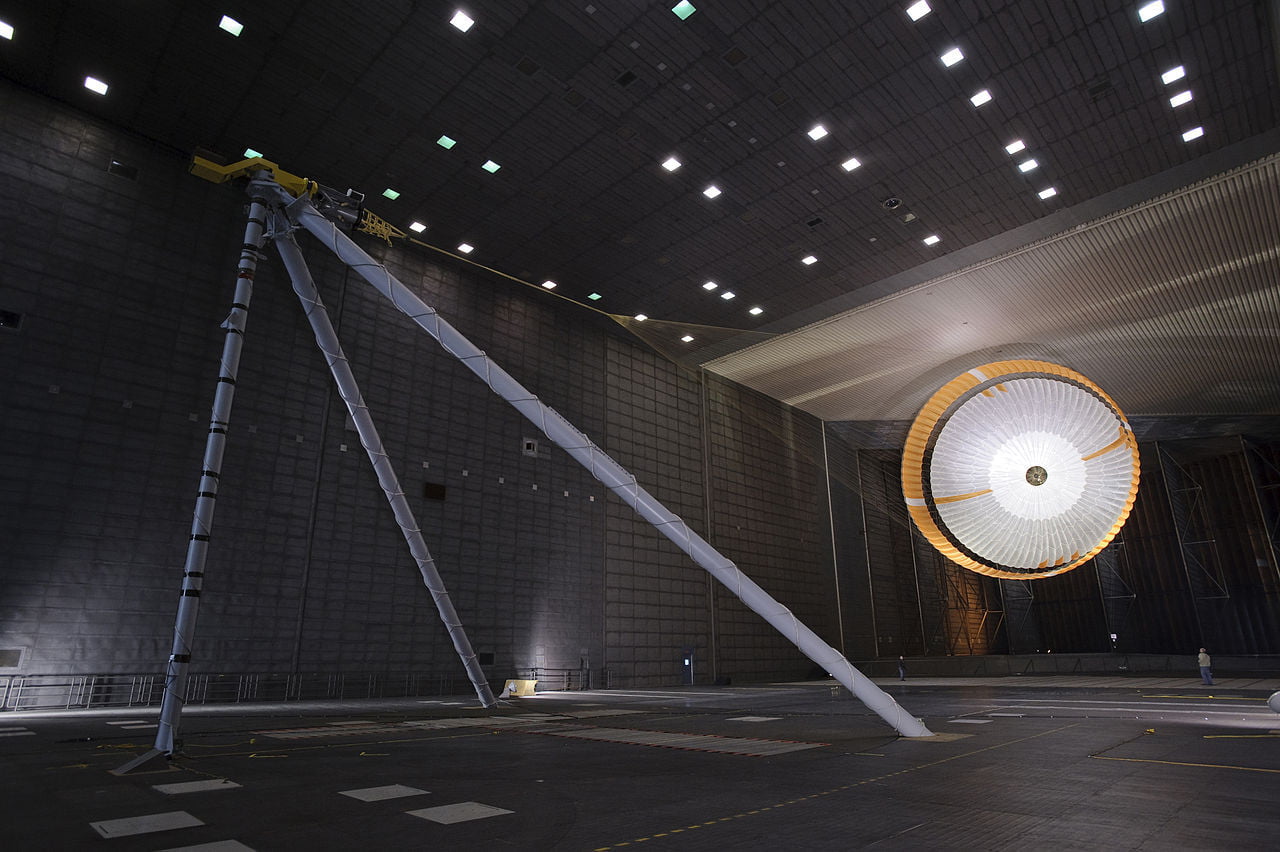
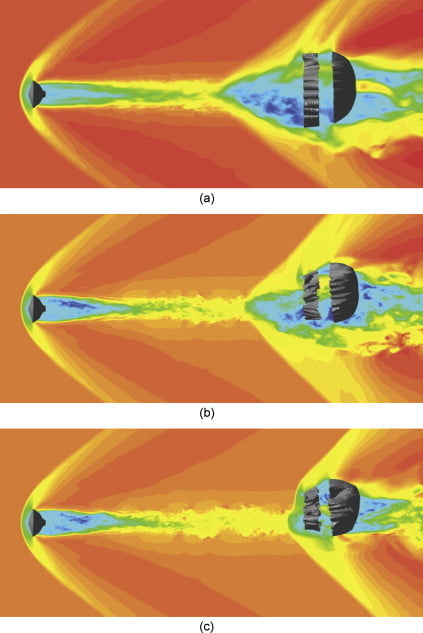
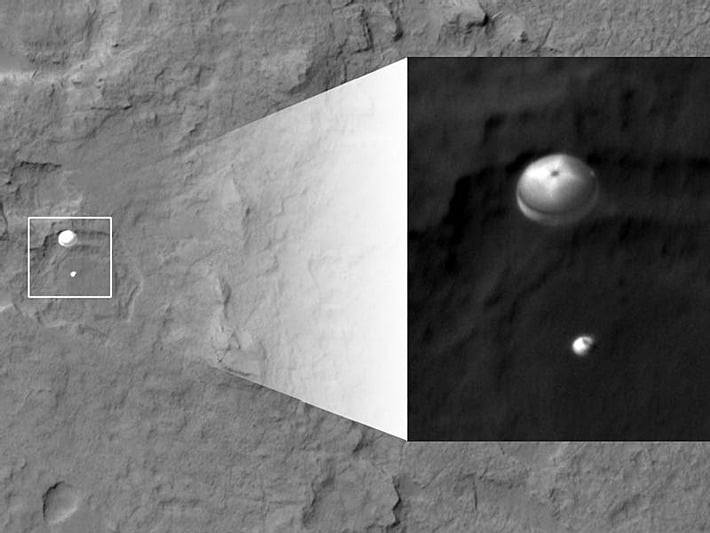
A little over a week ago, NASA’s Curiosity rover landed on Mars, the culmination of years of engineering. The mission’s landing, in particular, was the subject of intense scrutiny as Curiosity’s size necessitated some new techniques in the final segments of the landing sequence. As it hit the Martian atmosphere at 13,000 mph, the compression of the carbon dioxide behind the capsule’s shock wave slowed the descent. At roughly 1,000 mph–speeds still large enough to be supersonic–Curiosity deployed its parachute. Shown above are the parachute in numerical simulation (from Karagiozis et al. 2011), wind tunnel testing at NASA Ames, and during descent thanks to the Mars Reconnaissance Orbiter. The simulation shows contours of streamwise velocity at different configurations; note the bow shock off the capsule and the additional shocks off the parachute. These help generate the drag needed to slow the capsule. For an interesting behind-the-scenes look at the wind tunnel testing for Curiosity’s parachute check out JPL’s four–part video series. Congratulations to all the scientists and engineers who’ve made the rover a success. We look forward to your discoveries! (Photo credits: K. Karagiozis et al., NASA JPL, NASA MRO)