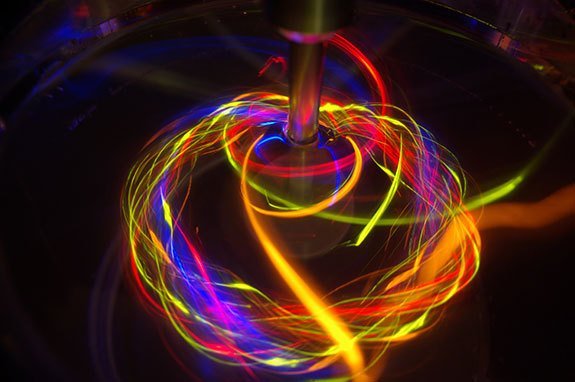
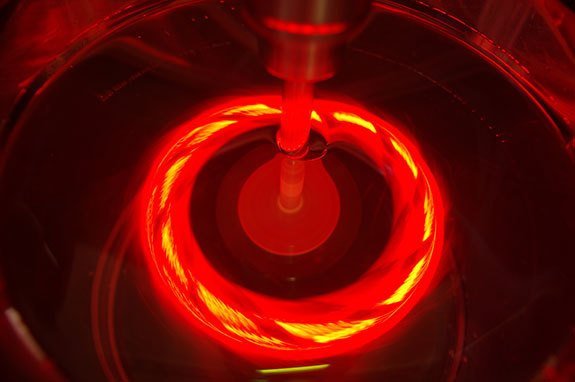
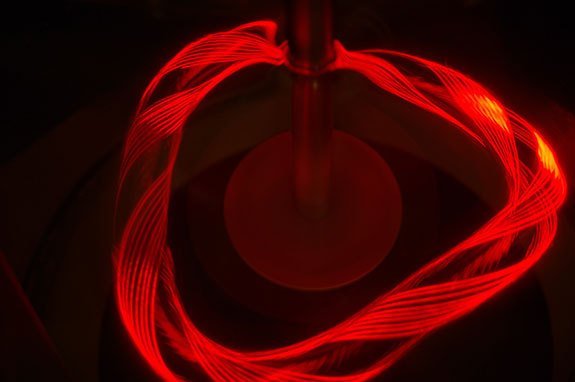
In industry, tanks are often agitated or stirred to mix different elements. The goal is to create a laminar but chaotic flow field throughout the mixture. Introducing particles to such a system reveals that things are not quite as chaotic as they might seem. The photographs above show the pathlines of various large, glowing particles initially poured into the tank from above. Over time, the particles scatter off of structures in the mixed sections of the tank and end up trapped in vortex tubes that form above and below the agitator. Once trapped in the vortex tube, the particles follow helical paths inside the tube, creating patterns like those seen in the lower two photos. (Image and research credit: S. Wang et al., 1, 2, 3)
Tag: laminar

Wavy Vortices
Shown above is the flow between two concentric cylinders (Taylor-Couette flow). In the laminar regime, the velocity profile between the two cylinders is linear. As the rate of rotation of the inner cylinder increases, the flow develops toroidal vortices known as Taylor vortices, seen in the video above after 9 seconds or so. This is a fluid instability exhibited by transitional flow. Increasing the rotational rate further can result in wavy Taylor vortex flow. At high enough speeds, the flow will become completely turbulent.
Effects of Viscosity
[original media no longer available]
Today’s video demonstrates the effect of viscosity, which measures a fluid’s resistance to deformation. On the left is a column of highly viscous fluid; the fluids become less viscous as one moves right. When a jet of dye is released into the highly viscous fluid, the jet is very slow to penetrate, whereas, in the rightmost column, the dye expands quickly into a turbulent jet. Between these extremes, we see a laminar dye jet entering the liquid. The mushroom-like shape the laminar jet takes is the result of the Rayleigh-Taylor instability, which occurs when a denser fluid is on top of a lighter fluid in a gravitational field.


