Tag: laminar mixing

  • Chaotic Mixing in Porous Media

    Chaotic Mixing in Porous Media

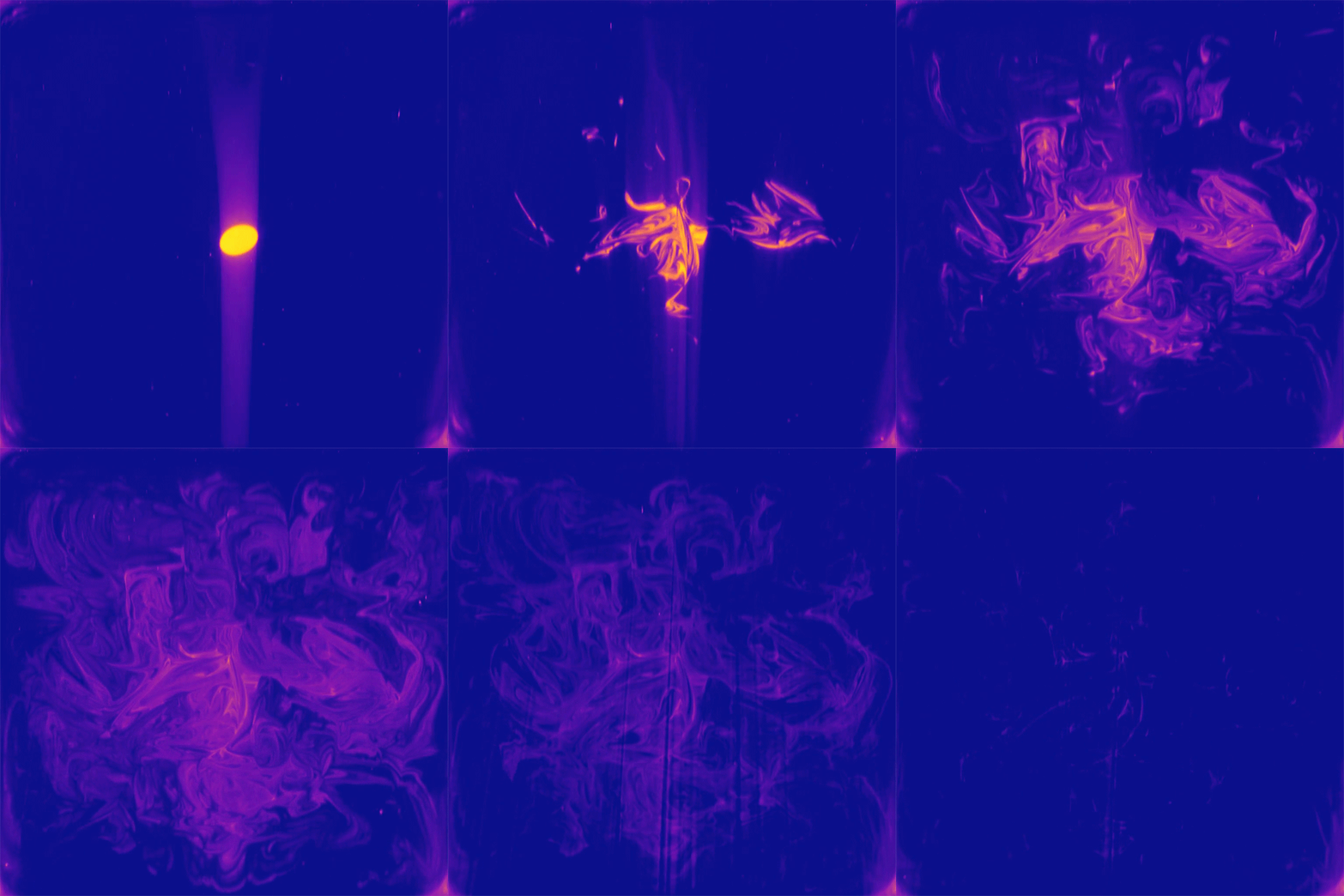
    One of the peculiar characteristics of viscous, laminar flows is that they are reversible. Squirt dye into glycerin, stir it one way, then the opposite direction, and the dye returns to its initial position. But this neat trick only works in simple geometries; in a more complex environment, like the pores between packed gravel, flows cannot make their way back to their initial state.

    That’s the idea at the heart of this new study of mixing in porous media. Researchers took a bed of packed beads and pushed a slow, steady flow of dye into the bed. Then they steadily withdrew fluid to reverse the flow and observed how the dye they’d injected appeared at the surface of the bed (top image). If the flow were perfectly reversible, we’d expect the dye to return to its injection point. But instead the dye is spread chaotically across the surface, giving researchers a snapshot of the chaotic mixing taking place between beads. (Image and research credit: J. Heyman et al.; via APS Physics)

  • Peering Between Particles

    Peering Between Particles

    Turbulence is not the only way to mix fluids. Even a steady, laminar flow can be an effective mixer if geometry lends a hand. Above, two dyes, fluorescein (green) and rhodamine (red), are injected into a porous flow through packed spheres. The flow runs from bottom to top in both images. Seeing the flow in such a crowded geometry is challenging. Here researchers used spheres with an index of refraction that matches water – that helps them avoid refraction that would prevent them from looking through spheres to the flow on the other side. They also lit a narrow plane of the flow using a laser sheet to isolate it. Together, this allowed the researchers to track the mixing of the two initially separate streaks of dye as they randomly mix in the spaces between spheres. (Image and research credit: M. Kree and E. Villermaux)