This video shows a CFD simulation of a bullet passing through a parallel channel at Mach 2. The simulation captures 3 milliseconds of real-time and shows the Mach number in the top view and the temperature in the bottom view. Note how the bow shock near the front of the bullet and the trailing shock behind it reflect off the walls of the channel and interact. Even though the calculation is inviscid, the shock waves cause intense heating (white) in front of and behind the bullet.
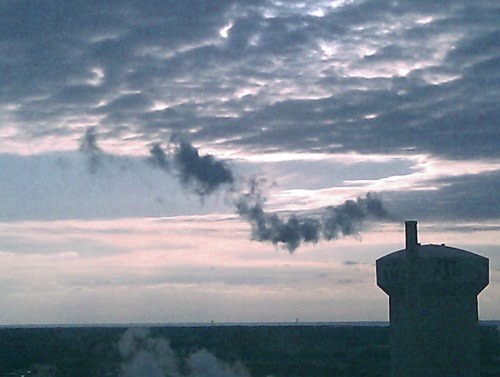
On a cold and windy day, the plume from a smokestack sometimes sinks downstream of the stack instead of immediately rising (Figure 1). This isn’t an effect of temperature–after all, the exhaust should be warm compared to the ambient, which would make it rise. It’s actually caused by vorticity.
Figure 2: Simple geometry (side view)
In Figure 2, we see a simplified geometry. The wind is blowing from right to left, and its velocity varies with height due to the atmospheric boundary layer. Mathematically, vorticity is the curl of the velocity vector, and because we have a velocity gradient, there is positive (counterclockwise) vorticity generated.
Figure 3: Vortex lines (top view)
According to Helmholtz, we can imagine this vorticity as a bunch of infinite vortex lines convecting toward the smokestack, shown in Figure 3. Those vortex lines pile up against the windward side of the smokestack–Helmholtz says that vortex lines can’t end in a fluid–and get stretched out in the wake of the stack. If we could stand upstream of the smokestack and look at the caught vortex line, we would see a downward velocity immediately behind the smokestack and an upward velocity to either side of the stack. It’s this downward velocity that pulls the smokestack’s plume downward.
Figure 4: Vortex wrapped around stack
Now Helmholtz’s theories actually apply to inviscid flows and the real world has viscosity in it–slight though its effects might be–and that’s why this effect will fade. The vortex lines can’t sit against the smokestack forever; viscosity dissipates them.