Tag: folding

  • Why Creases Don’t Disappear

    Why Creases Don’t Disappear

    Flex your fingers and you’ll see your skin fold into well-defined creases. Many soft solids (including old apples) fold this way, and like your skin, the creases never fully disappear, even when the stress is removed. A recent study finds that surface tension and contact-line-pinning are critical to the irreversibility of these creases.

    The authors studied sticky polymer gel layers under a confocal microscope as the gel folded. In doing so, they found that surface tension dictates the microscopic geometry of a fold, causing the two sides of a surface to touch. They also found that completely unfolding a creased surface requires more energy than folding it in the first place did because the folded surfaces adhere to one another.

    When unfolded, the crease behaves somewhat like a droplet on a rough surface. Such droplets move in fits; their contact line stays pinned to the rough microscopic peaks of the surface until there’s enough energy to overcome that attachment and the contact line jumps to another position. Similarly, a creased surface cannot simply unfold smoothly. Adhesion ensures that part of the crease remains, serving as a starting point for the next fold-unfold cycle. (Image credit: C. Rainer; research credit: M. van Limbeek et al.; via APS Physics; submitted by Kam-Yung Soh)

  • Folding Fluids

    Folding Fluids

    Highly viscous liquids – like cake batter, lava, or the spider silk above – fold as they fall. Several factors impact this instability including the fluid’s density, viscosity, surface tension, and how thin the falling sheet is. As with the coiling of falling honey, this behavior is actually a form of buckling. It’s also fascinating to watch how persistent the layers are. Even out near the edge of the puddle, you can still see individual folds. This is a sign of just how incredibly viscous the spider silk is. Imagine if this were cake batter instead: we’d see folding just like we do with the spider silk proteins, but the individual folds would quickly fade as the batter flowed to fill its container. The spider silk is more viscous, so it’s more resistant to flowing. (Image credit and submission: D. Breslauer, source)

  • Wrapping Droplets

    Wrapping Droplets

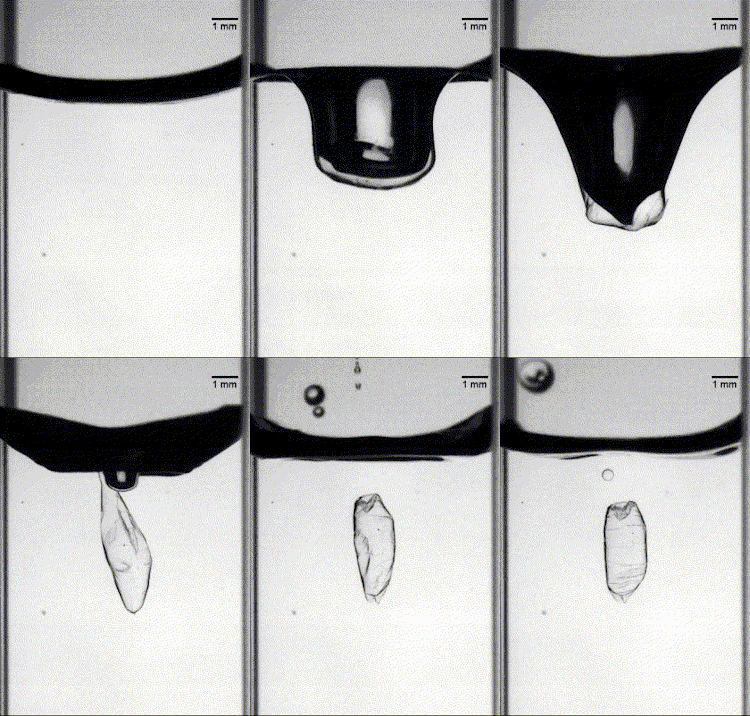
    Future efforts for targeted drug delivery may require encapsulating droplets before transporting them to their final location. One method for encapsulation is wrapping a drop in a thin, solid sheet. Previously, we saw that drops can wrap themselves with a little outside assistance, but here the drops achieve that same feat on their own, using the energy of droplet impact to wrap liquids. 

    Here’s how it works: float a thin sheet on a bath of a liquid like water, then let an oil drop fall into the bath. Its impact deforms the air-water interface and, with a sufficiently energetic impact, causes the oil droplet to pinch off. The flexible sheet wraps around the droplet, and the encapsulated droplet sinks due to gravity. The shape of the final drop depends on the sheet’s initial geometry. The researchers have successfully used circular, triangular, and cross-shaped sheets to wrap droplets. Check out the original paper or the video below for more. (Image and research credit: D. Kumar et al.; video credit: Science)

  • Self-Wrapping Drops

    Self-Wrapping Drops

    A liquid drop can fold itself up in a thin sheet. The animation above shows a drop of water with an ultra-thin (79nm) circular sheet of polystyrene atop it. As a needle removes water from the underside of the droplet, the shrinking droplet causes wrinkles and folds to form in the sheet. What’s going on here is a competition between the energy required to change the droplet’s shape and the energy needed to bend the sheet. Eventually, the droplet’s volume is small enough that the bending of the sheet overrules surface tension in dictating the droplet’s shape. The result is a tiny empanada-shaped droplet completely encapsulated by the sheet. (Image credit: J. Paulsen et al., source; research paper)