Tag: fluid dynamics

  • Underwater Optical Illusions

    Underwater Optical Illusions

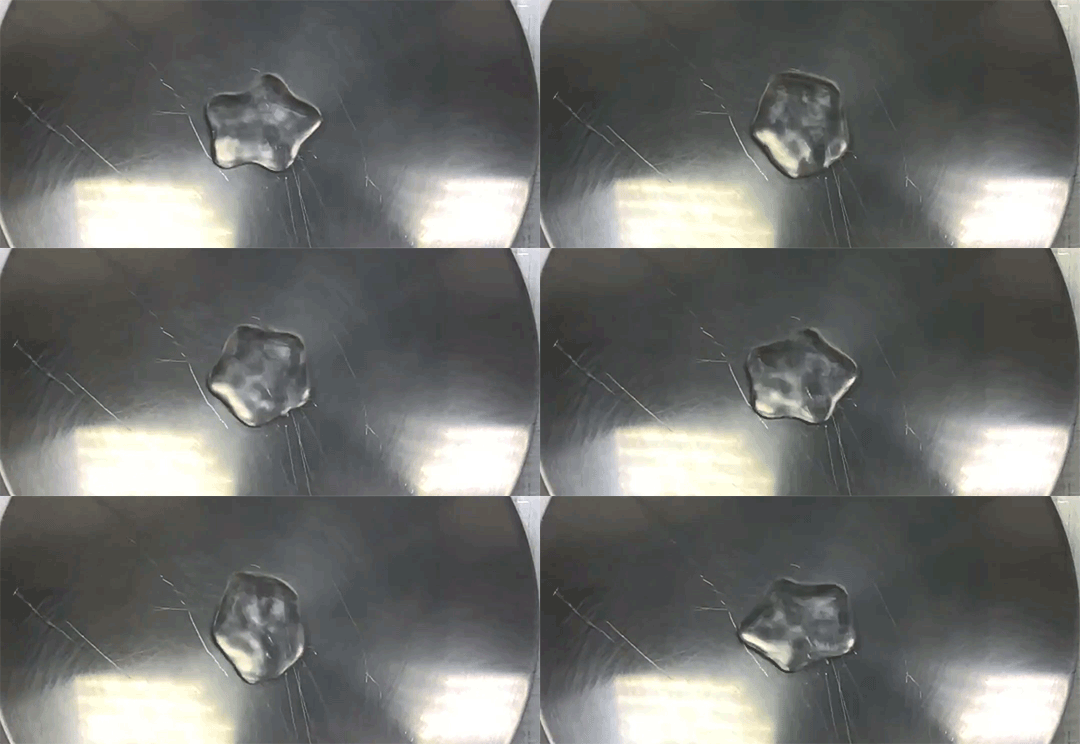
    On a hot day, it’s not unusual to catch a glimpse of a shimmering optical illusion over a hot road, but you probably wouldn’t expect to see the same thing 2,000 meters under the ocean. Yet that’s exactly what a team of scientists saw through the cameras of their unmanned submersible as it explored hydrothermal vents deep in the Pacific Ocean.

    At these depths, the pressure is high enough that water can reach more than 350 degrees Celsius without boiling. The hot fluid from the vents rises and gets caught beneath mineral overhangs, forming a sort of upside-down pool. Since the index of refraction of the hot water is different than that of the colder surrounding water, we see a mirror-like surface at some viewing angles. Be sure to check out the whole video for more examples of the illusion. (Image and video credit: Schmidt Ocean; via Smithsonian; submitted by Kam-Yung Soh)

  • Featured Video Play Icon

    “Aurora”

    In “Aurora”, artist Rus Khasanov uses fluids to create a short film full of psychedelic color and cosmic visuals. As in a soap bubble, the bright colors – as well as the pure black holes – come from the interference of light rays. The colors directly relate to the thickness of fluid, and they allow us to see all the subtle flows caused by variations in surface tension. (Video and image credit: R. Khasanov)

  • Storing Memory in Bubbles

    Storing Memory in Bubbles

    Soft systems like this bubble raft can retain memory of how they reached their current configuration. Because the bubbles are different sizes, they cannot pack into a crystalline structure, and because they’re too close together to move easily, they cannot reconfigure into their most efficient packing. This leaves the system out of equilibrium, which is key to its memory. 

    By shearing the bubbles between a spinning inner ring (left in image) and a stationary outer one (not shown) several times, researchers found they they could coax the bubbles into a configuration that was unresponsive to further shearing at that amplitude. 

    Once the bubbles were configured, the scientists could sweep through many shear amplitudes and look for the one with the smallest response. This was always the “remembered” shear amplitude. Effectively, the system can record and read out values similar to the way a computer bit does. Bubbles are no replacement for silicon, though. In this case, scientists are more interested in what memory in these systems can teach us about other, similar mechanical systems and how they respond to forces. (Image and research credit: S. Mukherji et al.; via Physics Today; submitted by Kam-Yung Soh)

  • Magnetic Storms

    Magnetic Storms

    Periodically, our sun releases plasma in a coronal mass ejection. Afterwards, the local magnetic field lines shift and reorganize. We can see that process in action here because charged particles spin along the magnetic lines, outlining them as bright loops in this imagery. This sequence – one of the best examples of this phenomenon to date – was captured by NASA’s Solar Dynamics Observatory in early 2017. To understand behaviors like these, scientists use magnetohydrodynamics, a marriage of the equations of fluid mechanics with Maxwell’s equations for electromagnetism. (Image credit: NASA SDO, source)

  • Condensing Halos

    Condensing Halos

    Drops that impact a very hot surface will surf on their own vapor, and ones that hit a very cold surface will freeze almost immediately. But what happens when the temperature differences aren’t so extreme? Scientists explored this (above) by dropping room-temperature water droplets onto a cool surface – one warmer than the freezing point but cooler than the dew point at which water condenses. 

    They found that impacting drops formed a triple halo of condensate (right).  The first and brightest ring forms at the radius of the drop’s maximum extent during impact. The second band forms from water vapor that leaves the droplet at impact. As that vapor cools, it condenses into a second band. The final, dimmest band forms as the droplet stabilizes and cools. It’s the result of water vapor near the droplet continuing to cool and condense. (Image and research credit: Y. Zhao et al.; via Nature News; submitted by Kam-Yung Soh)

  • Featured Video Play Icon

    How Fire Sprinklers Work

    Most of us have probably never given much thought to how a fire sprinkler works, but fortunately, the Slow Mo Guys have used their high-speed skills to answer that question anyway. Sprinkler systems of this variety are constantly pressurized by a full pipe line of water that’s held back by a thin metal disk and a colored glass ampule containing a fluid like alcohol. The color of ampule indicates the temperature at which the system is designed to activate. As the ampule heats up, the fluid inside expands, breaking the ampule at or near the critical temperature. That allows the metal disk to fall away and releases a torrent of water, which falls onto the gear-like disk at the bottom of the sprinkler and gets flung out over a wider area. Despite appearances, that bottom disk is stationary, not spinning; its shape alone is what distributes the water. (Image and video credit: The Slow Mo Guys)

  • Dandelion Flight, Continued

    Dandelion Flight, Continued

    Not long ago, we learned for the first time that dandelion seeds fly thanks to a stable separated vortex ring that sits behind their bristly pappus. Building on that work, researchers have now published a mathematical analysis of flow around a simplified dandelion pappus. Despite their simplifications, the model captures the flow observed in the previous experiments (bottom image: experiments on left; model on right). 

    The model also allowed researchers to test various features – like the number of filaments in the pappus – and see how they affected the flow. Interestingly, they found that dandelion flight was most stable with about 100 filaments, which is right around the number of a typical pappus! (Image credits: dandelion – Pixabay, figure – P. Ledda et al.; research credit: P. Ledda et al.; via APS Physics; submitted by Kam-Yung Soh and Marc A.)

  • Prehistoric Filter Feeders

    Prehistoric Filter Feeders

    Earth’s earlier ages are filled with enduring mysteries about the plants and creatures that lived and died long before humanity. Many of these organisms, like the aquatic Ernietta shown above, are known only from scattered fossil remains. Yet fluid dynamics is helping us understand how Ernietta lived and fed some 545 million years ago.

    Ernietta were sack-like organisms consisting of stitched-together tubular elements. They had no way to move around and no obvious method for transporting nutrients into their bodies. Scientists hypothesized that they likely used one of two feeding methods: either Ernietta relied on its surface area to extract nutrients directly from the water or its shape enabled it to trap larger particles to feed on from the flow. To decide between these modes, scientists turned to computational fluid dynamics.

    By modelling both single Ernietta and small groups, they found that the shape of the organism generates a rotating current inside the bag that pulls flow down along one side and back up the other. Moreover, being near one another enhanced this effect, helping downstream Ernietta catch more particles than they otherwise would. All in all, the results suggest not only Ernietta’s likely feeding method but also that they lived in colonies and practiced one of the earliest known examples of communal feeding! (Image credit: D. Mazierski, source; research credit: B. Gibson et al.; via ArsTechnica; submitted by Kam-Yung Soh)

  • Titan’s Dragonfly

    Titan’s Dragonfly

    Last week, NASA announced its next New Frontiers mission: a nuclear-powered drone named Dragonfly heading to Titan. This astrobiology mission is set to search our solar system’s second largest moon for signs of life. It’s exciting aerodynamically, as well, since Titan’s thick atmosphere makes it uniquely suited for heavier-than-air flight. Therefore, rather than using wheeled rovers like we have on Mars, Dragonfly is a rotorcraft. It will be capable of traveling up to 8km per flight, which will quickly surpass the fewer than 21km the Curiosity Rover has managed on Mars! 

    Like Earth, Titan has rainfall and open liquid bodies on its surface. I, for one, can’t wait to see the alien vistas Dragonfly sends back as it cruises over methane lakes. (Image and video credit: NASA)

  • Featured Video Play Icon

    Fingers of Clay

    Take a mixture of a viscous liquid – like clay mud – and squeeze it between two glass plates and you’ll create a mostly-round layer of liquid. As you pry the two glass plates apart, air will push its way into that layer, forcing through the mud in a dendritic pattern. This is called the Saffman-Taylor instability or viscous fingering. It occurs because the interface between the air and mud is unstable.  (Image and video credit: amàco et al.)