
Fans of swimming will recall the controversies of the now-banned sharkskin-style swimsuits that helped break so many records in the past few years. The suits decrease drag on a swimmer both by making them more hydrodynamic in form and by drastically reducing skin friction where the water meets the swimmer’s body. In addition to decreasing the two major sources of drag on a swimmer, the compression provided by the material can help increase blood flow to muscles. These improvements came at a high material cost, though, and, since the technology was not viable for all athletes, it has since been banned.
Tag: drag

Underwater Cloaking
Researchers have suggested that it may be possible to cloak submerged objects as they move through a fluid using layers of mesh and micro-pumps. By redirecting the fluid so that it enters and leaves the mesh surrounding the object in the same speed and direction that it entered, it is theoretically possible to have zero drag and no wake. So far researchers have only simulated this set-up computationally using a sphere with 10 layers of mesh. It’s also unfortunately limited in size and speed: a vehicle 1 cm across could only remain wake-free at speeds below 1 cm/s. (Photo credit: Michael J Rinaldi) #

Skydiving Indoors
Vertical wind tunnels like this one simulate the experience of skydiving with air speeds up to 270 km/h (168 mph). Here expert freefallers perform a routine similar to synchronized skydiving. By changing the angle and shape of their body with respect to the air flow, they are able to control their lift and drag to produce complex motion in three dimensions.

Tour de France Physics: Wind Tunnel Testing

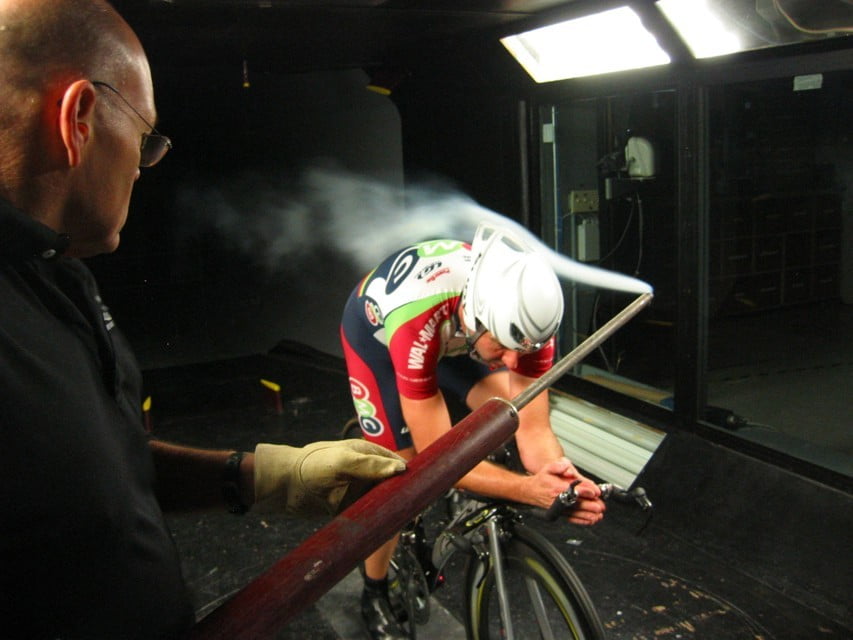
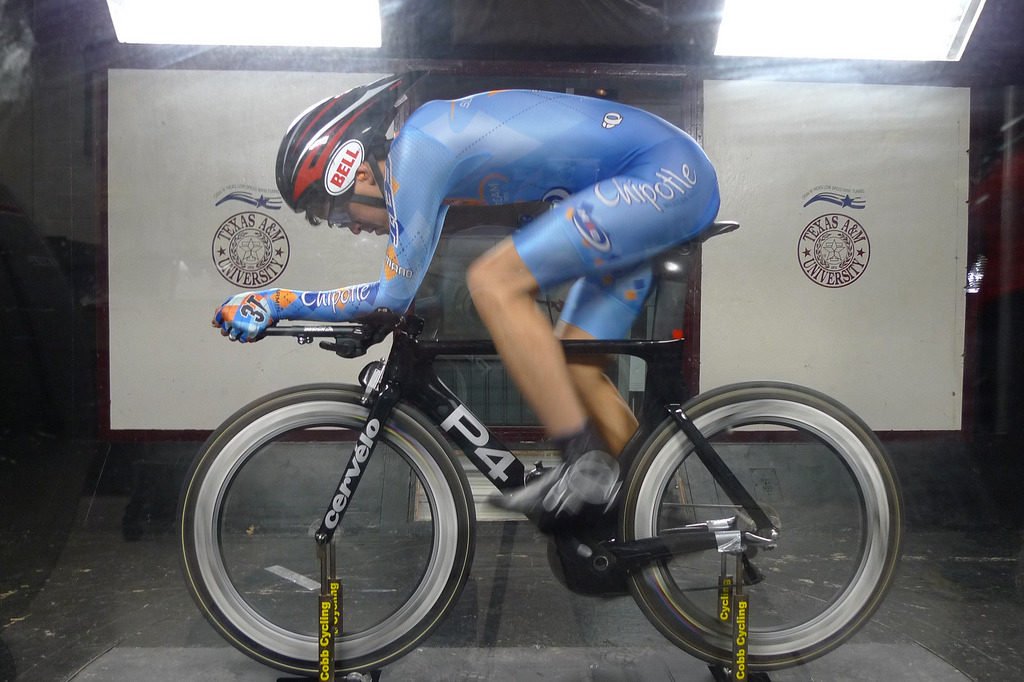
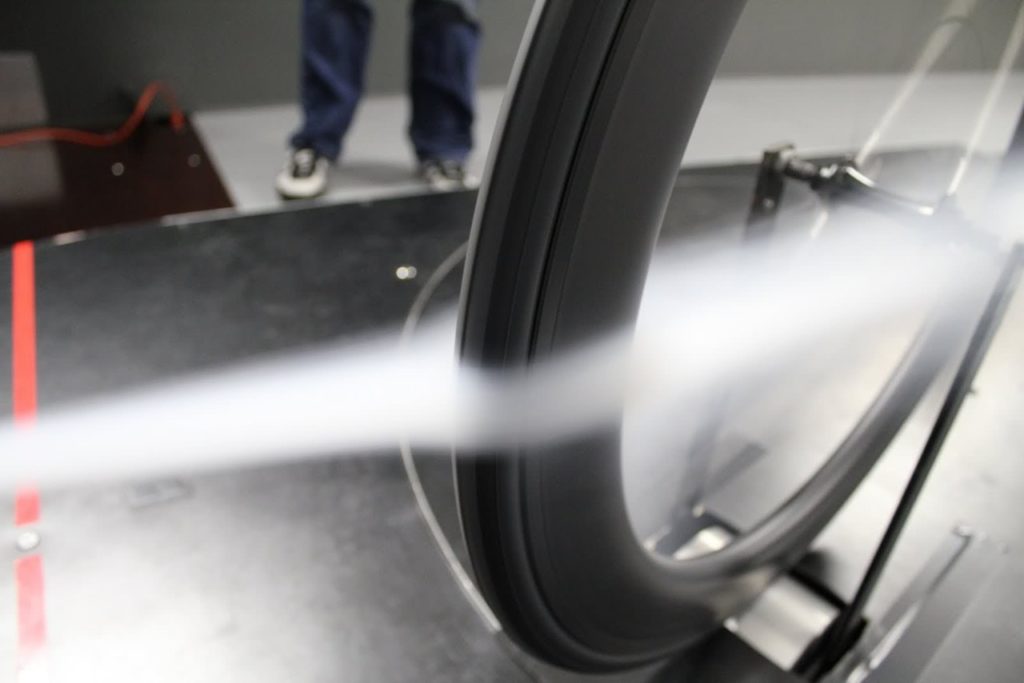
Over hours of racing, even a few grams of drag can be the difference between the top of the podium and missing out. For manufacturers as well as for individual professional cyclists, hours of wind tunnel testing help determine optimum configurations of equipment and positioning. During a day of wind tunnel testing, a cyclist may complete dozens of runs, in which bikes, wheels, helmets, skinsuits, and positioning are all tested and tweaked to find the best combination of aerodynamics.
But wind tunnel results don’t always translate perfectly to the road, where buildings, people, cars and other cyclists may interfere with the freestream. And, as any cyclist will attest, the wind is constantly shifting and changing speeds as one rides. The Garmin-Cervelo pro team has developed a rig to measure wind speeds and angles experienced by cyclists in real world conditions. (The exact components used are unclear, but probably include some form of Pitot tube or 5-hole probe.) As more on-the-road data is collected, wind tunnel tests can be improved by placing greater emphasis on the most common wind angle conditions. (Photo credits: John Cobb, Flo Cycling, and Nico T)

This completes FYFD’s weeklong celebration of the Tour de France and the fluid dynamics of cycling. See previous posts on drafting in the peloton, pacelining and echelons, the art of the sprint lead-out train, and the aerodynamics of time-trialing.

Tour de France Physics: Time Trials


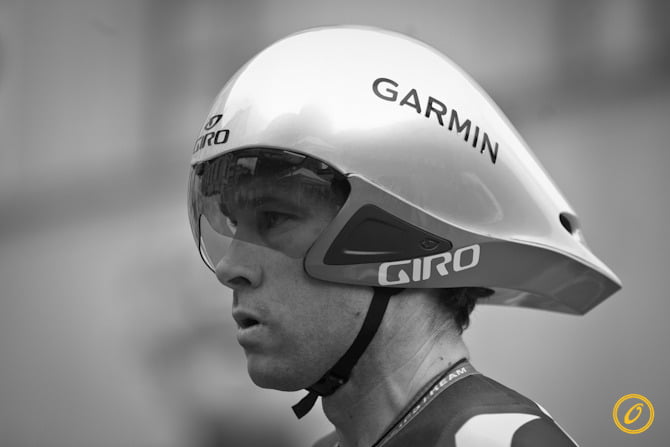
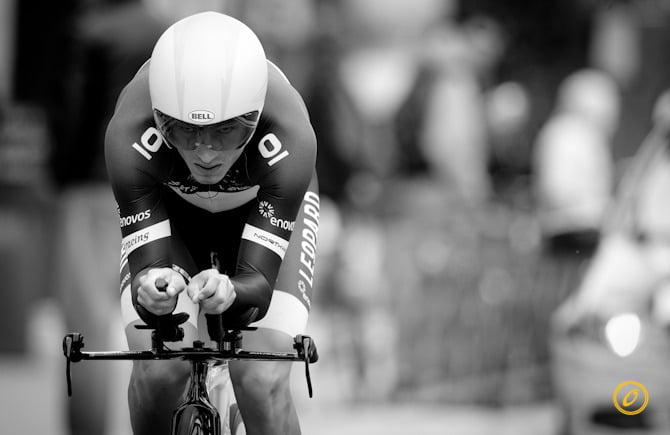
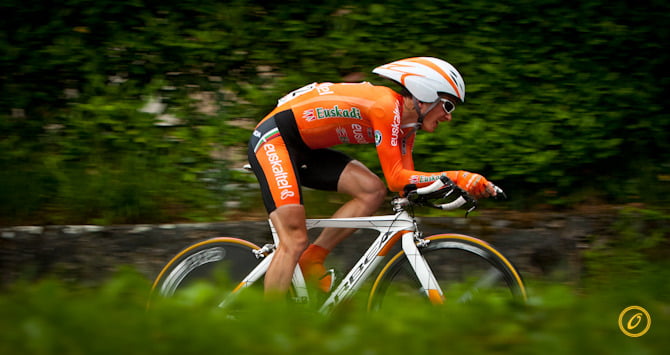
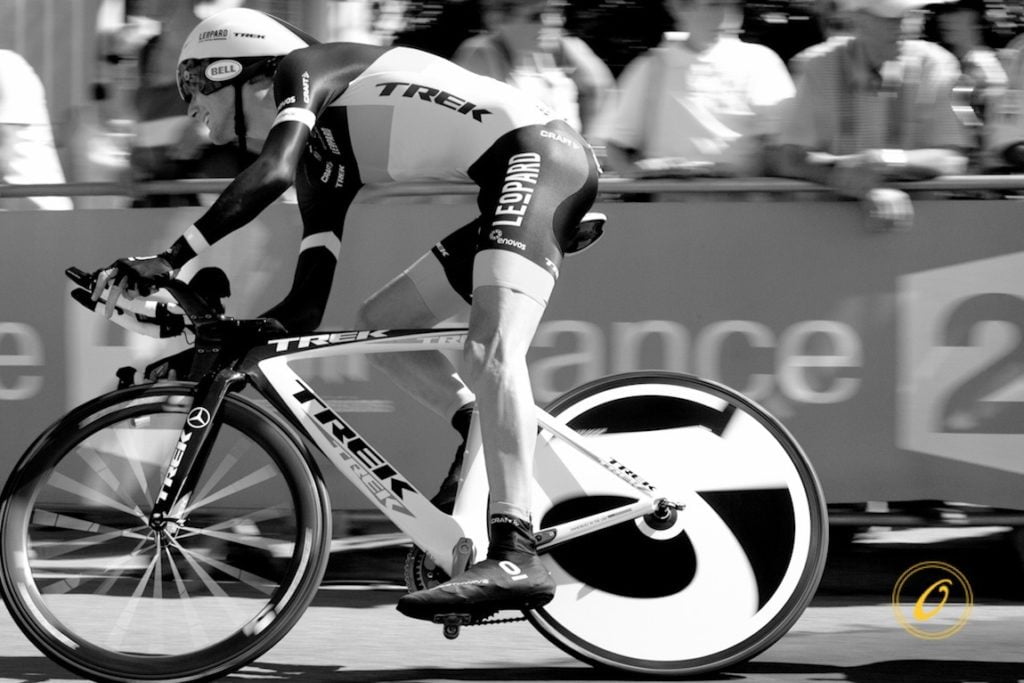
Unlike road stages in which cyclists can draft off one another to reduce drag, in the time trial a cyclist is on a solo race against the clock with nowhere to hide. As a result, the event features lots of technologies designed to reduce both pressure drag and skin friction on the cyclist. For time trials, cyclists wear skinsuits and shoe covers to eliminate any sources of flapping fabrics and to reduce skin friction. They ride bicycles designed to be as light and aerodynamic as possible. Instead of rounded tubing in the frames, these bikes consist of elongated airfoil profiles that direct air past and prevent separation that may increase pressure drag. The rims of their tires are wider and the back wheel is replaced with a disc wheel that allows no airflow aross the wheel. Like the airfoil tubing, these changes help prevent separation. Similarly, riders wear elongated helmets designed to be as aerodynamic as possible while the rider is in the “aero” position, with arms directed out over the wheels, head level, elbows tucked, and back flat. In wind tunnel tests, the rider best able to hold this position will experience the least drag. Even the addition or subtraction of a water bottle is not left to chance, with many time trial bikes designed to be more aerodynamic with a water bottle onboard (though you probably won’t catch the cyclists breaking their aero position to get a drink)! (Photos by Veeral Patel)
FYFD is celebrating the Tour de France with a weeklong exploration of the fluid dynamics of cycling. See previous posts on drafting in the peloton, and pacelining and echelons, and the art of the lead-out train.
Tour de France Physics: Lead-Out Trains
[original media no longer available]
One of the most impressive cycling techniques for drag reduction on a rider is the lead-out train that delivers a sprinter to the finish line. No current team is better at this than HTC-Highroad. Watch for them in the white and yellow from about ~4:00 in the above video.
The lead-out train begins 5 km or so before the line, with the entire team in a line at the front of the peloton with the sprinter in the final position. The rider at the front will ride for as long and hard as he can, ensuring that the pace is such that no riders from the main field are able to pull ahead. This accelerates the sprinter to higher speeds while sheltering him in the wake of the rest of the team.
One by one, the riders of the team will do their time at the front, expending their energy while protecting the sprinter. The final lead-out rider will be sprinting a few hundred meters from the finishing line; at this point the sprinter in the back may be riding 70 kph while enjoying protection from the wind. Finally, with the finish line in sight, he will swing out around his lead-out man and go all out for the line. Sprinters can hit speeds of nearly 80 kph in these short bursts.
FYFD is celebrating the Tour de France with a weeklong exploration of the fluid dynamics of cycling. See previous posts on drafting in the peloton, and pacelining and echelons.
Tour de France Physics: Breakaways
In cycling, a small group of riders often leave the protection of the peloton in a breakaway. These riders will often spend 80% or more of a stage or race outside of the peloton, trying to reach the finish line before they’re caught. Because the pressure drag is so draining on a lone cyclist, it’s vital that breakaway riders work together. When the wind comes predominantly from the front or back, riders will form one or two lines, riding with their wheels within a foot of one another (see ~0:23). This paceline rotates so that every rider takes a turn at the front, bearing the brunt of the effort while other cyclists recover in their wake, where they experience less drag.
If the wind blows predominantly across the riders, they will form a diagonal line with the frontmost rider rotating behind for shelter from the wind after a pull. This drag reduction technique is called an echelon (see ~1:40). As seen above, for experienced riders the echelon can protect individuals even in bike-stealingly high winds.
FYFD is celebrating the Tour de France with a weeklong exploration of the fluid dynamics of cycling. See part one on drafting in the peloton.

Tour de France Physics: Pelotons
July is well underway and for cycling fans around the world that means it’s time for the Tour de France. This week at FYFD we’re going to do something a little different: in honor of cycling’s biggest race, every post this week will focus on some of the fluid dynamics involved in the sport.
On a bicycle, except when climbing, the majority of a rider’s energy goes toward overcoming aerodynamic drag. Riders wear close-fitting clothes to reduce skin friction and loss to flapping fabric, but most of their drag is pressure-based. A blunt object disturbs the airflow around it, usually resulting in separated flow in its wake. A high pressure region forms in front of the rider and a low pressure region forms in the separated flow behind them. This pressure difference literally pulls the rider backwards. Since drag goes roughly as speed squared, adding a headwind makes matters even worse for a cyclist.
In races, especially on flat stages, the majority of the riders will stay in a large group called a peloton in order to counteract these aerodynamics. By riding in the wakes of those in the front, riders in the peloton experience a much smaller front-to-back pressure difference and thus much less drag. For a rider in the midst of the peloton, the drag reduction can be as great as 40% (#). This allows riders to conserve energy for solo efforts near the end of the race or stage, like breaking away from the peloton in the final kilometers or winning a sprint for the finish line. (Photo credit: Wade Wallace)

Drafting Flags
Wired Science has published a gallery of fluid dynamics photos and videos, several of which have been featured here previously. There’s some neat stuff there, well worth checking out. #
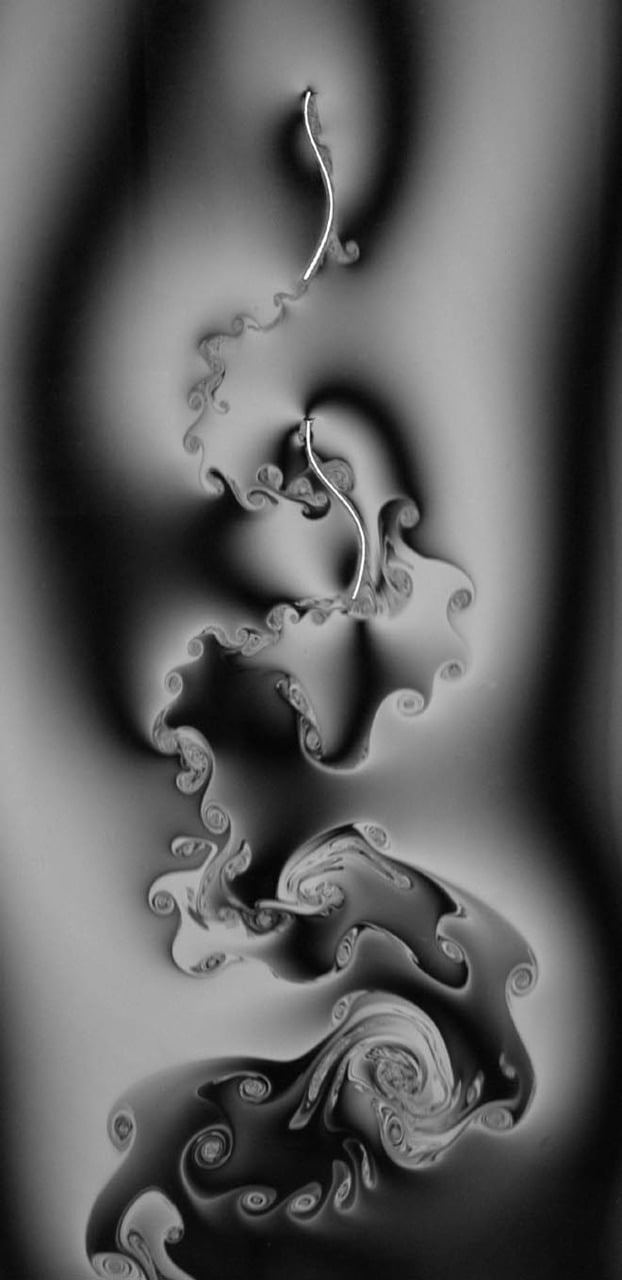
This image shows two flags oriented in line with a film flowing top to bottom. The second flag interrupts the wake of the first one, which reduces the drag experienced by the first flag and increases that on the second. This is called inverted drafting and occurs because the flags are passive objects that bend to every change in the flow. #
Hot Spheres Sink Faster
New research shows that the Leidenfrost effect–which causes water droplets to skitter across a hot pan–can drastically reduce the drag on objects moving through a liquid. When raised to a high enough temperature, a sphere falling water will be coated in a protective layer of vapor (see video above) that acts like a lubricant as the sphere moves through the water. If the temperature of the object drops too low, the vapor layer will dissolve into a mess of bubbles (~35 secs into video). One way that this mechanism reduces drag is by keeping flow attached to the sphere for longer as shown in this video. Preventing this flow separation increases the pressure recovered after the point of lowest pressure (the shoulders of the sphere), which reduces overall drag.
See also:
- PRL Article and Supplemental Materials
- Wired article
- The Photonist

.jpg)
