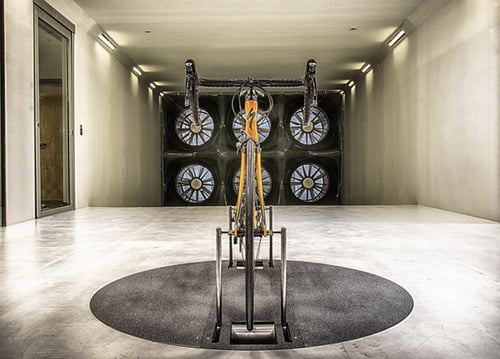
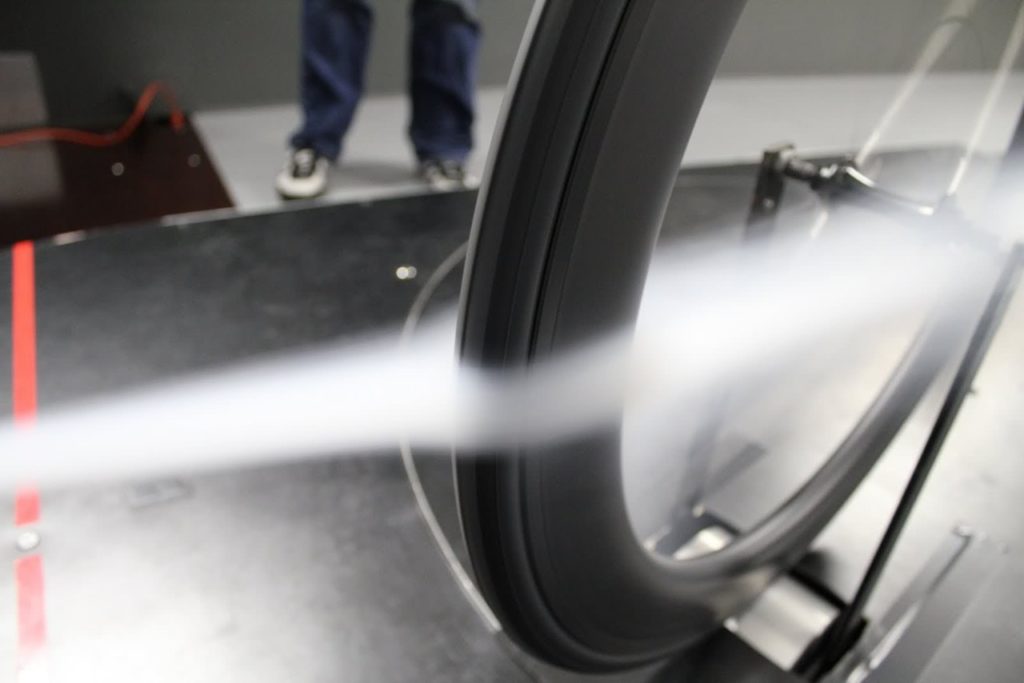
Awhile back, I mentioned that bike manufacturer Specialized had built their own wind tunnel to test cycling equipment. In this video, they provide a walk-through of their facility. Although there are features unique to this tunnel and its intended purpose, much of what Chris and Mark describe is standard for any subsonic wind tunnel. The story begins upstream in the inlet and contraction, where air is pulled into the tunnel. Honeycomb flow straighteners direct the incoming air, followed by a series of mesh screens. These screens break up any turbulent eddies, which helps smooth and laminarize the flow. The test section is where measurements occur, whether on cyclists or other models. This part of the tunnel is usually equipped with many sensors and specialized equipment, like the balance shown. These allow researchers to measure quantities like force, velocity, pressure, and/or temperature. Then the wind tunnel widens gradually in a diffuser, which slows down the air and helps prevent disturbances from propagating upstream. Finally, the fans at the back provide the source of low-pressure that drives the air flow. (Video credit: Specialized Bicycles; submitted by J. Salazar)
Tag: cycling

Fluids Round-up – 5 October 2013
This is the last week that my IndieGoGo project is open for donations. All money above and beyond what is needed for the conference will go toward FYFD-produced videos. Also, donors can get some awesome FYFD stickers.
As a reminder, those looking for more fluids–in video, textbook, or other form–can always check out my resources page. And if you know about great links that aren’t on there, let me know so that I can add them. On to the round-up!
- Popular Science has look at what it was like to fly on the Concorde, the only supersonic commercial airliner ever flown.
- For the cyclists and CFD folks out there, Zipp has put out a new video discussing their Firecrest wheels’ aerodynamics.
- io9 explains how superhydrophobic surfaces impart a charge to water droplets and how this can be used to increase efficiency at power plants.
- BuzzFeed UK has 32 fun science GIFs, several of which are fluids-related, and several of which will look familiar to long-time readers. (via Flow Visualization on FB)
- Wired has an intriguing short on Acoustic Archives, a group that focuses on capturing the acoustic qualities of historic locations using custom-designed 3D microphones.
- Congratulations to Richard over at Flow Viz for hitting his 100th post! Here’s to many more.
- Finally, our lead image comes from Martin Klimas. Smithsonian’s blog has a feature on his work in which he transforms songs from artists like Pink Floyd, Daft Punk, and Bach into sonic sculptures using paint on speakers. (via Flow Visualization on FB)
I had a lot of fun earlier this week giving a talk for the Texas A&M Applied Mathematics Undergraduate Seminar series. I didn’t get a chance to record it, but the slides are up here if anyone is interested.(Photo credit: M. Klimas)
Fluids Round-up – 25 May 2013
Sometimes I come across cool links and stories about fluid dynamics that don’t quite fit into a typical FYFD post, but I’d like to start sharing those semi-regularly with round-up posts. Here’s some fun stuff I’ve seen lately:
- We’ve talked before about penguins and fluid dynamics, but this IOP talk from Helen Czerski is a great take on how they use fluids to escape predators.
- Over at FlowViz, Richard has a great video demonstrating deep versus shallow water waves side-by-side.
- io9 shows off the vibrational modes of mercury as well as explaining why birds can be good at flying or swimming but not both.
- Giant paint explosions (specifically here) may be fun to watch but the dangers are not for squeamish viewers.
- Dylan G sent us this 512K real-time fluid particle simulation that’s a fun distraction.
- xckd’s Randall Munroe answers all kinds of physics questions at his What If? blog, but occasionally there are some fluids ones. Two of my favorites consider a hypersonic steak and what happens if the glass is literally half full.
- Finally, for the cyclists and triathletes among you, the recent news that bicycle manufacturer Specialized has built its own wind tunnel has generated lots of discussion of aerodynamics in sport. Mark Cote (@MITAeroBike) and Chris Yu (@chrisyuinc) of Specialized’s aero R&D have been answering questions on Slowtwitch, Twitter, and in live chats.
And, yes, that last Specialized video chat includes an FYFD shout-out about 49 minutes in. 🙂
(Photo credit: Specialized)

Reader Question: Drafting in Triathlons
Reader juleztalks writes:
I’ve just entered an amateur triathlon, and there’s a whole load of rules about not “drafting” in the cycle stage (basically, not sitting in other cyclists’ slipstream). However, there are no such rules for the swim or run stage; I thought the effects would be the same from drafting other swimmers and runners. Any ideas?
As in many endurance sports, it’s all a question of energy savings from drag reduction. Drag on an object, like a triathlete, is roughly proportional to fluid density (air for cycling or running, water for swimming), frontal area, and the velocity squared. Because drag increases more drastically for an increase in velocity, it makes sense one would worry most about drag when one’s velocity is highest – on the bike.
Drafting has major benefits in cycling and can reduce drag on a rider by 25-40%. Aerodynamic drag accounts for 70% or more of a cyclist’s energy expenditure, so that reduction can really add up. The energy saved by drafting during cycling can even increase a triathlete’s speed during a subsequent running leg. So it makes sense for a sport’s governing body to be concerned with it.
That said, there’s plenty of room for drag reduction in swimming as well. Even though the velocities are much lower, water’s density is 1,000 times higher than air’s, generating plenty of drag for an athlete to overcome. For swimmers at maximum speed, drafting can reduce drag by 13-26%, depending on relative positioning. Such drafting has been found to increase stroke length and may (or may not) improve subsequent cycling performance.
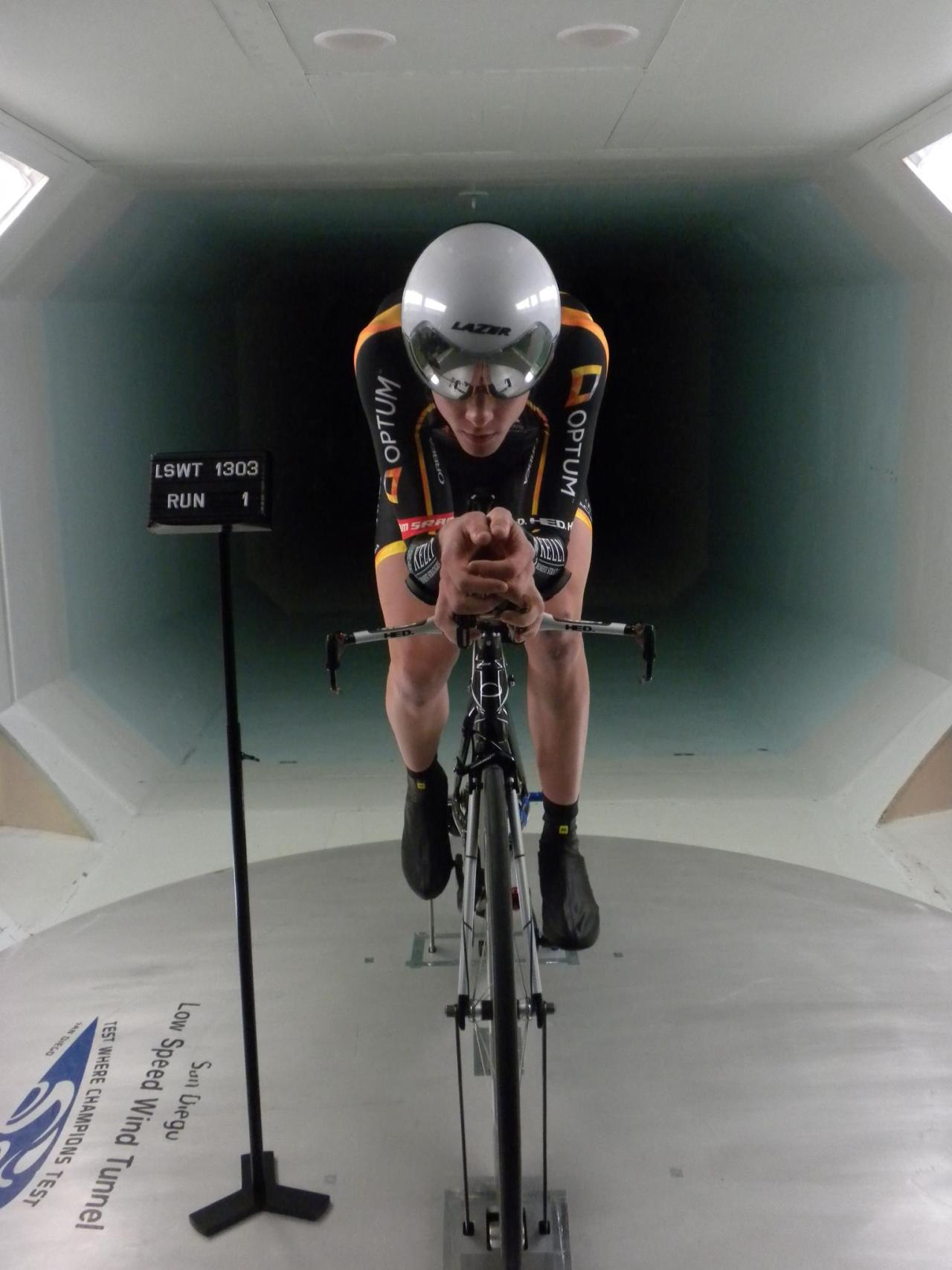
Although a similar reduction in drag is possible by drafting when running, drag on a runner only accounts for about 8% of his/her energy expenditure so such savings would matters very little next to the swimming and cycling legs. There could be some psychological benefits, though, in terms of pacing oneself. (Photo credit: Optum Pro Cycling p/b Kelly Benefit Strategies)

London 2012: Cycling Physics


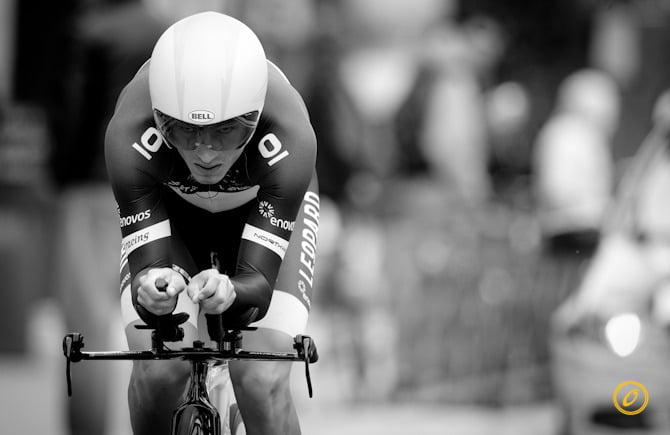
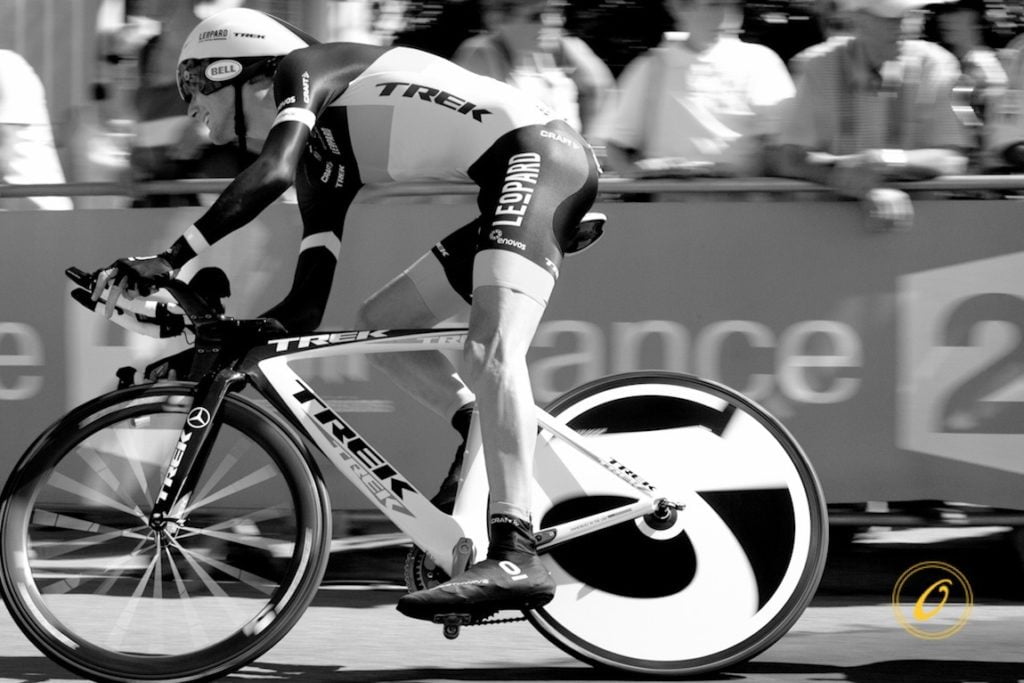
In no discipline of cycling is more emphasis placed on fluid dynamics than in the individual time trial. This event, a solo race against the clock, leaves riders no place to hide from the aerodynamic drag that makes up 70% or more of the resistance riders overcome when pedaling. Time trial bikes are designed for low drag and light weight over maneuverability, using airfoil-like shapes in the fork and frame to direct airflow around the bike and rider without separation, which creates an area of low pressure in the wake that increases drag. Riders maintain a position stretched out over the front wheel of the bike, with their arms close together. This position reduces the frontal area exposed to the flow, which is proportional to the drag a rider experiences.
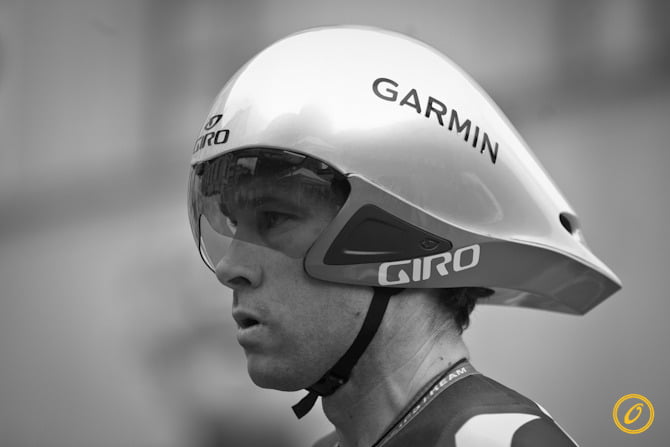
Special helmets, some with strangely streamlined curves, are used to direct airflow over the rider’s head and straight along his or her back. Both helmets and skinsuits are starting to feature areas of dimpling or raised texturing. These function in much the same way as a golf ball; the texture causes the boundary layer, the thin layer of air near a surface, to become turbulent. A turbulent boundary layer is less susceptible to separating from the surface, ultimately leading to lower drag than would be observed if the boundary layer remained laminar. Wheels, skinsuits, gloves, shoe covers, and even the location of the brakes on the bike are all tweaked to reduce drag. In an event that can be decided by hundredths of a second between riders, every gram of drag counts. (Photo credits: Stefano Rellandini, POC Sports, Reuters, Paul Starkey, Louis Garneau)
FYFD is celebrating the Olympics by featuring the fluid dynamics of sports. Check out our previous posts on how the Olympic torch works, what makes a pool fast, the aerodynamics of archery, and the science of badminton.

Reader Question: Drafting in Cycling


jonesmartinez asks:
As a cyclist, I’m curious about drafting. How fast do I need to be going for there to be a measurable benefit? Additionally, often in a time trial a single rider is often followed by the team car and I’ve heard the rider can be pushed by the air around the team car. Any truth to this rumor? Thanks, I love the blog.
Drafting plays a major role in cycling and its tactics (check out our previous series on cycling). In general, drag increases with the square of velocity and data show this holds for cyclists. The rule of thumb I’ve heard given is that aerodynamic drag doesn’t play a large role below 15 mph, but I have not seen the numbers that inform that claim. Moreover, you have to consider the resultant airspeed around the cyclist. For example, a cyclist moving 13 mph into a 15 mph headwind (28 mph effective) will be experiencing more drag than a cyclist moving 20 mph with a 10 mph tailwind (10 mph effective). With drag being reduced 25-40% by drafting a leading rider, it is almost always beneficial to get behind someone.
That said, I have seen no measurable benefit for a leading rider with a paceline behind him, even though this should, in theory, reduce the drag on the lead rider by closing out his wake. With a large object like a car behind a solo rider, there might theoretically be some benefit. However, the car would have to be driving extremely close to the rider–far closer than they do in reality.
That said, with the prevalence of power meters in the amateur market these days, I think it would be a neat project to go out and try a few of these things firsthand and see whether such tactics actually result in a measurable difference in a cyclist’s performance–though I don’t recommend riding a foot off the front or back of a car!

Tour de France Physics: Wind Tunnel Testing

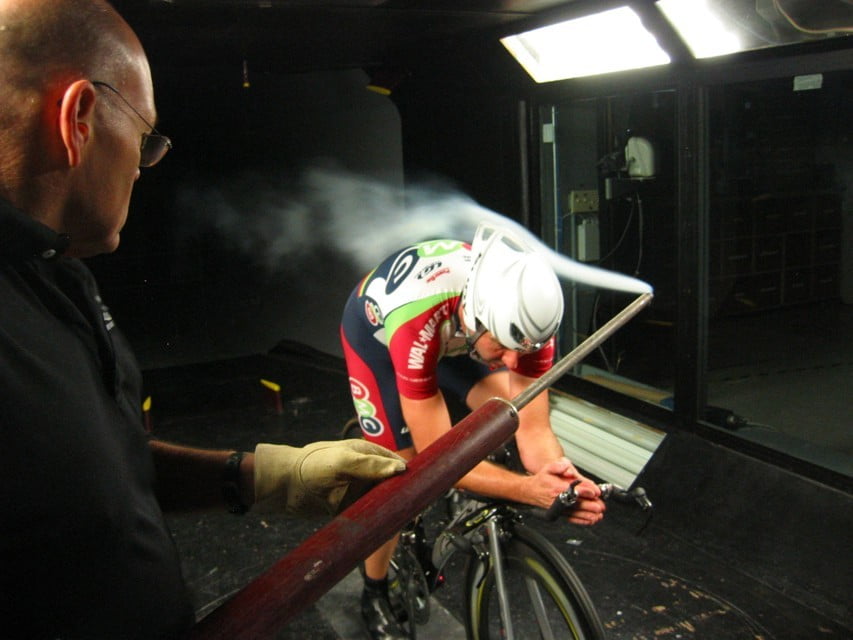
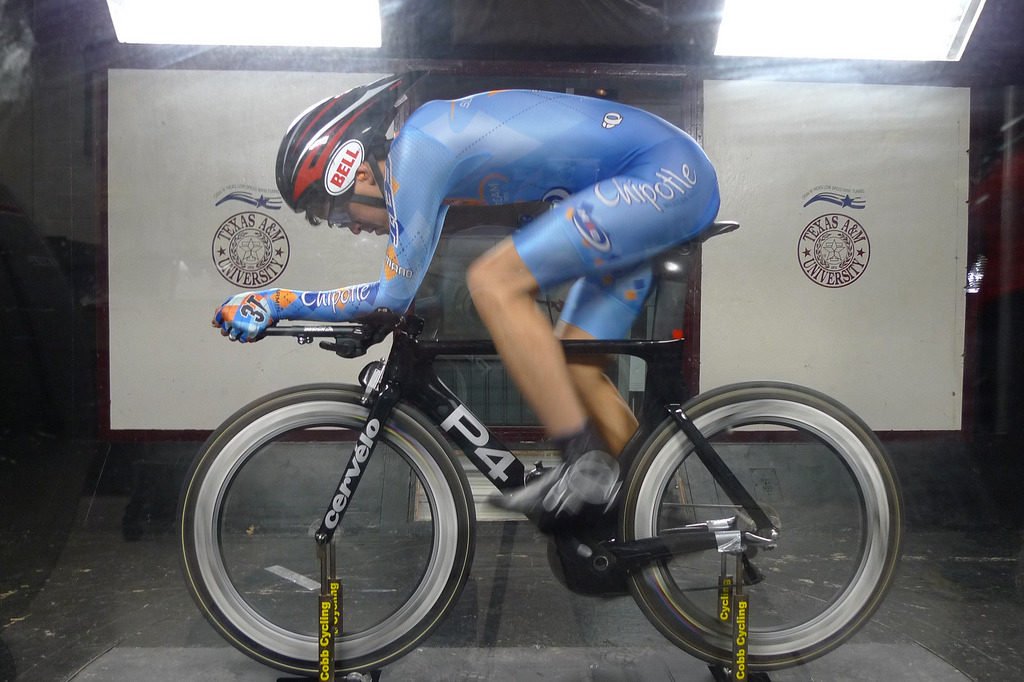
Over hours of racing, even a few grams of drag can be the difference between the top of the podium and missing out. For manufacturers as well as for individual professional cyclists, hours of wind tunnel testing help determine optimum configurations of equipment and positioning. During a day of wind tunnel testing, a cyclist may complete dozens of runs, in which bikes, wheels, helmets, skinsuits, and positioning are all tested and tweaked to find the best combination of aerodynamics.
But wind tunnel results don’t always translate perfectly to the road, where buildings, people, cars and other cyclists may interfere with the freestream. And, as any cyclist will attest, the wind is constantly shifting and changing speeds as one rides. The Garmin-Cervelo pro team has developed a rig to measure wind speeds and angles experienced by cyclists in real world conditions. (The exact components used are unclear, but probably include some form of Pitot tube or 5-hole probe.) As more on-the-road data is collected, wind tunnel tests can be improved by placing greater emphasis on the most common wind angle conditions. (Photo credits: John Cobb, Flo Cycling, and Nico T)

This completes FYFD’s weeklong celebration of the Tour de France and the fluid dynamics of cycling. See previous posts on drafting in the peloton, pacelining and echelons, the art of the sprint lead-out train, and the aerodynamics of time-trialing.

Tour de France Physics: Time Trials


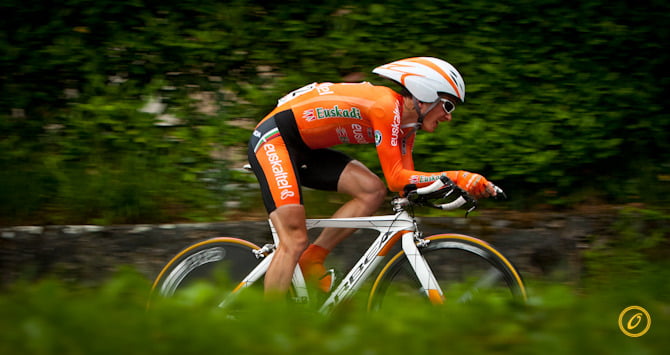
Unlike road stages in which cyclists can draft off one another to reduce drag, in the time trial a cyclist is on a solo race against the clock with nowhere to hide. As a result, the event features lots of technologies designed to reduce both pressure drag and skin friction on the cyclist. For time trials, cyclists wear skinsuits and shoe covers to eliminate any sources of flapping fabrics and to reduce skin friction. They ride bicycles designed to be as light and aerodynamic as possible. Instead of rounded tubing in the frames, these bikes consist of elongated airfoil profiles that direct air past and prevent separation that may increase pressure drag. The rims of their tires are wider and the back wheel is replaced with a disc wheel that allows no airflow aross the wheel. Like the airfoil tubing, these changes help prevent separation. Similarly, riders wear elongated helmets designed to be as aerodynamic as possible while the rider is in the “aero” position, with arms directed out over the wheels, head level, elbows tucked, and back flat. In wind tunnel tests, the rider best able to hold this position will experience the least drag. Even the addition or subtraction of a water bottle is not left to chance, with many time trial bikes designed to be more aerodynamic with a water bottle onboard (though you probably won’t catch the cyclists breaking their aero position to get a drink)! (Photos by Veeral Patel)
FYFD is celebrating the Tour de France with a weeklong exploration of the fluid dynamics of cycling. See previous posts on drafting in the peloton, and pacelining and echelons, and the art of the lead-out train.

Drafting Behind a Big Rig
Tour de France Physics: Lead-Out Trains
[original media no longer available]
One of the most impressive cycling techniques for drag reduction on a rider is the lead-out train that delivers a sprinter to the finish line. No current team is better at this than HTC-Highroad. Watch for them in the white and yellow from about ~4:00 in the above video.
The lead-out train begins 5 km or so before the line, with the entire team in a line at the front of the peloton with the sprinter in the final position. The rider at the front will ride for as long and hard as he can, ensuring that the pace is such that no riders from the main field are able to pull ahead. This accelerates the sprinter to higher speeds while sheltering him in the wake of the rest of the team.
One by one, the riders of the team will do their time at the front, expending their energy while protecting the sprinter. The final lead-out rider will be sprinting a few hundred meters from the finishing line; at this point the sprinter in the back may be riding 70 kph while enjoying protection from the wind. Finally, with the finish line in sight, he will swing out around his lead-out man and go all out for the line. Sprinters can hit speeds of nearly 80 kph in these short bursts.
FYFD is celebrating the Tour de France with a weeklong exploration of the fluid dynamics of cycling. See previous posts on drafting in the peloton, and pacelining and echelons.