Tag: civil engineering

  • Featured Video Play Icon

    Dam Failure

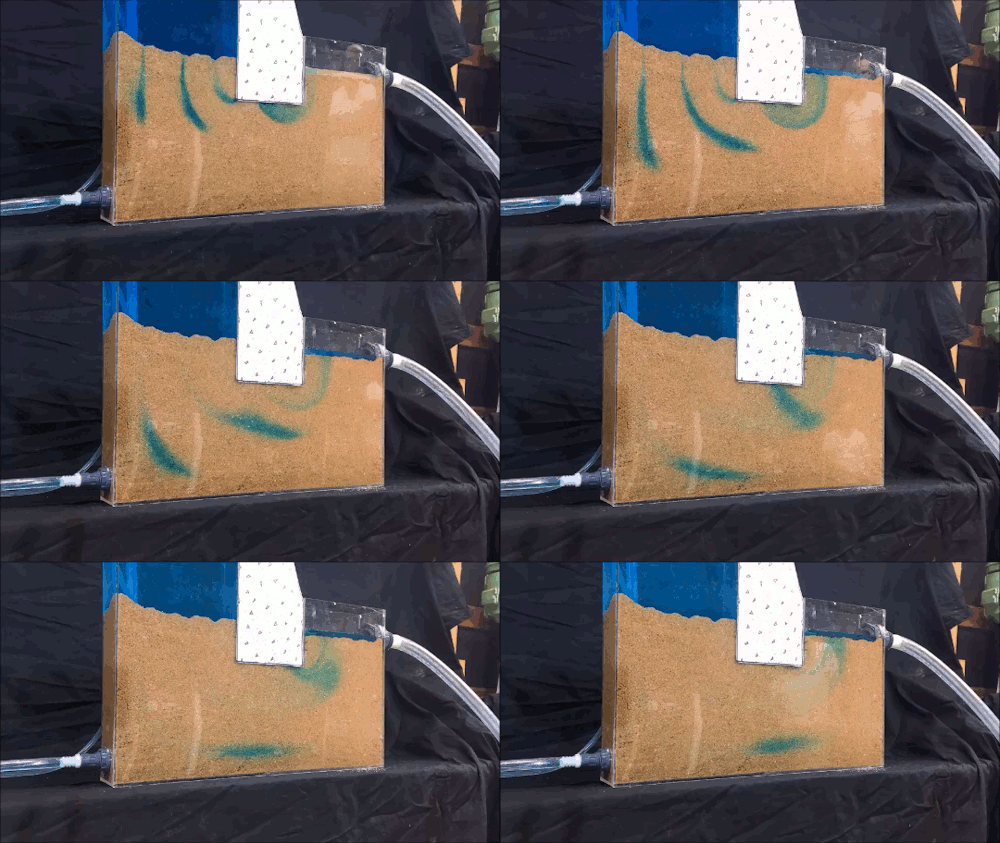
    In a recent video, Practical Engineering tackles an important and often-overlooked challenge in civil engineering: dam failure. At its simplest, a levee or dam is a wall built to hold back water, and the higher that water is, the greater the pressure at its base. That pressure can drive water to seep between the grains of soil beneath the dam. As you can see in the demo below, seeping water can take a curving path through the soil beneath a dam in order to get to the other side. When too much water makes it into the soil, it pushes grains apart and makes them slip easily; this is known as liquefaction. As the name suggests, the sediment begins behaving like a fluid, quickly leading to a complete failure of the dam as its foundation flows away. With older infrastructure and increased flooding from extreme weather events, this is a serious problem facing many communities. (Video and image credit: Practical Engineering)
  • Recreating Hurricanes

    Recreating Hurricanes

    Hurricane-related winds and storm surge cause massive damage every year. Understanding and being able to predict the impact of these storms on coastal structures can help save lives and properties. Until recently the most ferocious of hurricanes–category 5 storms that feature winds above 250 kph (150 mph)–could not be recreated in a laboratory scale. Now the University of Miami’s SUSTAIN (SUrge-STructure-Atmosphere INteraction) facility can produce category-5 equivalent winds, waves, and surge in a controlled environment. The massive test section measures 18 m x 6 m x 2 m and can be filled with over 140,000 liters of saltwater. The acrylic walls of the facility let researchers use optical flow diagnostics like particle image velocimetry (PIV) to measure flow anywhere in the test section. Some of their planned studies include experiments on how oil spills behave in storms and how strong aquaculture nets must be to maintain their catch through a storm. It will also be used to study interactions between buildings and storm surge. For more, check out their website or this video from the Weather Channel. (Image credits: Gort Photography, AFP/K. Sheridan, AP Photo/W. Lee; SUSTAIN Laboratory)