
Sand and other granular materials can be strikingly fluid-like. Here the impact of a solid sphere on sand generates a splash remarkably similar to what’s seen with water. When the ball hits, it creates a crater in the surface and sends up a bowl-like spray of sand. As the ball continues falling through the sand, the grains try to fill the empty space left behind. The walls of sand collapsing around the void meet somewhere between the surface and the depth of the ball. This generates the tall jet we observe, as well as a second one under the surface that we can’t see. We know that collapse traps an air bubble under the surface because of the eruption that occurs as the jet falls. That’s the air bubble reaching the surface. (Image credit: T. Nguyen et al., source; see also R. Mikkelsen et al.)
Tag: cavity seal

Water Music of Vanuatu
In the Pacific Island nation of Vanuatu, women have a tradition of water music, accompanying their singing with a percussive use of water. This video explores the physics behind this music. Performers use three basic motions – a slap, a plunge, and a plow – that each have distinctive acoustics thanks to the interaction of hand, water, and air. High pitches come from the initial impact on the water, whereas lower pitches come mostly from the collapse of the air cavity in the hand’s wake. By altering the rhythms and patterns of these three building blocks, the musicians create a rich harmony to accompany their singing. (Video credit: R. Hurd et al.)

Squishy Impacts

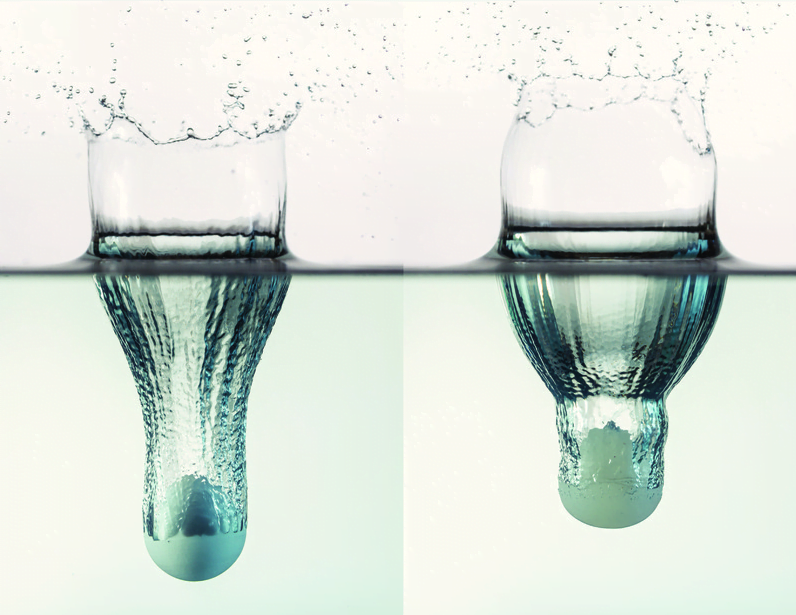


How spheres impact water has been studied for more than a century. The typical impact for a rigid sphere creates a cavity like the one on the upper left – relatively narrow and prone to pinching off at its skinny waist. If the sphere is elastic –squishy – instead, the cavity ends up looking much different. This is shown in the upper right image, taken with an elastic ball and otherwise identical conditions to the upper left image. The elastic ball deforms; it flattens as it hits the surface, creating a wider cavity. If you watch the animations in the bottom row, you can see the sphere oscillating after impact. Those changes in shape form a second cavity inside the first one. It’s this smaller second cavity that pinches off and sends a liquid jet back up to the collapsing splash curtain.
From the top image, we can also see that the elastic sphere slows down more quickly after impact. This makes sense because part of its kinetic energy at impact has gone into the sphere’s shape changes and their interaction with the surrounding water.
If you’d like to see more splashy stuff, be sure to check out my webcast with a couple of this paper’s authors. (Image credits: top row – C. Mabey; bottom row – R. Hurd et al., source; research credit: R. Hurd et al.)

Crown Splash Sealing
A sphere falling into water generates a spectacular crown
splash at the surface. The object’s impact ejects a thin sheet of fluid
that rises vertically. The air pulled down into the cavity by the
sphere’s passage makes the air pressure inside the sheet lower than the
ambient air pressure on the exterior of the sheet. This pressure
difference is part of what draws the crown inward to seal the cavity. As
the splash collapses inward and seals, the liquid sheet starts to
buckle and wrinkle, leaving periodic stripes around the closing neck.
This so-called buckling instability occurs when the radius of the neck
collapses faster than the vertical speed of the splash. For more, see
the research paper or this award-winning video. (Image credit: J. Marston et al., source)

