Tag: cars

  • Reshaping the Wake to Decrease Drag

    Reshaping the Wake to Decrease Drag

    When it comes to the aerodynamics of cars, there’s only so much streamlining one can do. In the end, most cars have a certain boxy-ness as a matter of practicality; they do, after all, have to carry people and things. But that doesn’t mean we’re stuck with the level of drag those shapes entail.

    For cars and other non-streamlined objects, much of their drag comes from their wake, which usually contains a large, asymmetric, and unsteady recirculation region. In a new wind tunnel study, scientists used air blasts to reshape this wake, making it more symmetrical, even when the wind direction did not align with the car model. That reduced the drag by 6%. They’re now experimenting with adding additional nozzles along the non-windward edges of the model to see if they can reduce drag even further.

    Although this appears to be the first time this technique has been tested for road vehicles, the idea of blowing air to improve aerodynamics is well-established, particularly in aviation. (Image credit: V. Malagoli; research credit: R. Li et al., submitted by Marc A.)
  • Reader Question: Dry Rear Windshields in the Rain

    Reader Question: Dry Rear Windshields in the Rain

    Reader sheepnamedpig asks:

    I was driving through the rain down the highway when I noticed something strange: though the rain was heavy enough to reduce visibility to a quarter mile, the rear windshield of my Corolla was bone dry except for the streams of water flowing off the roof. There was no wind so far as I could tell, but I had to slow down all the way to ~20-25 mph for rain to start falling on the rear windshield. Why is that?

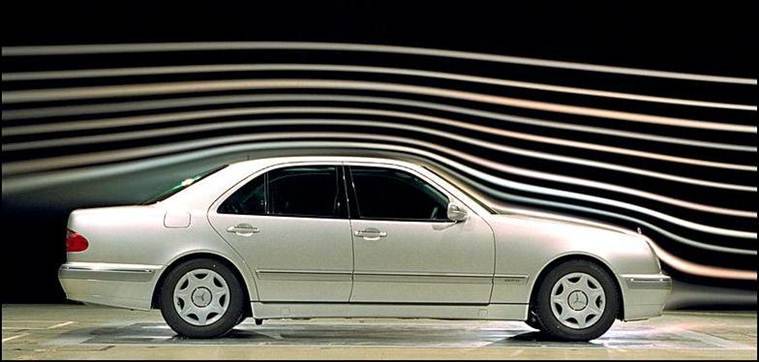
    That’s a wonderful observation! Like many sedans, your Corolla has a long, sloped rear window that acts much like a backward-facing step with respect to the airflow while the car is moving. Note the smoke lines in the photo above. At the front of the car, we see closely spaced intact lines near the hood and windshield, indicating relatively fast, smooth airflow over the front of the vehicle. At the back, though, there is a big gap over the rear windshield. This is because flow over the car has separated at the rear windshield and a pocket of recirculating air. This recirculation zone is, for the most part, isolated from the rest of the air moving over the car; that’s why the smoke lines continue relatively unaffected a little ways above the surface. This same pocket of recirculating air is protecting your rear windshield from rainfall. It’s an area of low-speed, high-pressure fluid, and the raindrops are preferentially carried by the high-speed, low-pressure air over the recirculation zone. This is one reason why many sedans don’t have rear windshield wipers. (Photo credit: F-BDA)

    ETA: Reposted by request to make it rebloggable.

  • Formula 1 Aerodynamics

    [original media no longer available]

    Computational fluid dynamics (CFD) and the advent of supercomputing have forever changed the way engineers design. Here the use of CFD in the design of Formula 1 racing cars is discussed. Although CFD is used by many companies in place of wind tunnel testing, each method has its advantages.  CFD provides information about all flow quantities at all points in the flow but can only do so with an accuracy dependent on the grid and models used.  It remains impossible to solve the equations of motion exactly for any problem of practical application because the computational cost is simply too high; instead software packages like FLUENT utilize turbulence models that approximate the physics.  Wind tunnel testing, on the other hand, is physically accurate but typically yields only limited data and flow quantities due to the difficulty of instrumentation. (Video credit: BBC News; submitted by carhogg)

    (Source: /)
  • Automotive Wind Tunnels

    Automotive Wind Tunnels

    Wind tunnels have been a staple of aerodynamics since the Wright brothers built one to help them test wing shapes for their gliders and airplanes. The GM Aerodynamics Laboratory’s  much larger wind tunnel, pictured above, tests full-sized vehicles’ aerodynamics. It is the largest automotive wind tunnel and has been in operation since August 1980. GM estimates that it has cut the coefficient of drag on vehicles by approximately 25% in that time. The tunnel can reach speeds near 125 mph, as one hapless reporter discovered firsthand. (Submitted by @Vinnchan)