Tag: atmospheric science

  • Jupiter in a Lab

    Jupiter in a Lab

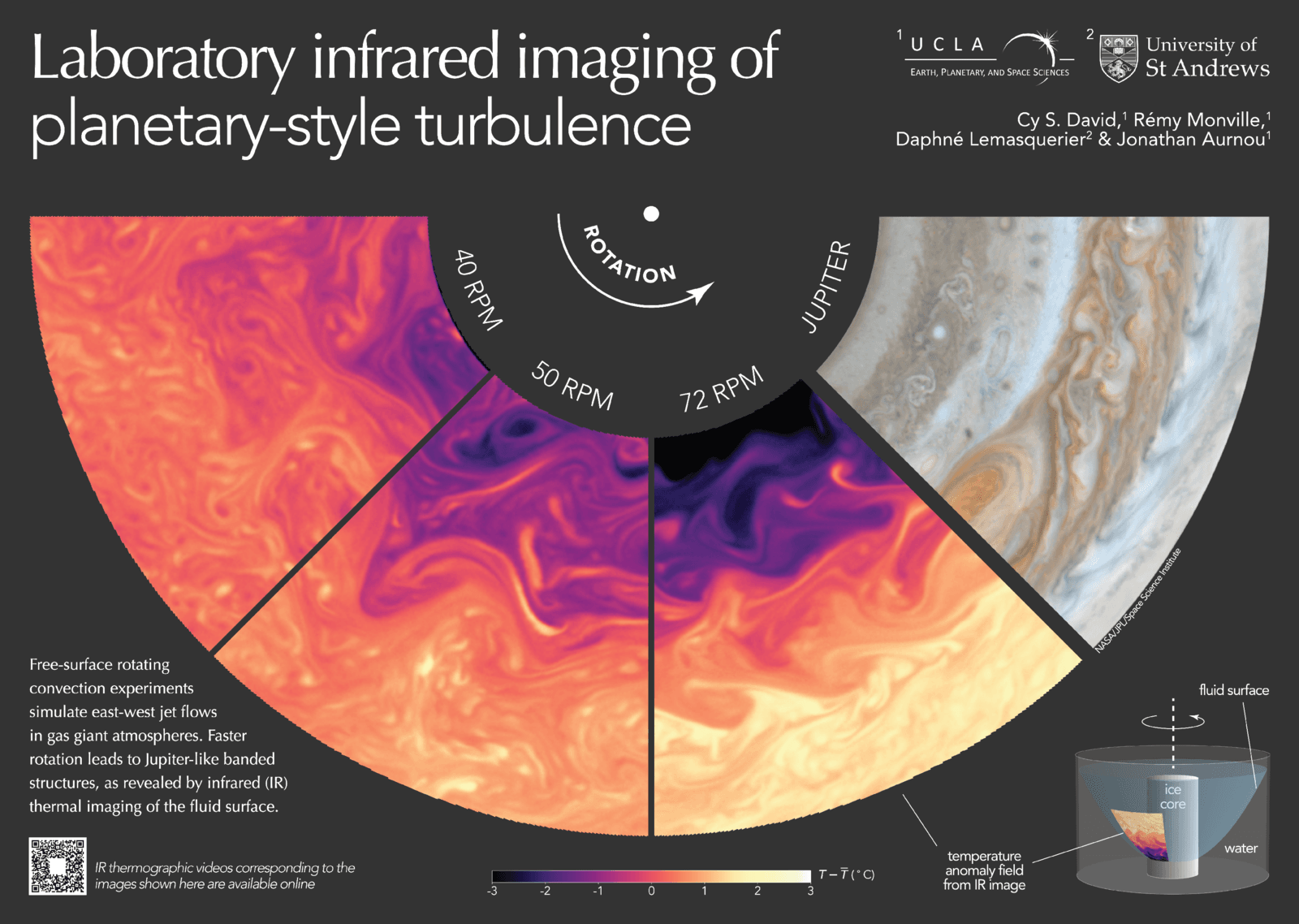
    The vivid bands of a gas giant like Jupiter come from the planet’s combination of rotation and convection. It’s possible to create the same effect in a lab by rapidly spinning a tank of water around a central ice core. That’s the physical set-up behind this research poster–note the illustration in the lower right corner. The central snapshots show how temperature gradients on the water surface change the faster the tank rotates. At higher rotational speeds, the parabolic water surface gets ever steeper and Jupiter-like temperature bands form. (Image credit: C. David et al.)

    Research poster showing how a rotating tank in a lab can develop features that match Jupiter.
    Fediverse Reactions
  • Thermal Tides Drive Venusian Winds

    Thermal Tides Drive Venusian Winds

    Venus is a world of extremes. A full rotation of the world takes 243 Earth days, but winds race around the planet at a speed that makes a Category 5 hurricane look sedate. Just what drives these winds has been an ongoing question for planetary scientists. A recent study suggests that tides are a major contributor to this superrotation.

    Unlike Earth’s tides, Venus’s are not gravitational in origin. Instead, Venusian tides are thermal, driven by heating in the sunward side of the atmosphere. This creates a diurnal tide, which cycles once per Venusian day and pumps momentum toward the tops of Venus’s clouds. The new analysis–rooted in both observations and numerical simulation–finds that diurnal tides are the primary driver behind the planet’s incredibly fast winds. (Image credit: NASA/JPL-Caltech; research credit: D. Lai et al.; via Eos)

    Fediverse Reactions
  • Panama’s Missing Pacific Upwelling

    Panama’s Missing Pacific Upwelling

    Strong seasonal winds blowing from the Atlantic typically push water away from Panama’s Pacific coast, allowing deeper, colder waters to rise up. This upwelling cools reefs and feeds phytoplankton blooms, both of which support the rich marine life found there. But in early 2025, the upwelling didn’t occur.

    Normally, coastal ocean temperatures drop to about 19 degrees Celsius during upwelling. Instead, temperatures only reached 23.3 degrees at their coolest. Wind seems to be the missing ingredient: winds from the Atlantic side were short-lived and 74% less frequent than in typical years.

    That lack of upwelling is expected to carry consequences to Panama’s economy. About 95% of the country’s fishing catch comes from the Pacific side, so any drop in fish populations will be felt. The open question remains: was the missing upwelling a singular extreme event or a harbinger of a new normal? (Image credit: R. Heuvel; research credit: A. O’Dea et al.; via Eos)

    Fediverse Reactions
  • Cloud Convection on Titan

    Cloud Convection on Titan

    Saturn’s moon Titan is a fascinating mirror to our own planet. It’s the only other planetary body with surface-level liquid lakes and seas, but instead of water, Titan’s are made of frigid ethane and methane. Like Earth, Titan has a weather cycle that includes evaporation, condensation, and rain. And now scientists have made their first observations of clouds convecting in Titan’s northern hemisphere.

    Using data from both the Keck Observatory and JWST, the team tracked clouds on Titan rising to higher altitudes, a critical step in the planet’s methane cycle. This translation took place over a period of days, giving scientists modeling the Saturnian moon new insight into the seasonal behaviors of Titan’s atmosphere. (Image credit: NASA/ESA/CSA/STScI; research credit: C. Nixon et al.; via Gizmodo)

    Fediverse Reactions
  • A Sprite From Orbit

    A Sprite From Orbit

    A sprite, also known as a red sprite, is an upper-atmospheric electrical discharge sometimes seen from thunderstorms. Unlike lightning, sprites discharge upward from the storm toward the ionosphere. This particular one was captured by an astronaut aboard the International Space Station. That’s a pretty incredible feat because sprites typically only last a millisecond or so. The first one wasn’t photographed until 1989. (Image credit: NASA; via P. Byrne)

    Fediverse Reactions
  • Inside Hail Formation

    Inside Hail Formation

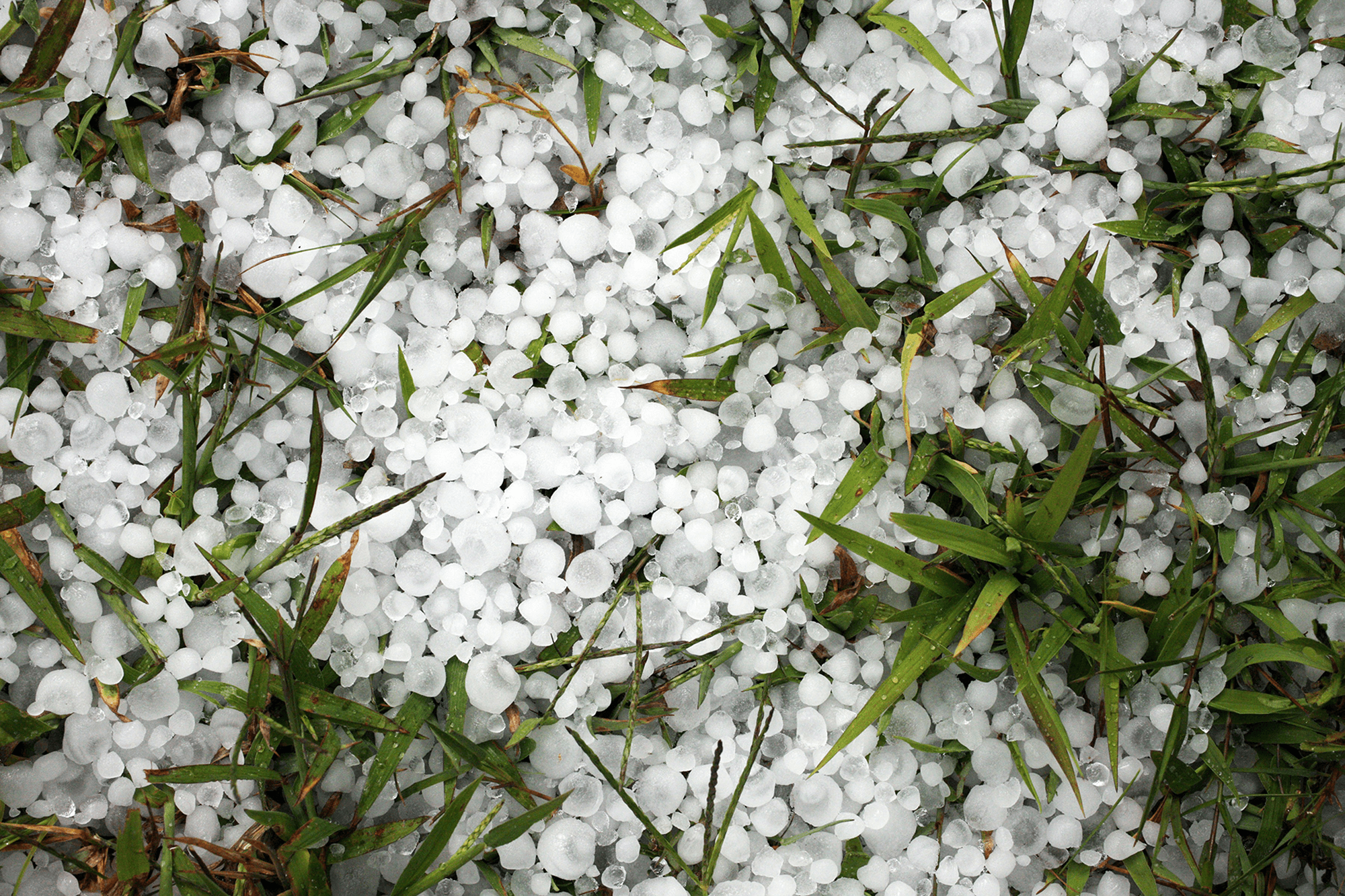
    Conventional wisdom suggests that hailstones form over the course of repeated trips up and down through a storm, but a new study suggests that formation method is less common than assumed. Researchers studied the isotope signatures in the layers of 27 hailstones to work out each stone’s formation history. They found that most hailstones (N = 16) grew without any reversal in direction. Another 7 only saw a single period when upwinds lifted them, and only 1 of the hailstones had cycled down-and-up more than once. They did find, however, that hailstones larger than 25mm (1 inch) in diameter had at least one period of growth during lifting.

    So smaller hailstones likely don’t cycle up and down in a storm, but the largest (and most destructive) hailstones will climb at least once before their final descent. (Image credit: D. Trinks; research credit: X. Lin et al.; via Gizmodo)

    Fediverse Reactions
  • Climate Change and the Equatorial Cold Tongue

    Climate Change and the Equatorial Cold Tongue

    A cold region of Pacific waters stretches westward along the equator from the coast of Ecuador. Known as the equatorial cold tongue, this region exists because trade winds push surface waters away from the equator and allow colder, deeper waters to surface. Previous climate models have predicted warming for this region, but instead we’ve observed cooling — or at least a resistance to warming. Now researchers using decades of data and new simulations report that the observed cooling trend is, in fact, a result of human-caused climate changes. Like the cold tongue itself, this new cooling comes from wind patterns that change ocean mixing.

    As pleasant as a cooling streak sounds, this trend has unfortunate consequences elsewhere. Scientists have found that this cooling has a direct effect on drought in East Africa and southwestern North America. (Image credit: J. Shoer; via APS News)

    Fediverse Reactions
  • Featured Video Play Icon

    Playful Martian Dust Devils

    The Martian atmosphere lacks the density to support tornado storm systems, but vortices are nevertheless a frequent occurrence. As sun-warmed gases rise, neighboring air rushes in, bringing with it any twisted shred of vorticity it carries. Just as an ice skater pulling her arms in spins faster, the gases spin up, forming a dust devil.

    Black and white video illustrating a small Martian dust devil catching up to and getting swallowed up by a larger dust devil.

    In this recent footage from the Perseverance Rover, four dust devils move across the landscape. In the foreground, a tiny one meets up with a big 64-meter dust devil, getting swallowed up in the process. It’s hard to see the details of their crossing, but you can see other vortices meeting and reconnecting here. (Video and image credit: NASA/JPL-Caltech/LANL/CNES/CNRS/INTA-CSIC/Space Science Institute/ISAE-Supaero/University of Arizona; via Gizmodo)

  • Inside an Alien Atmosphere

    Inside an Alien Atmosphere

    Studying the physics of planetary atmospheres is challenging, not least because we only have a handful of examples to work from in our own solar system. So it’s exciting that researchers have unveiled our first look at the 3D structure of an exoplanet‘s atmosphere.

    Using ground-based observations, researchers studied WASP-121b, also known as Tylos, an ultra-hot Jupiter that circles its star in only 30 Earth hours. One face of the planet always faces its star while the other faces into space. The team found that the exoplanet has a flow deep in the atmosphere that carries iron from the hot daytime side to the colder night side. Higher up, the atmosphere boasts a super-fast jet-stream that doubles in speed (from an estimated 13 kilometers per second to 26 kilometers per second) as it crosses from the morning terminator to the evening. As one researcher observed, the planet’s everyday winds make Earth’s worst hurricanes look tame. (Image credit: ESO/M. Kornmesser; research credit: J. Seidel et al.; via Gizmodo)

    Fediverse Reactions
  • Atmospheric Rivers Raise Temperatures

    Atmospheric Rivers Raise Temperatures

    Atmospheric rivers are narrow streams of moisture-rich air running from tropical regions to mid- or polar latitudes. Though relatively short-lived, they are capable of carrying — and depositing — more water than the largest rivers. But researchers have found that their impact is not measured in water content alone. Instead, a survey of 43 years’ worth of data shows that atmospheric rivers also bring unusually warm temperatures. In some cases, the authors found surface temperatures near an atmospheric river climbed to as high as 15 degrees Celsius above the typical. On average, temperatures were about 5 degrees Celsius higher than expected for the region’s climate.

    Several factors raise those temperatures — like the heat released when rising vapor meets cooler air and condenses into liquid — but the biggest effect came from carrying warm tropical temperatures to (usually) cooler regions. (Image credit: L. Dauphin/NASA; research credit: S. Scholz and J. Lora; via Physics Today)

    Fediverse Reactions