Tag: artificial intelligence

  • “Metamorphe”

    “Metamorphe”

    A smoke-like haze drifts over surreal landscapes in the “Metamorphe” series by Reuben Wu and Jenni Pasanen. Though fluidic in appearance, these pieces are a merger between Wu’s drone light photography and Pasanen’s AI-assisted digital creations. Even so, the images are extremely evocative of fluid motion, connected as they are to human senses (like smell, hearing, and touch) that often rely directly on fluid dynamics. For more, check out the artists’ sites and Instagram. (Image credits: R. Wu and J. Pasanen; via Colossal)

  • Robotic Research Facilities

    Robotic Research Facilities

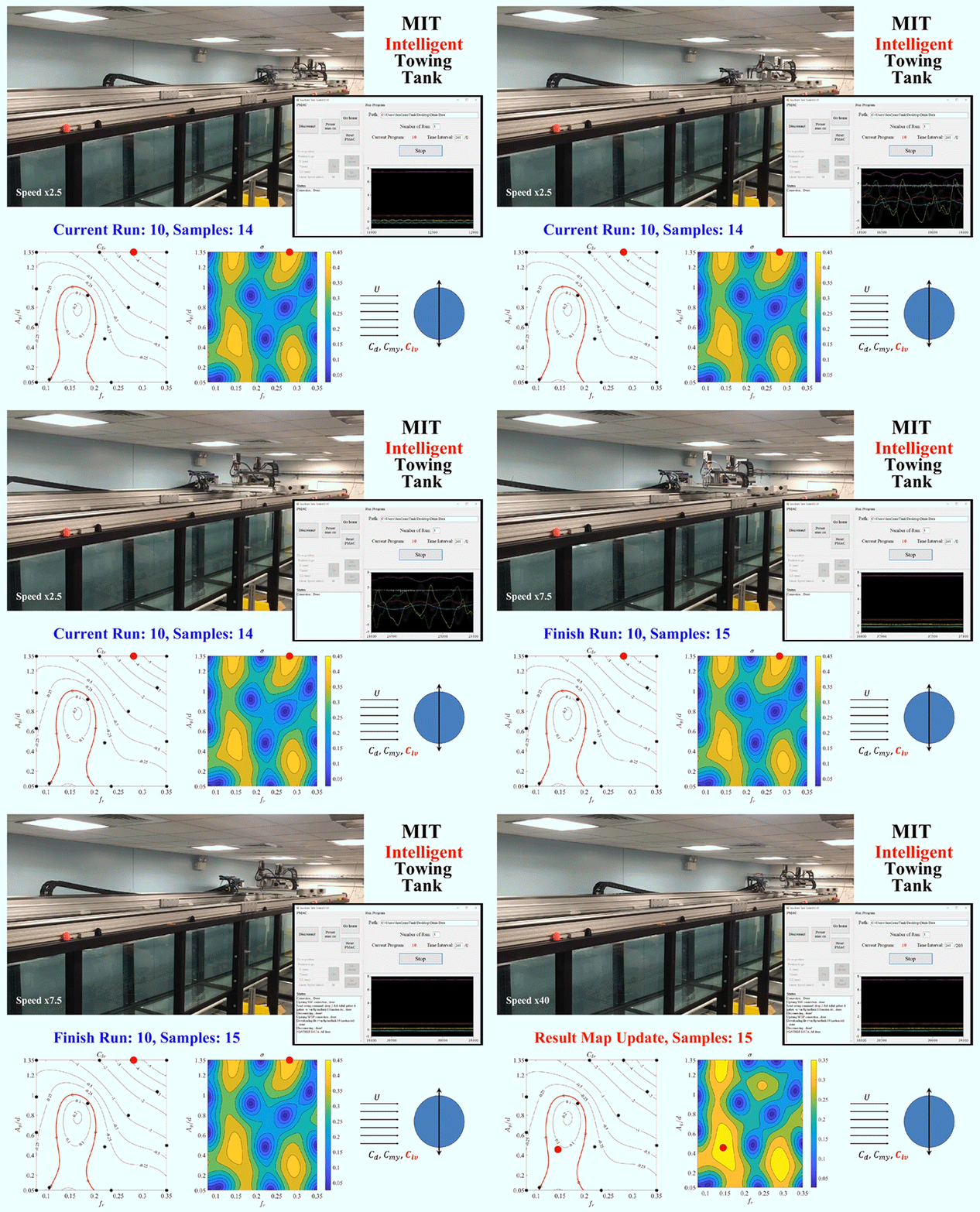
    One of the major challenges in fluid dynamics is the size of the parameter spaces we have to explore. Because many problems in fluid dynamics are non-linear, making small changes in the initial set-up can result in large differences in the results. Consider, for example, a simple cylinder towed through a water tank. As the cylinder moves, vortices will form around it and shed off the back, causing the cylinder to vibrate. The details of what will happen will depend on variables like the cylinder’s size and flexibility, the speed it’s being towed at, and which directions it’s allowed to vibrate in. Mapping out the parameter space, even sparsely, could take a graduate student hundreds of experiments.

    To speed up this process, engineers are now building robotic facilities like the Intelligent Towing Tank (ITT) shown above. Like graduate students, the ITT can work into the wee hours of the night, but, unlike graduate students, it never needs to eat, sleep, or stop experimenting. Now, one could use a facility like this to brute-force the answers by testing every possible combination of parameters, but even working 24 hours a day, that would take a long time. Instead, researchers use machine learning to guide the robotic facility into choosing test parameters in a way that optimizes the factors the researchers define as important.

    Essentially, the system starts with experiments chosen at random within the parameter space, and then uses those results to select areas of interest until it’s gathered enough data to satisfy the limits specified by human researchers. In theory, a well-designed algorithm can dramatically reduce the number of experiments needed to explore a parameter space. (Image and research credit: D. Fan et al.; submitted by Kam-Yung Soh)

  • Building Smart Swimmers

    Building Smart Swimmers

    Scientists have long wondered whether the schooling of fish is driven by hydrodynamic benefits, but the complexity of their environment makes unraveling this complex motion difficult. A recent study uses a different tactic, combining direct numerical simulation of the fluid dynamics with techniques from artificial intelligence and machine learning to build and train autonomous, smart swimmers.

    The authors use a technique called deep reinforcement learning to train the swimmers. Essentially, the swimmer being trained is able to observe a few variables, like its relative position to the lead swimmer and what its own last several actions have been – similar to the observations a real fish could make. During training, the lead swimmer keeps a steady pace and position, and the follower, through trial and error, learns how to follow the leader in such a way that it maximizes its reward. That reward is set by the researchers; in this case, one set of fish was rewarded for keeping a set distance from their leader, one intended to keep them in a position that was usually beneficial hydrodynamically. Another set of fish was rewarded for finding the most energy-efficient method for following.

    Once trained, the smart swimmers were set loose behind a leader able to make random decisions. Above you can see the efficiency-seeker chasing this leader. Impressively, even though this smart swimmer had the option to go it alone (and had never followed such a dynamic leader), it does an excellent job of keeping to the leader’s wake. Compare it with real swimmers and there’s a definite similarity in their behavior, which suggests the technique may be capturing some of an actual fish’s intuition. (Image and research credit: S. Verma et al., source; thanks to Mark W. for assistance)