Tag: amorphous solid

  • Inside Solidification

    Inside Solidification

    As children, we’re taught that there are three distinct phases of matter–solid, liquid, and gas–but the reality is somewhat more complicated. In the right–often exotic–conditions, there are far more phases matter takes on. In a recent study, researchers described a metal that sits somewhere between a liquid and a solid.

    In a liquid, atoms are free to move. During solidification, atoms lose this freedom, and their frozen positions relative to one another determine the solid’s properties. Atoms frozen into orderly patterns form crystals, whereas those frozen haphazardly become amorphous solids. In their experiment, researchers instead observed atoms in liquid metal nanoparticles that remained stationary throughout the transition from liquid to solid. The number and position of stationary atoms affected whether the final solid crystallized or not.

    By tracking these stationary atoms and their influence, the team hopes to better control the material properties of the final solidified metal. (Image credit: U. of Nottingham; research credit: C. Leist et al.; via Gizmodo)


    Fediverse Reactions
  • Does Liquid in a Vacuum Boil or Freeze?

    Does Liquid in a Vacuum Boil or Freeze?

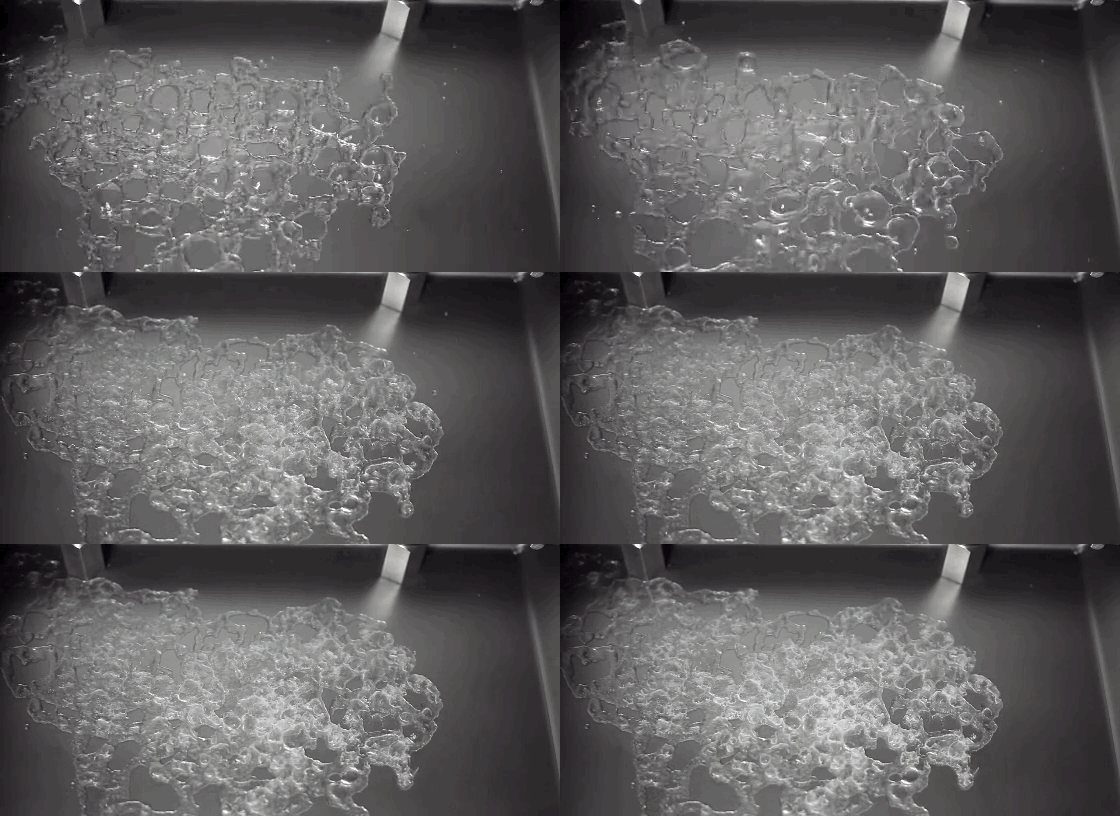
    What happens to a liquid in a cold vacuum? Does it boil or freeze? These animations of liquid nitrogen (LN2) in a vacuum chamber demonstrate the answer: first one, then the other! The top image shows an overview of the process. At standard conditions, liquid nitrogen has a boiling point of 77 Kelvin, about 200 degrees C below room temperature; as a result, LN2 boils at room temperature. As pressure is lowered in the vacuum chamber, LN2’s boiling point also decreases. In response, the boiling becomes more vigorous, as seen in the second row of images. This increased boiling hastens the evaporation of the nitrogen, causing the temperature of the remaining LN2 to drop, the same way sweat evaporating cools our bodies. When the temperature drops low enough, the nitrogen freezes, as seen in the third row of images. This freezing happens so quickly that the nitrogen molecules do not form a crystalline lattice. Instead they are an amorphous solid, like glass. As the residual heat of the metal surface warms the solid nitrogen, the molecules realign into a crystalline lattice, causing the snow-like flakes and transition seen in the last image. Water can also form an amorphous ice if frozen quickly enough. In fact, scientists suspect this to be the most common form of water ice in the interstellar medium. (GIF credit: scientificvisuals; original source: Chef Steps, video; h/t to freshphotons)