Tag: adsorption

  • Water Builds Static Charge

    Water Builds Static Charge

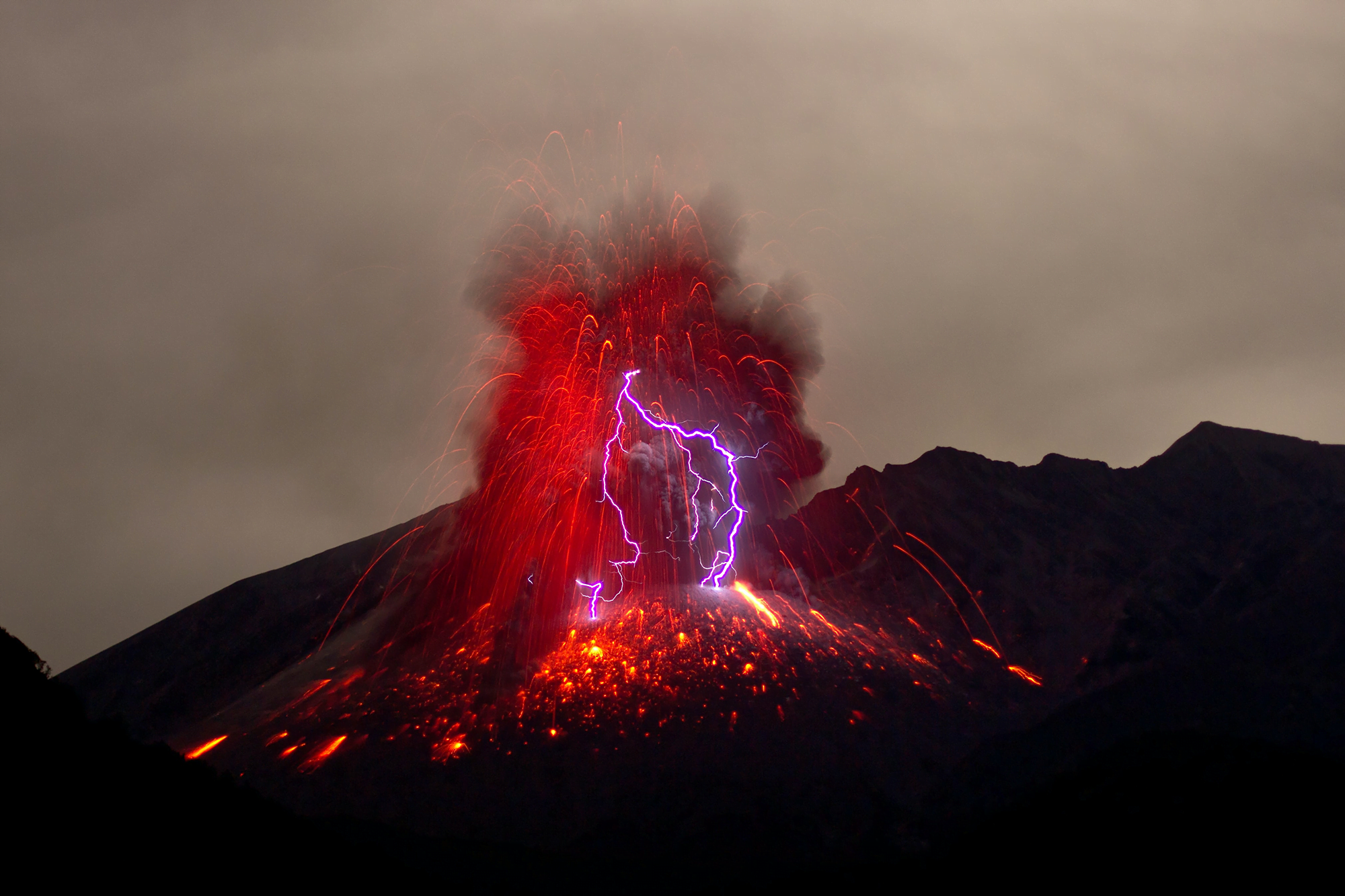
    The ancient Greeks first recognized static electricity, but the mechanisms behind it remain somewhat mysterious. In particular, it’s unclear how two pieces of the same material can build a charge between them simply by touching. Yet we regularly see examples of this when volcanic ash creates enough charge to discharge lightning. A new study sheds light on the question by studying the impact of a single grain of silica on a silica disk.

    The researchers used acoustic levitation to hold their silica particle in place. By turning the acoustic waves off, they could bounce the grain off the disk, then catch the particle again with the acoustic field. After a bounce, they swept an electrical field across the particle and observed its oscillations to determine how much charge the particle held. When necessary, they could also discharge the particle.

    Animation showing three stages of the experiment.
    This animation demonstrates the three phases of an experiment. In the first (left), the acoustic field is shut off, allowing the silica grain to fall and strike the disk. Then the field is turned back on to “catch” the particle. In the second phase (middle), the researchers use a sweeping electrical field to determine the charge built up on the grain. In the third phase (right), they periodically discharge the built-up charge on the particle.

    What they found was that charge on the particle grew with the number of impacts. They also saw that they could reverse the polarity of the charge with careful cleaning and baking of their objects. Their conclusion is that adsorption of water from the surrounding air is what enables the build-up of static charge on identical materials. (Image credit: volcano – M. Szeglat, experiment – G. Grosjean and S. Waitukaitis; research credit: G. Grosjean and S. Waitukaitis; via APS Physics)

  • A Macro View of Weathering

    A Macro View of Weathering

    Water constantly weathers sedimentary rock, both physically — through abrasion — and chemically — through dissolution and recrystallization. Now researchers have gotten their first view of this weathering at the Ångstrom level by observing porous rocks with environmental transmission electron microscopy as they interact with both water vapor and liquid water.

    As expected, the experiments with liquid water showed that water dissolved the rocks and substantially changed the geometry of the rock’s pores. But the experiments also showed significant weathering from water vapor alone. The researchers found that water vapor formed a film on the surface of the rock’s pores in a process known as adsorption. This film substantially decreased the size of each pore and created strain in the rock. Once the water vapor was removed, the rock’s pores were notably altered, supporting the idea that this adsorption was, itself, a form of weathering. (Image credit: M. Kosloski; research credit: E. Barsotti et al.; via AGU EOS; submitted by Kam-Yung Soh)