Search results for: “vortex”

  • Featured Video Play Icon

    Turbulence From Vortex Rings

    When vortex rings collide, they reconnect into smaller, rings that eventually break down into chaos. Here, researchers experiment with colliding multiple vortex rings — focusing on an eight-ring collision. When they collide rings over and over, it creates a zone of isolated turbulence at the heart of the collisions.

    Many of the theories and predictions that exist around turbulence assume that the flow is homogeneous and isotropic; what this means is that the (statistical) characteristics of the flow are the same in every direction. In reality, this kind of flow isn’t always easily achieved, which makes testing theoretical predictions challenging.

    What’s neat about this set-up is that you get this desired turbulence in a very controlled way. It’s easy to tune the size and energy of your vortex rings, and those tweaks allow you to observe what — if any — changes occur in the resulting turbulence. (Image and video credit: T. Matsuzawa et al.)

  • Featured Video Play Icon

    Inside a Metal Vortex

    What do you get when you combine liquid gallium, a blender, and a special probe lens? Some pretty wild slow-mo video of a liquid metal vortex, courtesy of the Slow Mo Guys. This video is almost as notable for its set-up as it is for the high-speed footage, given the lengths Gav and Dan go to in order to get the shot! (Image and video credit: The Slow Mo Guys)

  • Featured Video Play Icon

    Vortex Arms

    A fixed cylinder will shed alternating vortices in its wake, but one allowed to oscillate forward and backward in the flow instead sheds simultaneous vortices. The shape of the wake still depends on the flow’s velocity. At low flow speeds, the two vortices are the same size when they shed. At higher velocities, the two vortices still shed simultaneously, but one will be large while the other is small. The larger vortex moves faster and travels downstream, but the smaller, slower vortex drifts inward. In the next shedding cycle, the small and large vortices switch positions, creating alternating symmetric shedding. (Image and video credit: P. Boersma et al.)

  • Featured Video Play Icon

    “Kármán Vortex Street”

    Although engineers often consider fluid mechanics through the lens of mathematics, that’s far from the only way to understand fluid physics. Today’s video is an alternative interpretation of a classic flow — the flow around a cylinder — created in a collaboration between dancers and engineers. The result is what they call a “physics-constrained dance improvisation” that shows how the flow changes as its speed increases. I love this concept! It highlights the visual and qualitative differences between flow states and maintains space for artistic creativity. Be sure to watch the full video! (Video and submission credit: J. Capecelatro et al.)

  • Vortex Rings on V-Shaped Walls

    Vortex Rings on V-Shaped Walls

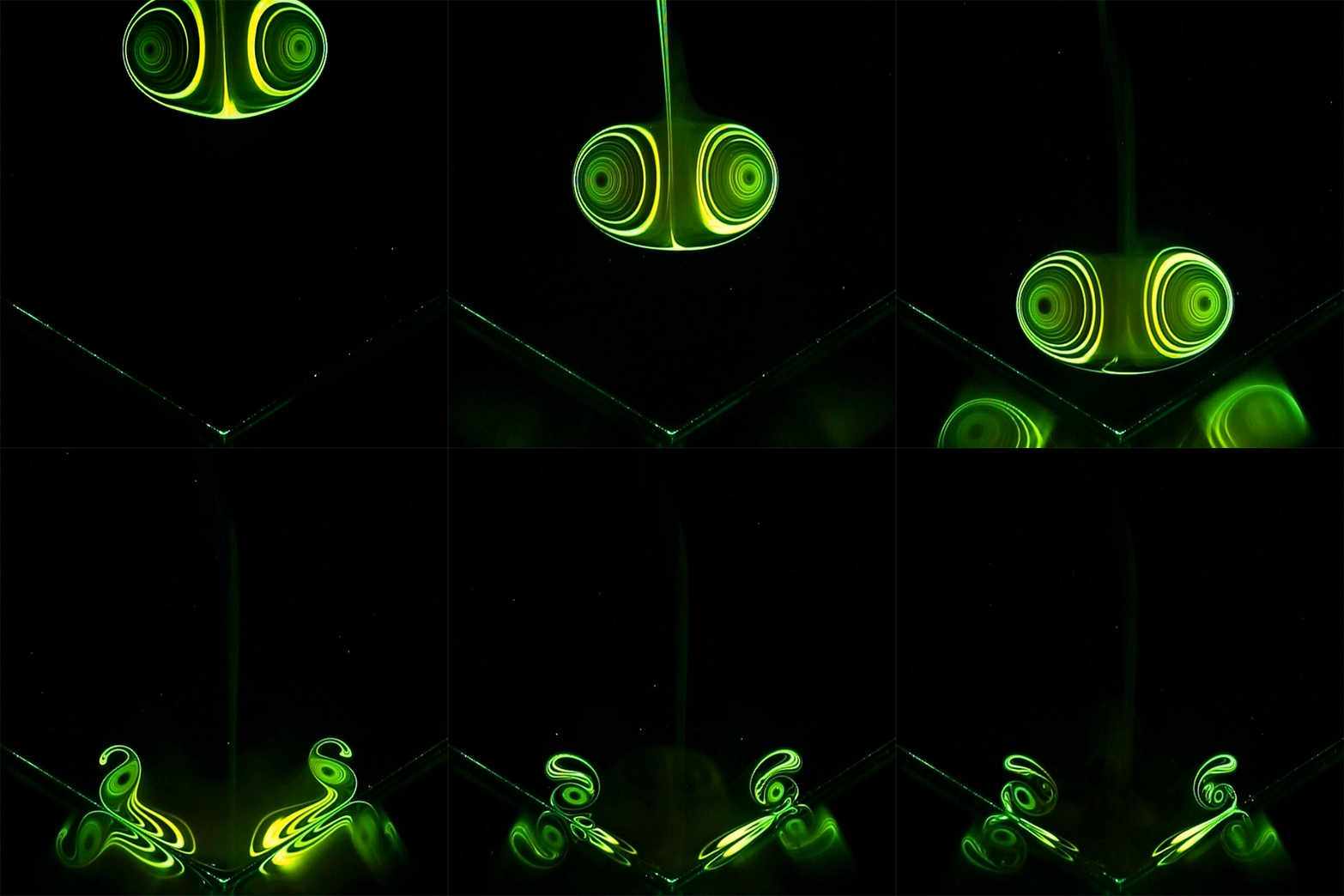
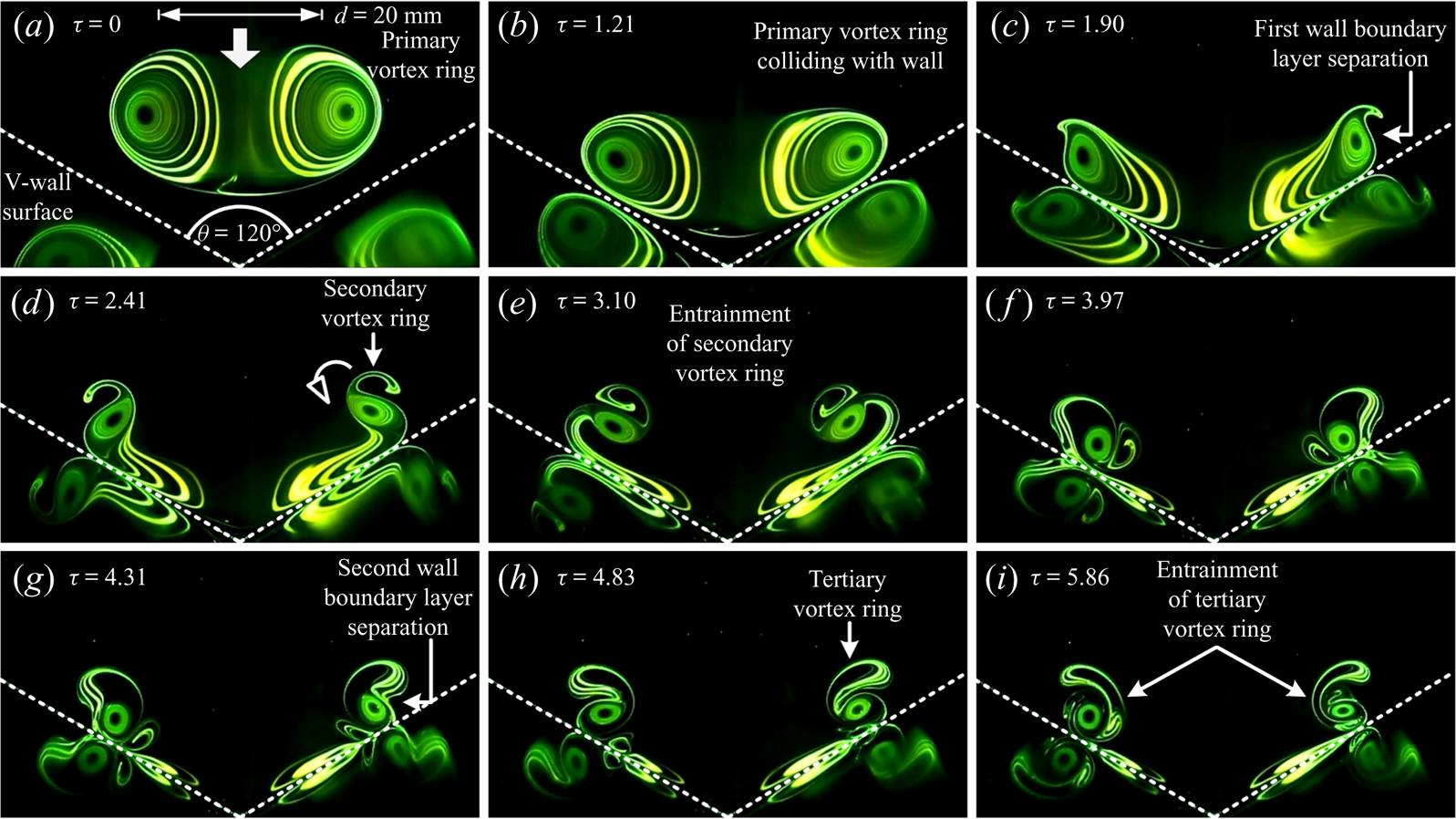
    Vortex ring impacts are eternally fascinating. Here, researchers explore what happens when a vortex ring encounters a V-shaped wall. Because the outer portions of the vortex ring hit the wall sooner than the inner ones, distortions begin there first.

    The vortex’s approach creates a pressure gradient that causes flow near the wall to separate, generating that first little hook in each arm of the vortex. Next, secondary vortices develop on either side and quickly get pulled into the original vortex. The whole process repeats a second time to generate tertiary vortices that continue the inward spiral. The impact appears even more complicated when viewed from the side of the valley (Image 2). Check out Image 3 for a point-by-point breakdown of the impact process. (Image and research credit: T. New et al.)