Search results for: “turbulence”

  • Overcoming Turbulence

    Overcoming Turbulence

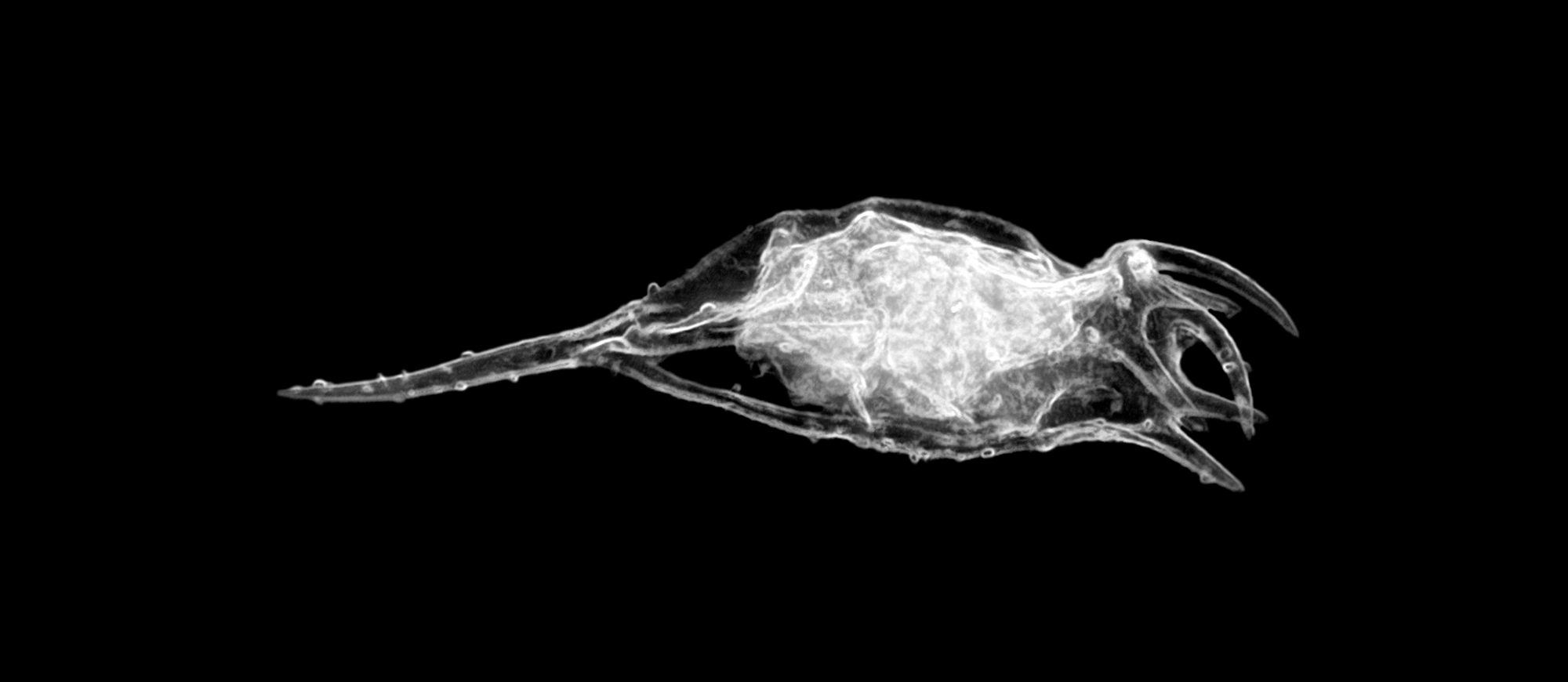
    Despite their microscopic size, many plankton undertake a daily migration that covers tens of meters in depth. As they journey, they must contend with currents, turbulence, and other flows that could knock them off-course. And, increasingly, research shows that a plankton’s shape makes a big difference in these flows.

    Spherical plankton tend to cluster in areas of flow moving opposite to their direction of travel. But more elongated plankton can resist — or even reverse — this tendency, helping them stay on track. In turbulence, elongated swimmers are also better at keeping their thrust oriented in the desired direction of travel. So both nature and engineers should favor elongated microswimmers when contending with turbulence and potential crossflows. (Image credit: Picturepest/Flickr; research credit: R. Bearon and W. Durham)

  • Featured Video Play Icon

    “Turbulence”

    In his recent short film, artist Roman De Giuli explores turbulence using metallic paints and inks in a fishtank. The effects are beautiful: sparkling pigments dispersing in clouds, mushroom- and umbrella-shaped Rayleigh-Taylor instabilities, and lots of swirling eddies. It’s exactly the kind of eyecandy to kick off your weekend with! (Image and video credit: R. De Giuli)

  • Featured Video Play Icon

    Turbulence From Vortex Rings

    When vortex rings collide, they reconnect into smaller, rings that eventually break down into chaos. Here, researchers experiment with colliding multiple vortex rings — focusing on an eight-ring collision. When they collide rings over and over, it creates a zone of isolated turbulence at the heart of the collisions.

    Many of the theories and predictions that exist around turbulence assume that the flow is homogeneous and isotropic; what this means is that the (statistical) characteristics of the flow are the same in every direction. In reality, this kind of flow isn’t always easily achieved, which makes testing theoretical predictions challenging.

    What’s neat about this set-up is that you get this desired turbulence in a very controlled way. It’s easy to tune the size and energy of your vortex rings, and those tweaks allow you to observe what — if any — changes occur in the resulting turbulence. (Image and video credit: T. Matsuzawa et al.)

  • Turbulence in Accretion Disks

    Turbulence in Accretion Disks

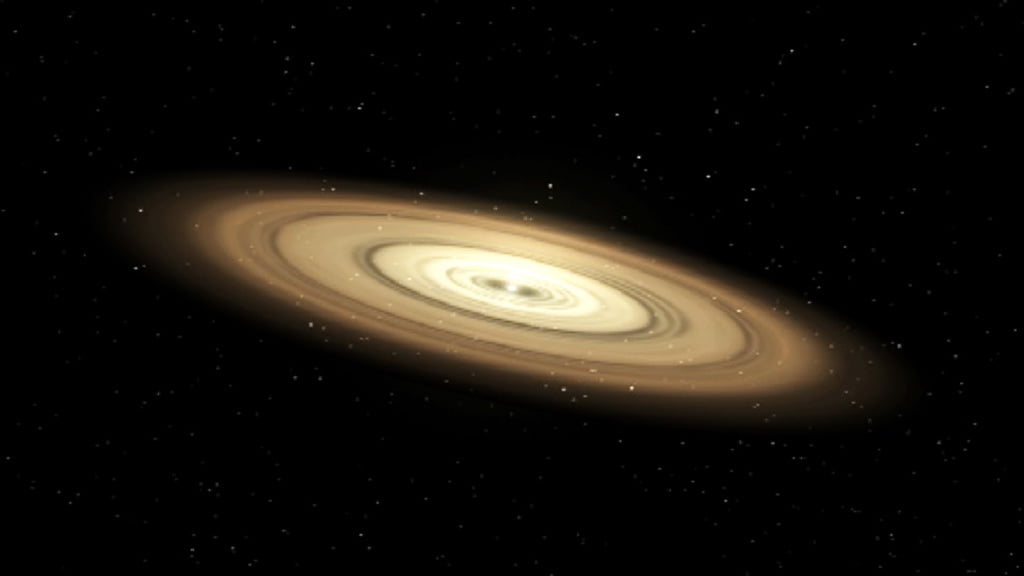
    Accretion disks form everywhere, from around young, planet-building stars to massive black holes. As matter circles in the disk, it slowly loses angular momentum and falls inward toward the central gravitational body. But the details of this process have long vexed astronomers. The low-viscosity environment of gas and dust in accretion disks simply is not sufficient to account for the level of angular momentum lost. Turbulence is expected to provide a boost to the effect, but neither astronomical observations or Taylor-Couette experiments have shown how.

    A new study uses a liquid metal, confined in a disk using radial and vertical electrical fields. Unlike prior experiments, this set-up creates a more gravity-like force to rotate the liquid. With it, researchers can tune both the rotation speed and the level of turbulence. They found that turbulence is, indeed, responsible for the loss of angular momentum that transports mass inward — even at the limit of zero intrinsic viscosity.

    Unfortunately, the apparatus isn’t a perfect analog for astrophysical disks; in the experiment, the turbulence originates from secondary flows that aren’t present in real systems. So while the team demonstrated that turbulence can drive the accretion disk’s behavior, it can’t pinpoint where that turbulence originates in real accretion disks. (Image credit: NASA; research credit: M. Vernet et al.; via Physics World)

  • Rising Through Turbulence

    Rising Through Turbulence

    Plankton — microscopic creatures with often limited swimming abilities — can face daily journeys of hundreds of vertical meters in the ocean. That’s a daunting prospect for any tiny swimmer. A new mathematical model suggests that plankton can have an easier time of it, though, by riding turbulent currents.

    The researchers modeled an individual planktar (singular of plankton) capable of sensing nearby velocity gradients and rotating its body to control its swimming direction. With this simple set of controls, their simulated planktar was able to “surf” turbulent currents, covering vertical distances at twice its normal swimming speed despite its curvy path.

    Currently, there’s no direct experimental evidence that plankton do this, but it does seem to make sense of experimenters’ observations. With the model’s results to guide them, experimentalists are looking for microswimmers actively orienting themselves based on turbulence. (Image credit: top – B. de Kort, illustration – R. Monthiller et al.; research credit: R. Monthiller et al.; via APS Physics)
  • Bubbles in Turbulence

    Bubbles in Turbulence

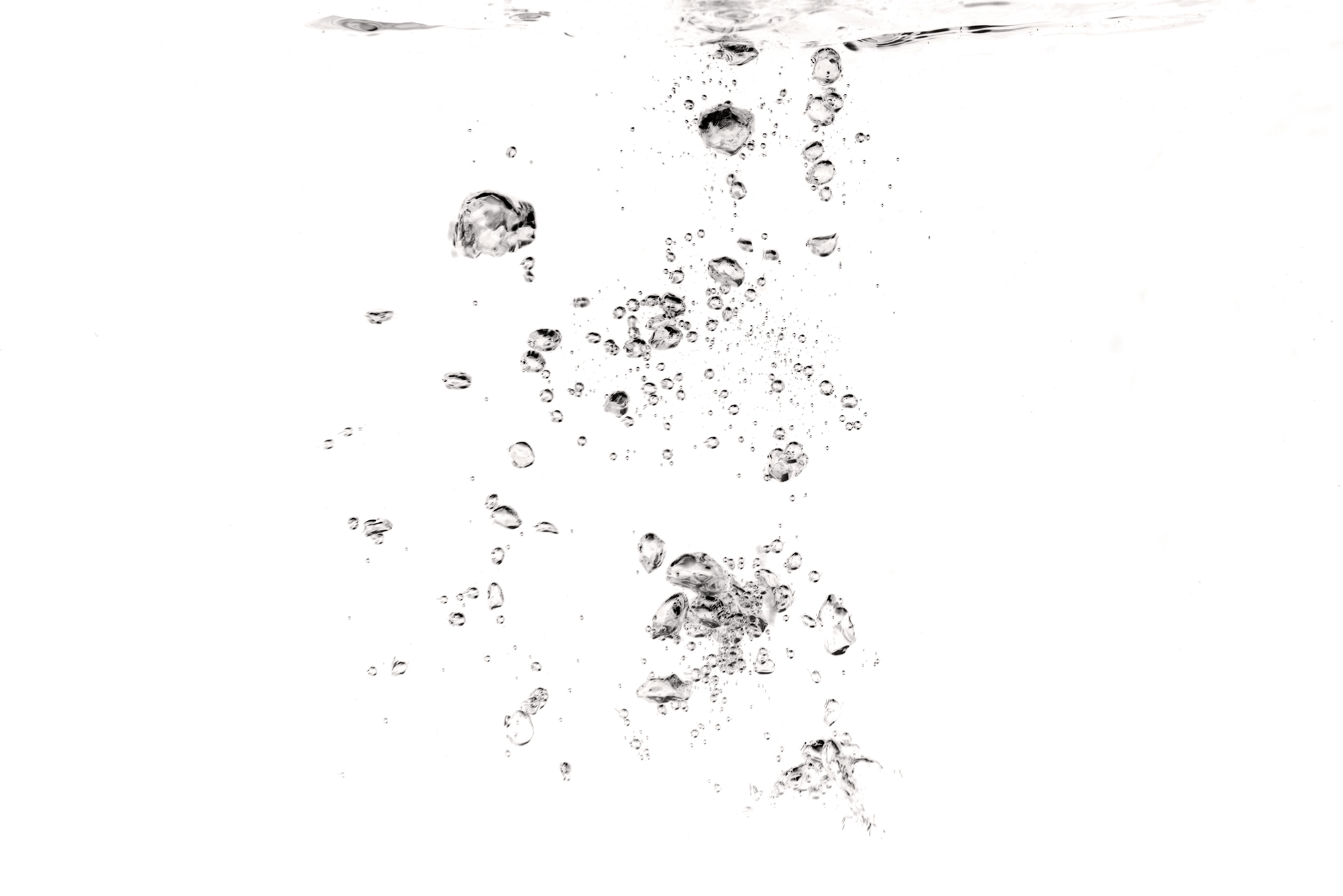
    In nature and industry, swarms of bubbles* often encounter turbulence in their surrounding fluid. To study this situation, researchers used numerical simulation to observe bubbles across a range of density, viscosity, and surface tension values relative to their surroundings. They found that density differences between the two fluids made negligible changes to the way bubbles broke or coalesced.

    In contrast, viscosity played a much larger role. More viscous bubbles were less likely to deform and break, thanks to their increased rigidity. When looking at small deformations along the bubble interface, both density and viscosity had noticeable effects. With increasing bubble density, they observed more dimples on the interface; increasing the viscosity had the opposite effect, making the bubbles smoother. (Image credit: Z. Borojevic; research credit: F. Mangani et al.)

    *We usually think of bubbles as air or another gas contained within a liquid. But this study’s authors use the term “bubble” more broadly to mean any coherent bits of fluid in a different surrounding fluid. Colloquially, this means their results apply to both bubbles and drops.

  • Using Turbulence in Flight

    Using Turbulence in Flight

    When small, heavy particles are in a turbulent flow, they settle faster than in a quiescent one. Their interactions with turbulent eddies sweep them along, extracting energy that lengthens their overall path but reduces the time necessary for them to fall. Using the same principles, researchers are finding ways for rotorcraft and other vehicles to extract energy from turbulence for more efficient flight.

    The technique forces a vehicle to behave like a heavy particle by sensing turbulent gusts from its own accelerations and adding forcing to those accelerations when they are in the desired direction of flight. In essence, the vehicle uses the turbulence of its surroundings to find helpful tailwinds. (Image credit: A. Soggetti; research and submission credit: S. Bollt and G. Bewley)

  • Turbulence in Flight

    Turbulence in Flight

    Eagles and other birds spend much of their lives in the turbulence of our atmospheric boundary layer. Some of their interactions with turbulence — like using topographical effects to aid their flight — are well-known, but much remains uncertain. One team of researchers looked at a tagged golden eagle’s flight data, compared with known wind conditions, and looked for evidence of turbulence’s influence. To do this, they drew on years of research into how turbulence interacts with inertial particles — particles that are heavier than the surrounding fluid and thus unable to follow the flow exactly.

    What they found is that turbulence seems to be baked into many aspects of the eagle’s flight. Even the basic accelerations of the eagle’s body during flight showed characteristics that match those of turbulent flows. The findings suggest that turbulence — rather than something to be avoided — is an integral part of flight for birds, an energy source they’ve learned to exploit. (Image credit: J. Wang; research credit: K. Laurent et al.; submission by G. Bewley)