
Some snakes in Southeast and South Asia are known to glide some 100 m between trees. Researchers filmed snakes, constructed computational models of their flights, and tested plastic models in a water tunnel. They found that the snakes angled their bodies such that they generate lift to counteract their fall and that the S-configuration they assume increases lift much the way flying in a V-formation does for geese. The wake from the forward portion of the snake interacts with the flow around the back of the snake and reduces downwash, which increases lift. In effect, the back of the snake is drafting off the front. #
Search results for: “lift”

Bell’s Powered Kite
Inventor Alexander Graham Bell is best known for the telephone but also made many contributions to early aeronautics. This man-carrying kite, the Cygnet III, was a powered kite with a “wing” made of 3,393 tetrahedral cells; it managed enough lift to fly on March 1, 1912. National Geographic is featuring photos from the early days of flight courtesy of the Smithsonian National Air and Space Museum. They’re well worth checking out. #
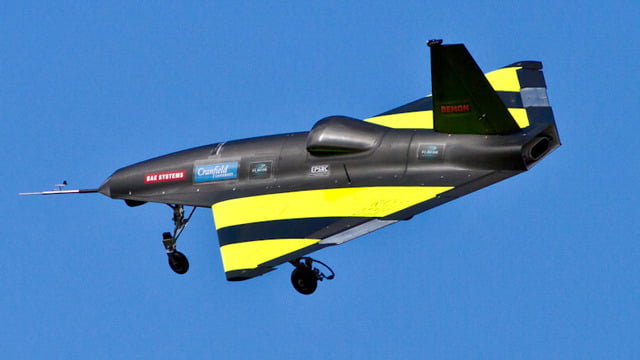
Jet-Based Control
Researchers have flown the first aircraft designed to maneuver without conventional control surfaces like ailerons and flaps. Instead of changing the wing geometry to alter the lift on different parts of the craft, the UAV uses strategically placed jets of air along the wing to control its flight. The plane can also alter the direction of its thrust, not by turning the nozzle as is conventionally done, but by modifying the thrust vector by directing and firing a secondary jet into the exhaust. #

Human-Powered Ornithopter
A team at the University of Toronto has flown the world’s first human-powered ornithopter, an aircraft that flies by flapping its wings like a bird. The concept dates back all the way to Da Vinci in the 15th century. Part of why it’s taken centuries to realize the dream is that bird flight is much more complicated than simply flapping up and down. Flapping a wing up and down will produce lift equally upward and downward. In order to create usable lift and thrust, it’s necessary to change the angle of attack during each stroke by twisting the wing while flapping. Watch the U of T craft carefully, and you can see this happening. #
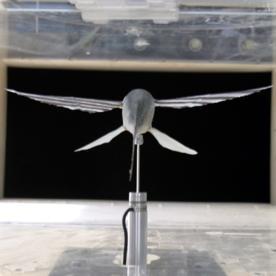
Flying Fish Aerodynamics
New research using wind tunnel measurements of (dead) flying fish is giving new insight into how these fish are able to fly over the waves. Lift and drag data indicates that flying fish have a gliding ability comparable to soaring birds like hawks! #