Search results for: “eddy”

  • Bay of Fundy Tides

    Bay of Fundy Tides

    Canada’s Bay of Fundy has some of the wildest tidal flows in the world. Every six hours, the flow direction through the strait shifts and tidal currents rise to several meters per second. This creates distinct jets a couple kilometers long that pour from one side of the strait to the other. 

    What you see here is a numerical simulation of the flow using a technique called Large Eddy Simulation (or LES, for short). It’s one method used by fluid dynamicists to model turbulent flows without taking on the complexity of the full Navier-Stokes equations. At large lengthscales, like those of the jets and eddies we see above, LES uses the exact physics. But when it comes to the smaller scales – like the flow nearest the shores or the bottom of the strait – the simulation will approximate the physics in order to make calculations quicker and easier. Models like these make large-scale problems – including modeling our daily weather patterns – possible. (Image credit: A. Creech, source)

  • Flow Inside the Heart

    Flow Inside the Heart

    Inside each of us is a remarkable and constant flow, driven by a muscle that’s always at work. As blood circulates through our bodies, it goes through a surprisingly varied journey. In the heart, as seen above, blood flow is very unsteady and quite turbulent, due to the beating pulse of the heart. As valves open and close and the muscle walls constrict and relax, the rushing blood moves in eddy-filled spurts. In the outer reaches of our capillaries, however, the nature of the flow is quite different. Thanks to smaller vessel sizes and other factors, capillary blood flow is much steadier and more laminar. Viscosity becomes more important, as do the non-Newtonian properties of components in our blood. (Image credit: mushin111/YouTube, source; via Science; submitted by Gary N.)

  • Washington Ice Disk

    Washington Ice Disk

    Winter weather in northern latitudes sometimes brings with it unusual phenomena like this ice disk spinning in the Middle Fork Snoqualmie River in Washington state. Photographer Kaylyn Messer ventured out to capture photos and videos of the event over the weekend. There are a couple theories as to how such disks form, but swirling river eddies are a key ingredient. One theory posits that chunks of ice forming on the river get caught up by the spinning eddy and slowly freeze together to form the disk. Another theory proposes that the disks occur when an existing chunk of ice breaks away, gets caught in the spinning eddy and slowly has its edges ground down into a circle. Personally, I lean toward the former explanation, though there is likely grinding at the edges either way. See more about this ice circle over at Messer’s blog.  (Image credit: K. Messer; GIF by @itscolossal; via Colossal)

  • Ocean Mixing

    Ocean Mixing

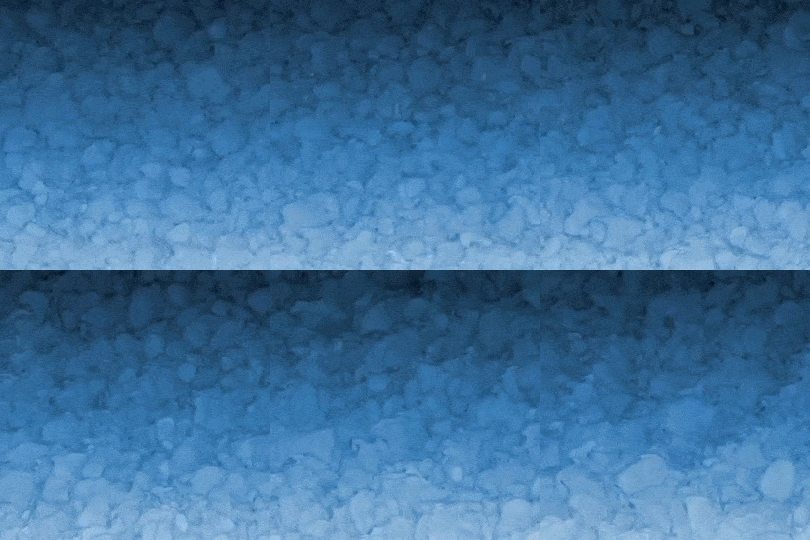
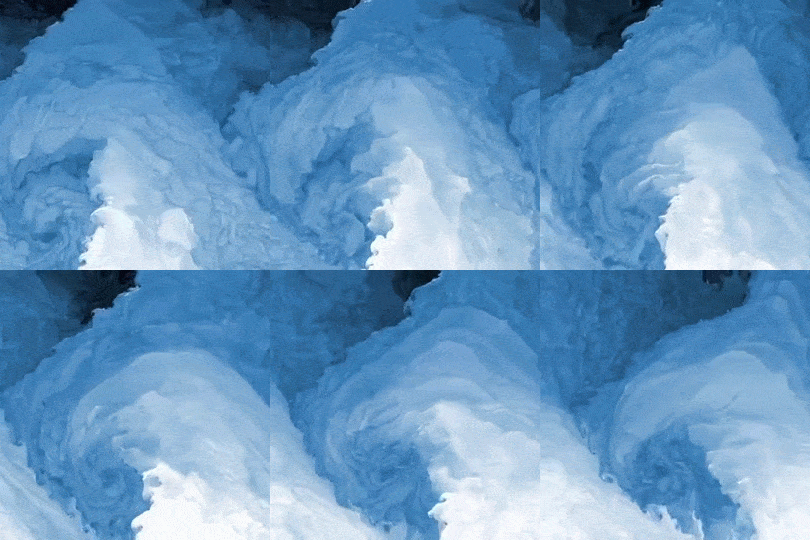
    Movement in Earth’s oceans is driven by a complicated interplay of many factors like temperature, salinity, and Earth’s rotation. Above are results from a numerical simulation of the top 100 meters of ocean contained within a 1 km x 1 km box.  The colors indicate surface temperature. Two major processes create the motion we see. The first is convection, in which water at the surface releases heat to the atmosphere and cools, causing it to then sink due to its greater density. Warmer water rises to replace it. This process happens quickly and dominates the early part of the simulation where we see the puffy convection cells shown on the left animation.

    A slower process is in effect as well. Because of variations in the water temperature, the density of the fluid at a given depth is not constant. We can already see that at the water surface, where the temperature (and thus density) is varying significantly. Those variations in density at the same depth combined with gravity’s tendency to shift fluids create what is known as a baroclinic instability. Put simply, this instability will cause warmer water to slide horizontally past colder water. The result is the large, spinning eddy motion seen in the animation on the right. To see how the whole system develops, check out the full video below.  (Image/video credit: J. Callies)

  • Featured Video Play Icon

    Blood Flow Simulations

    Though we may not often consider it, our bodies are full of fluid dynamics. Blood flow is a prime example, and, in this video, researchers describe their simulations of flow through the left side of the heart. Beginning with 3D medical imaging of a patient’s heart, they construct a computational domain – a meshed virtual heart that imitates the shape and movements of the real heart. Then, after solving the governing equations with an additional model for turbulence, the researchers can observe flow inside a beating heart. Each cycle consists of two phases. In the first, oxygenated blood fills the ventricle from the atrium. This injection of fresh blood generates a vortex ring. Near the end of this phase, the blood mixes strongly and appears to be mildly turbulent. In the second phase, the ventricle contracts, ejecting the blood out into the body and drawing freshly oxygenated blood into the atrium. (Video credit: C. Chnafa et al.)

  • Featured Video Play Icon

    The Reynolds Experiment

    One of the most famous and enduring of all fluid dynamics experiments is Osborne Reynolds’ pipe flow experiment, first published in 1883 and recreated in the video above. At the time, it was understood that flows could be laminar or turbulent, though Reynolds’ terminology of direct or sinuous is somewhat more poetic:

    Again, the internal motion of water assumes one or other of two broadly distinguishable forms-either the elements of the fluid follow one another along lines of motion which lead in the most direct manner to their destination, or they eddy about in sinuous paths the most indirect possible. #

    There had, however, been no direct evidence of these eddies in a pipe. Reynolds built an apparatus that allowed him to control the velocity of flow through a clear pipe and simultaneously introduce a line of dye into the flow. He carefully varied the velocity and temperature (and thus viscosity) in his apparatus and not only documented both laminar and turbulent flow but found that the transition from one to another could be described by a dimensionless number he derived from the Navier-Stokes equation. This number was dependent on the fluid’s velocity and kinematic viscosity as well as the diameter of the pipe. This was the birth of the Reynolds number, one of the most important parameters in all of fluid dynamics. (Video credit: S. dos Santos; research credit: O. Reynolds)

  • Featured Video Play Icon

    North Dakota Ice Disk

    Cold weather can create some wild fluid dynamics, so pay attention to your local rivers and waterfalls during the next cold snap. The video above comes from North Dakota where a combination of cold dense air and a stable river eddy created a spinning ice disk, roughly 16 meters in diameter. The disk forms as a collection of ice chunks–not one solid, spinning piece–because the ice formed gradually. As ice pieces form, they get caught in the river eddy and begin to spin as part of the disk, rather like dust and ice do in the rings of Saturn. Such formations are rare but not unheard of; here’s a video showing a similar disk as it grows. (Video credit: G. Loegering; via Yahoo and io9; submitted by Simon H and John C)

  • Featured Video Play Icon

    Visualizing Ocean Currents

    Researchers used computational models of ocean currents to produce this video visualizing worldwide ocean surface currents from June 2005 through December 2007. Dark patterns under the ocean are representative of ocean depths and have been exaggerated to 40x; land topography is exaggerated to 20x. Notice the wide variety of behaviors exhibited in the simulation: some regions experience strong recirculation and eddy production, while others remain relatively calm and unmoving. Occasionally strong currents sweep long lines across the open waters, carrying with them warmth and nutrients that encourage phytoplankton blooms and other forms of ocean life. (Video credit: NASA; submitted by Jason S)

  • Featured Video Play Icon

    Astronomical Jets

    Researchers have pieced together Hubble images of jets from newborn stars into timelapse movies that reveal the interstellar fluid mechanics responsible for the formation of stars like our sun. These jets stream out clumps of matter that has fallen on the new star. When faster moving eddies impact slower ones, bow shocks can form, much like shockwaves running before an airplane. See more HD video of these jets and bow shocks here#

  • Featured Video Play Icon

    Simulating Turbulence

    Turbulent flows are complicated to simulate because of their many scales. The largest eddies in a flow, where energy is generated, can be of the order of meters, while the smallest scales, where energy is dissipated, are of the order of fractions of a millimeter. In Direct Numerical Simulation (DNS), the exact equations governing the flow are solved at all of those scales for every time step–requiring hundreds or thousands of computational hours on supercomputers to solve even a small domain’s worth of flow, as on the airplane wing in the video. Large Eddy Simulation (LES) is another technique that is less computationally expensive; it calculates the larger scales exactly and models the smaller ones. The video shows just how complicated the flow field can look. The red-orange curls seen in much of the flow are hairpin vortices, named for their shape, and commonly found in turbulent boundary layers.