Search results for: “art”

  • Kirigami Parachutes

    Kirigami Parachutes

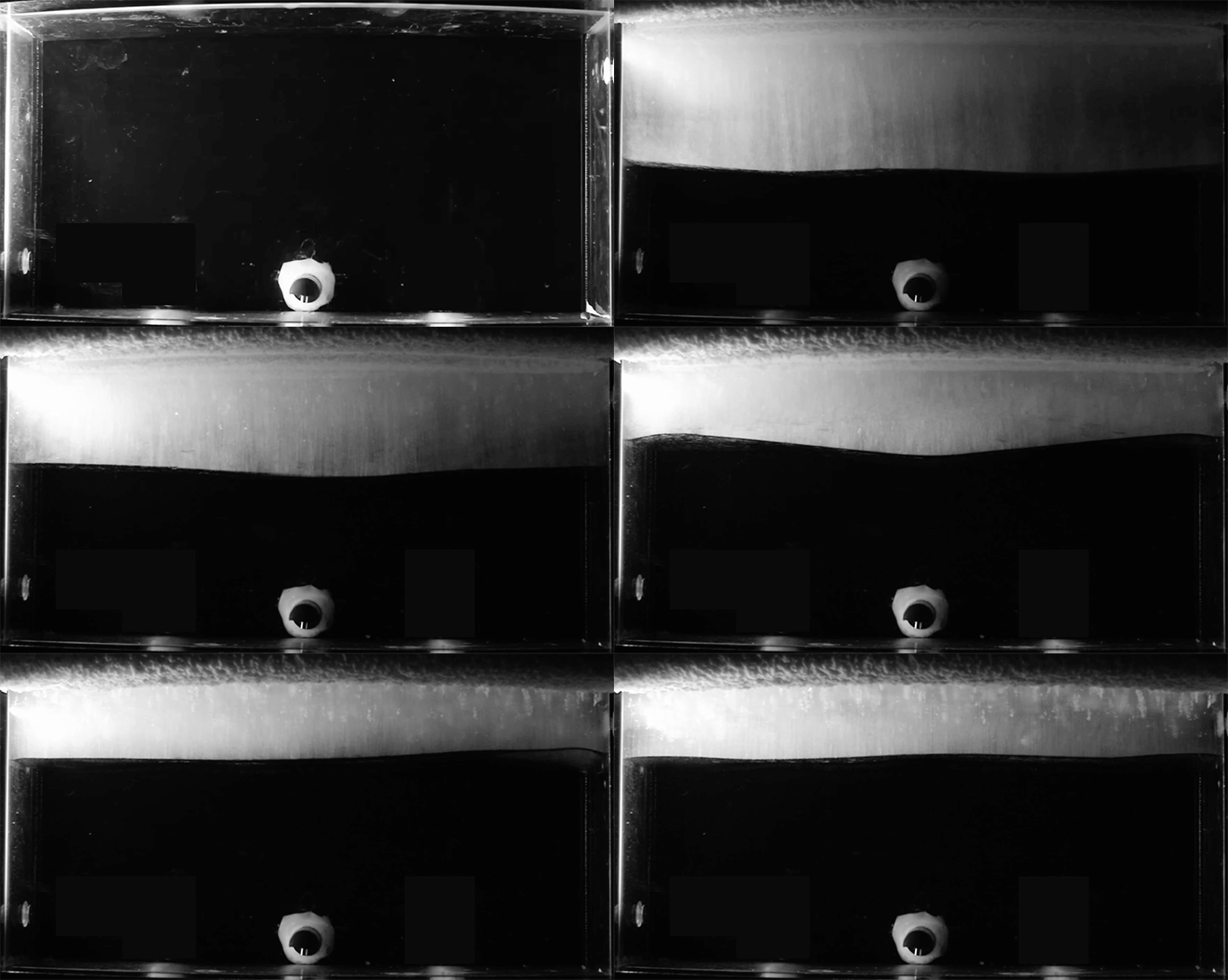
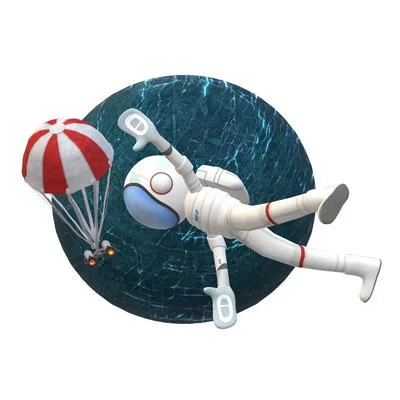
    In kirigami, careful cuts to a flat surface can morph it into a more complicated shape. Researchers have been exploring how to use this in combination with flow; now they’ve created a new form of parachute. Like a dandelion seed, this parachute is porous, with a complex but stable wake structure. This allows the parachute to drop directly over its target, unlike conventional parachutes, which require a glide angle to avoid canopy-collapsing turbulence.

    When dropping conventional parachutes, users either have to tolerate random landings far off target or invest in complicated active control systems that guide the parachute. Kirigami parachutes, in contrast, offer a potentially simple and robust option for accurately delivering, for example, humanitarian aid. (Image and research credit: D. Lamoureux et al.; via Physics World)

    Fediverse Reactions
  • Circulation in a Capillary Network

    Circulation in a Capillary Network

    Today’s video shows red blood cells flowing through a capillary network in a rat’s skeletal muscle. At this resolution, our eyes can follow the paths of individual red blood cells squeezing through each capillary, as well as the faster blur of thicker capillaries where many cells can pass at once. Watching videos like this is a great way to build intuition for particle image velocimetry, streaklines, and other flow visualization methods as our brains can readily recognize where the cells are moving fast and where they are slower. (Video and image credit: Dr. G. McEvoy et al.; via Colossal)

    Fediverse Reactions
  • Geoengineering Trials Must Consider Unintended Costs

    Geoengineering Trials Must Consider Unintended Costs

    As the implications of climate change grow more dire, interest in geoengineering–trying to technologically counter or mitigate climate change–grows. For example, some have suggested that barriers near tidewater glaciers could restrict the inflow of warmer water, potentially slowing the rate at which a glacier melts. But there are several problems with such plans, as researchers point out.

    Firstly, there’s the technical feasibility: could we even build such barriers? In many cases, geoengineering concepts are beyond our current technology levels. Burying rocks to increase a natural sill across a fjord might be feasible, but it’s unclear whether this would actually slow melting, in part because our knowledge of melt physics is woefully lacking.

    But unintended consequences may be the biggest problem with these schemes. Researchers used existing observations and models of Greenland’s Ilulissat Icefjord, where a natural sill already restricts inflow and outflow from the fjord, to study downstream implications. Right now, the fjord’s discharge pulls nutrients from the deep Atlantic up to the surface, where a thriving fish population supports one of the country’s largest inshore fisheries. As the researchers point out, restricting the fjord’s discharge would almost certainly hurt the fishing industry, at little to no benefit in stopping sea level rise.

    Because our environment and society are so complex and interconnected, it’s critical that scientists and policymakers carefully consider the potential impacts of any geoengineering project–even a relatively localized one. (Research and image credit: M. Hopwood et al.; via Eos)

    Fediverse Reactions
  • Growing Salty

    Growing Salty

    Ngangla Ringco sits atop the Tibetan Plateau, breaking up the barren landscape with eye-catching teal and blue. This saline lake sits at an altitude of 4,700 meters, fed by rainfall, Himalayan runoff, and melting glaciers and permafrost. The lake, like many inland bodies of salt water, has no outflow. Instead, water evaporates from the lake, leaving behind any salts that were dissolved in it. Over time, those left-behind salts build up and make the lake ever saltier. (Image credit: NASA; via NASA Earth Observatory)

    Fediverse Reactions
  • Featured Video Play Icon

    Dissolution and Crystallization

    A colorful assortment of salts dissolve and recrystallize in this microscopic timelapse video by retired engineer Jay McClellan. Every step is a gorgeous rainbow of color as the cobalt, copper, and sodium chlorides dissolve, mix, and change. Though we don’t see what’s going on in the water, fluid dynamics are a critical component of both dissolution and crystallization. In the former, concentration gradients change the water’s density, driving buoyant flows. For the latter, crystallization comes out of evaporation, where surface tension often determines where solid particles get left behind. (Video and image credit: J. McClellan; via Colossal)

  • Featured Video Play Icon

    The Forces on an Arch Dam

    Although they’re iconic, arch dams like the Hoover Dam are relatively unusual. In this Practical Engineering video, Grady looks at the forces a dam needs to withstand and where and why an arch dam is useful. It’s a good reminder that even water that (for the most part) isn’t moving is still a challenge to deal with. (Video and image credit: Practical Engineering)

    Fediverse Reactions
  • Predicting Sea States

    Predicting Sea States

    Transferring cargo between ships and landing aircraft on carriers requires predicting how the waves will behave for the next few minutes. That’s a notoriously difficult task for several reasons: rough seas can hide a ship radar’s view and the inherent nonlinearity of ocean waves means that they can occasionally coalesce unexpectedly large (“rogue“) waves, seemingly from nowhere.

    A new study describes a technique for improving sea state predictions. In their model, the team first use multiple radar returns to average out gaps in the current wave state data, then feed that interpolated data into a prediction algorithm that includes nonlinearities up to the third-order. The results, they found, gave far better predictions than current techniques, some of which had errors 3 times as high. (Image credit: R. Ding; research credit: J. Yao et al.; via APS News)

    Fediverse Reactions
  • Featured Video Play Icon

    What Limits a Siphon

    Siphons are a bit mind-boggling for anyone who has internalized the idea that water always flows downhill. But gravity actually allows a siphon’s water to flow up and over an obstacle, provided certain conditions are met. Steve Mould digs into the details of those conditions in this video, where he searches for the maximum height a siphon can reach.

    A quick note on terminology: Steve explains that the siphon breaks when water near the top starts “boiling.” Other sources may use the term “cavitating” for this sudden phase change. There’s not–to my knowledge–a generally-agreed-upon definition that clearly distinguishes between boiling and cavitation in this situation. Whichever term you use, the water in the siphon doesn’t care; either way, it’s experiencing a local pressure that’s so low that it switches from a liquid state (where it can resist tensile forces) to a gaseous one (where it cannot resist tension). (Video and image credit: S. Mould)

    Fediverse Reactions
  • Featured Video Play Icon

    “Re:Birth”

    In “Re:Birth,” videographer Vadim Sherbakov explores the fascinating patterns of ferrofluids, which suspend tiny ferrous particles in another liquid, often oil. When this magnetic liquid is mixed with ink or paint, its black lines take on a labyrinthine appearance. The result is rather psychedelic, especially with Sherbakov’s bold colors. (Video and image credit: V. Sherbakov)

  • Ice Discs Surf on Herringbones

    Ice Discs Surf on Herringbones

    Inspired by the roaming rocks of Death Valley, researchers went looking for ways to make ice discs self-propel. Leidenfrost droplets can self-propel on herringbone-etched surfaces, so the team used them here, as well. On hydrophilic herringbones, they found that meltwater from the ice disc would fill the channels and drag the ice along with it.

    But on hydrophobic herringbone surfaces, the ice disc instead attached to the crest of the ridges and stayed in place–until enough of the ice melted. Then the disc would detach and slingshot (as shown above) along the herringbones. This self-propulsion, they discovered, came from the asymmetry of the meltwater; because different parts of the puddle had different curvature, it changed the amount of force surface tension exerted on the ice. Thus, when freed, the ice disc tried to re-center itself on the puddle.

    The team is especially interested in how effects like this could make ice remove itself from a surface. After all, it requires much less energy to partially melt some ice than it does to completely melt it. (Image and research credit: J. Tapochik et al.; via Ars Technica)

    Fediverse Reactions