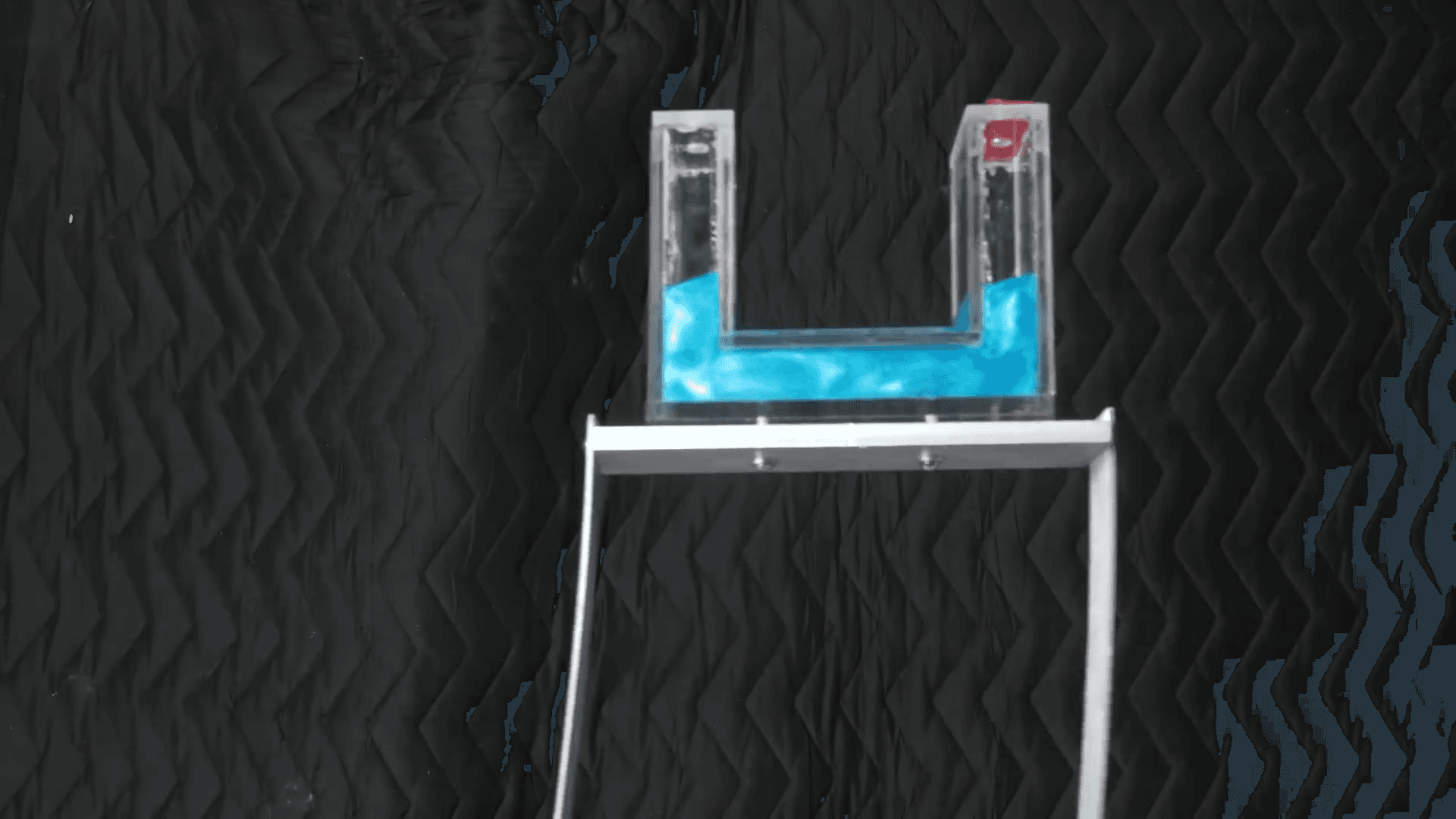
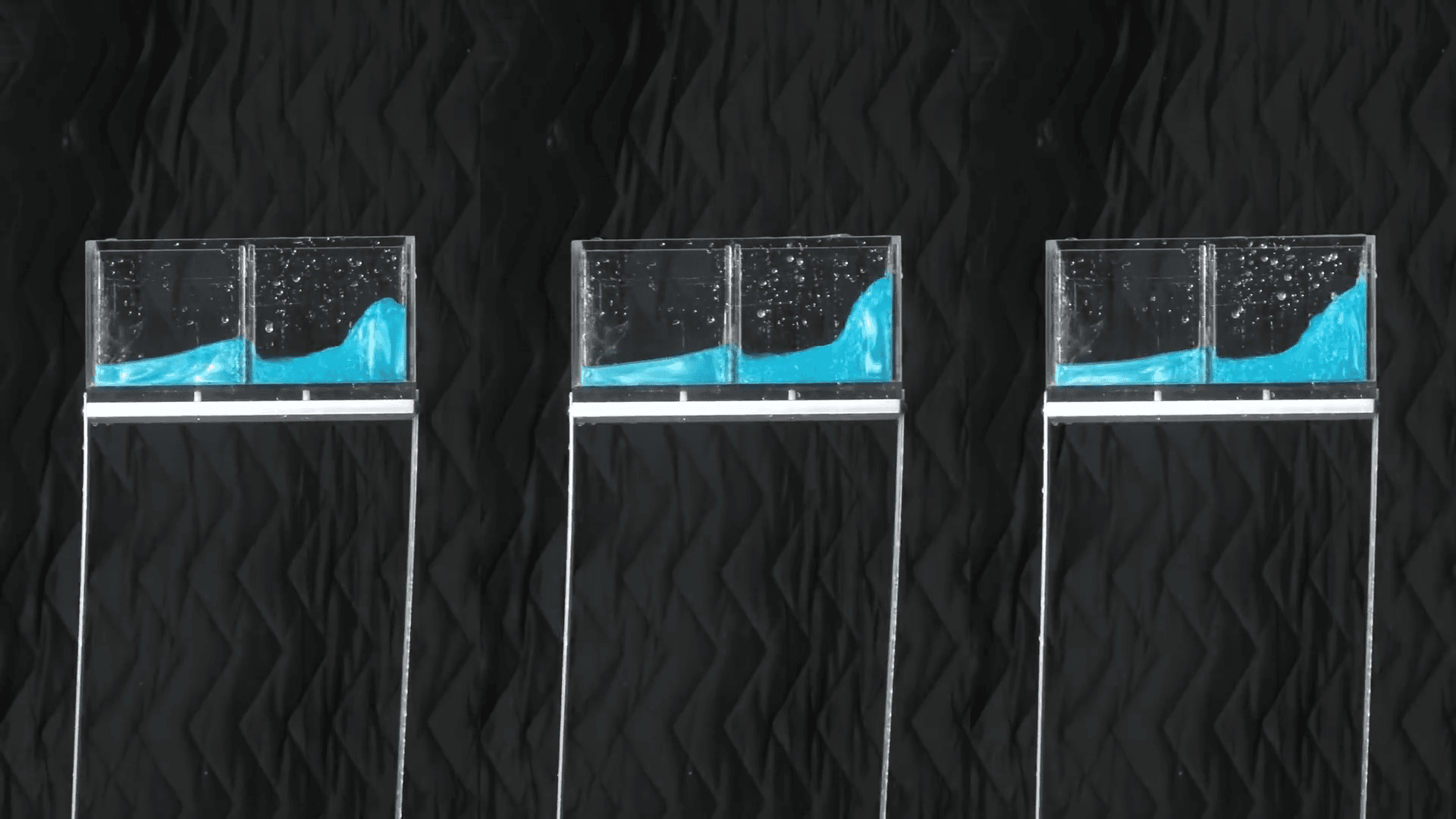
Wind forces on a skyscraper can set it swaying, so engineers design dampers to stop the motion and keep users comfortable. Some buildings use suspended solid mass dampers to counter a building’s motion, but others take a liquid approach. Whether by shifting water through specially shaped chambers or by sloshing it back and forth in a tank, a tuned liquid damper system can quickly bring a building back to rest. In this Practical Engineering video, Grady discusses the challenges of designing these systems and demonstrates how they work with a cool tabletop version. As a reminder, sloshing also helps in water-bottle flipping and stopping a bouncing ball. (Video and image credit: Practical Engineering)
Tag: slosh dynamics

Water Bottle Flipping Physics

Water bottle flipping has become quite the craze, and in a recent video The Backyard Scientist presented his own take on the subject, testing whether you could flip a bottle with mercury rather than water. As it turns out, fluid dynamicists have studied this topic, too, by dropping partially-filled elastic spheres containing water, isopropyl alcohol, and glycerin. The key physics here comes from the sloshing of liquid inside the container. When the elastic ball bounces, energy that would otherwise go into the sphere’s rebound instead gets distributed into sloshing the fluid inside. The result is that the sphere bounces less on its subsequent impacts.
Interestingly, the researchers found that the properties of the fluid inside the ball made very little difference to its rebound height. Instead, the most important feature was the volume of fluid in the container. Balls filled to approximately 30% of their volume had the most damping – that’s totally consistent with the best water bottle flips, which use bottles about 1/3rd full.
The main difference between flipping a bottle and dropping a ball is what goes on in the first bounce. When a bottle hits a surface, the liquid inside has already been disturbed by the bottle’s rotation. For a ball being dropped, that first impact is what disturbs the fluid. So while a water-filled ball’s first rebound will reach nearly the same height as an empty ball, the spinning water bottle is, in effect, already on its second bounce. The motion of the fluid inside the bottle acts as a damper, allowing the bottle to stick the landing. (Image credit: Mercury Bottle Flip – The Backyard Scientist, source; Water Ball Bounce – The Splash Lab, source; research credit: T. Killian et al.)


Other Ig Nobel Fluids
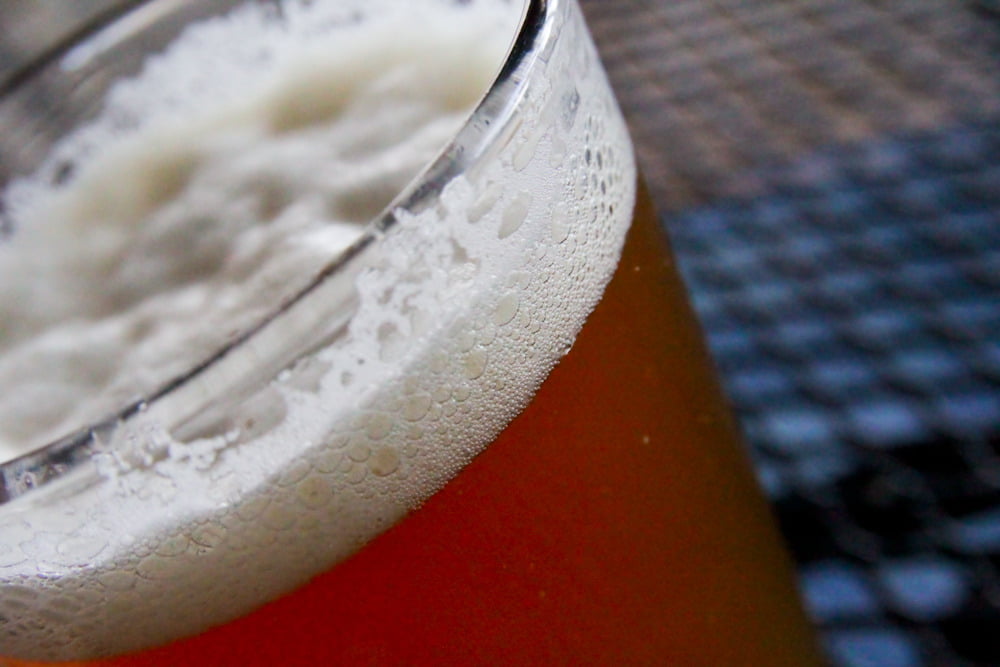
To round out our series on fluid dynamics in the Ig Nobel Prizes (which are not the same thing as the actual Nobel Prizes), here are some of the other winners. Last year Mayer and Krechetnikov won for a study on coffee sloshing when people walk. We’ve mentioned the pitch-drop experiment measuring the viscosity of an extremely viscous fluid a couple times; Mainstone and Parnell won a 2005 Ig Nobel for that (on-going) work. Another 2005 prize went to Meyer-Rochow and Gal for calculating the pressures involved in penguin defecation. (Yes, seriously.) A avian-related award was also handed out to B. Vonnegut for estimating tornado wind speeds by their ability to strip a chicken of its feathers. And, finally, for those looking to interest undergraduate lab students in mathematics and fluid dynamics, I suggest following the lead of 2002 winner A. Leike who demonstrates laws of exponential decay with beer head. (Photo credit: S. Depolo)

Sloshing in a Bouncing Sphere
The sloshing of liquids inside solids is usually presented as a difficulty to overcome, as with the transport of tanks, the motion of fuel in satellites, or even the problem of walking with a full cup of coffee. But liquids also make a very effective damper, as in the case of a bouncing ball partially filled with liquid. Here we see high-speed video of the liquid’s motion inside the ball as it bounces and rebounds. Part of the ball’s kinetic energy at rebound is transferred into the fluid jet, reducing that available for the ball to transfer into potential energy. (Video credit: BYU Splash Lab)

Swirling Fluids
In this video, researchers investigate swirling fluids by studying the shapes of the free surface between air and the liquid. As parameters like the diameter of the glass, initial (unperturbed) height of the liquid, and angular velocity of the rotation change, the surface of the liquid displays different modal behaviors, seen in the photos on the lower left of the video. By non-dimensionalizing the physical parameters of the system (students: think Buckingham pi theorem), they are able to replicate the shape of the free surface by matching a Froude number and dimensionless depth and offset. Such similitude between fluids under different conditions is key to understanding the underlying physics. (Video credit: M. Reclari et al; submitted by co-author M. Farhat)

Sloshing to Dampen
In this high-speed video, two flexible spheres are dropped from the same height. The one on the left is filled with air, the other is partially filled with a liquid. Although both spheres rebound to nearly the same height after the first bounce, their behavior differs drastically after that. The sloshing of the liquid inside the sphere acts as a damper, absorbing energy that would otherwise cause the ball to continue bouncing. The effects of contained liquids sloshing are important for understanding the dynamics of tankers, fuel on spacecrafts, and even how to walk without spilling your coffee.
Sloshing Dynamics
[original media no longer available]
Sloshing refers to the motion of a liquid inside a moving container, for example, in tanker trucks or inside a spacecraft’s fuel tank. The motion of the liquid payload can drastically affect the dynamics of the vehicle carrying it due to the ever shifting center of mass. In the video above, dyed water is being oscillated horizontally to and from the camera. As the frequency of this oscillation changes, the modes of sloshing–the shapes the liquid surface assumes–change dramatically.