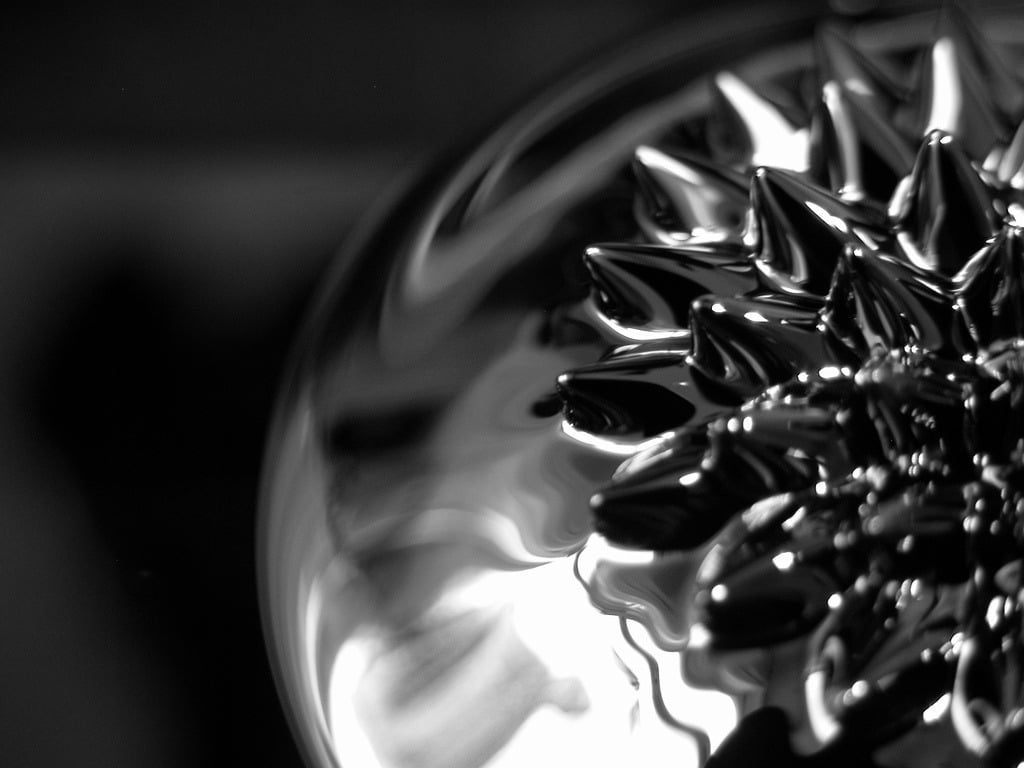
Ferrofluids are an ever-fascinating topic. Consisting of ferromagnetic nanoparticles suspended in a carrier fluid, ferrofluids are known for their bizarre behaviors in the presence of a magnetic field, like their tendency to form pointed peaks reminiscent of Bart Simpson’s hair. In a new Concept Zero video, photographer Linden Gledhill creates fascinating micro-landscapes using ferrofluids suspended in solvents. Driven by magnetic fields, the ferrofluids take on many shapes that change as the solvent and eventually the ferrofluid’s carrier fluid evaporate. Check out the full video above and, if you’re looking for some new decorations for your walls, you can check out the project’s fine art gallery. (Video and image credit: L. Gledhill and Concept Zero; submitted by L. Gledhill)
Tag: normal-field instability

“The Flow II”
“The Flow II” film by Bose Collins and colleagues features a ferrofluid, a magnetically-sensitive liquid made up of a carrier fluid like oil and many tiny, ferrous nanoparticles. Although ferrofluids are known for many strange behaviors, their most distinctive one is the spiky appearance they take on when exposed to a constant magnetic field. This peak-and-valley structure is known as the normal-field instability. It’s the result of the fluid attempting to follow the magnetic field lines upward. Gravity and surface tension oppose this magnetic force, allowing the fluid to be drawn upward only so far until all three forces balance. (Video credit: B. Collins et al.)

Breaking Up a Ferrofluid
Ferrofluids are known for their fascinating behaviors when subjected to magnetic fields, especially for the distinctive peaks they can form. In this video, we see a very thin ferrofluid drop on a pre-wetted surface just as a uniform perpendicular magnetic field is applied. Immediately the droplet breaks up into tiny isolated peaks that migrate out to the circumference. The interface breaks down from center, where the drop height is largest, and moves outward. Simultaneously, the diffusion of ferrofluid from the circumferential droplets into the surrounding fluid lowers the magnetization of those droplets, making it more difficult for them to repel their neighbors. As a result, they drift outward more slowly and get caught by the faster-moving droplets from within. (Video credit: C. Chen)

Spiraling Ferrofluid
Here a ferrofluid climbs a spiral steel structure sitting on an electromagnet. Magnetic field lines emanating from the sculpture’s edges tend to push the ferrofluid out into long spikes–part of the normal field instability–but surface tension resists. The short, somewhat squat spikes we see are the balance struck between these opposing forces. Though known for their wild appearance, ferrofluids appear many in common applications, including hard drives, speakers, and MRI contrast agents. Researchers have also recently suggested they might help understand the behavior of the multiverse. (Photo credit: P. Davis et al.)
Ferrofluid
[original media no longer available]
The motion of ferrofluids in magnetic fields is always mesmerizing. Here a ferrofluid has been submerged in a clear alcohol-based solution in a shallow dish while a permanent magnet is used to perturb the liquid. Instead of forming its distinctive spikes due to the normal-field instability, the fluid forms ribbons and mazes due to the shifting magnetic field and the surrounding fluid.

High-Speed Ferrofluid
High-speed video captures the behavior of a ferrofluid trapped between two magnets. Ferrofluids contain tiny ferromagnetic particles suspended in a carrier fluid like oil or water. The distinctive peaks and valleys of a ferrofluid subject to a strong magnetic field is due to the normal-field instability and is a result of the fluid minimizing its magnetic energy.

Spiky Ferrofluid
Ferrofluids consist of ferromagnetic nanoparticles suspended in a fluid. When subjected to strong magnetic fields, they develop a distinctive peak-and-valley formation due to the normal-field instability. The shape is a result of minimizing the magnetic energy of the fluid. Both gravity and surface tension resist the formation of these peaks. Ferrofluids, in addition to appearing in art exhibits, can be used as liquid seals, MRI contrast agents, and loudspeaker cooling fluids. (Photo credit: Maurizio Mucciola)